There's a reason so many people, across every school of thought in Islam, say the same thing after reciting Surah Rahman: it feels different. Not louder, not more dramatic — just quieter, steadier, like something in the chest finally exhales. I've heard elders describe it as "the Surah that makes you cry without knowing exactly why," and honestly, once you sit with its meaning properly, you understand what they mean.
If you've recited Surah Rahman your whole life without ever really pausing on what it's saying, or if you're just now discovering it, this guide walks through everything — its meaning, its central message, its most powerful verses, when to recite it, what the reward actually is according to both Shia and Sunni sources, the etiquettes around it, and something people rarely talk about openly: how it genuinely brings healing to a mind and body under strain.
Introduction to Surah Rahman
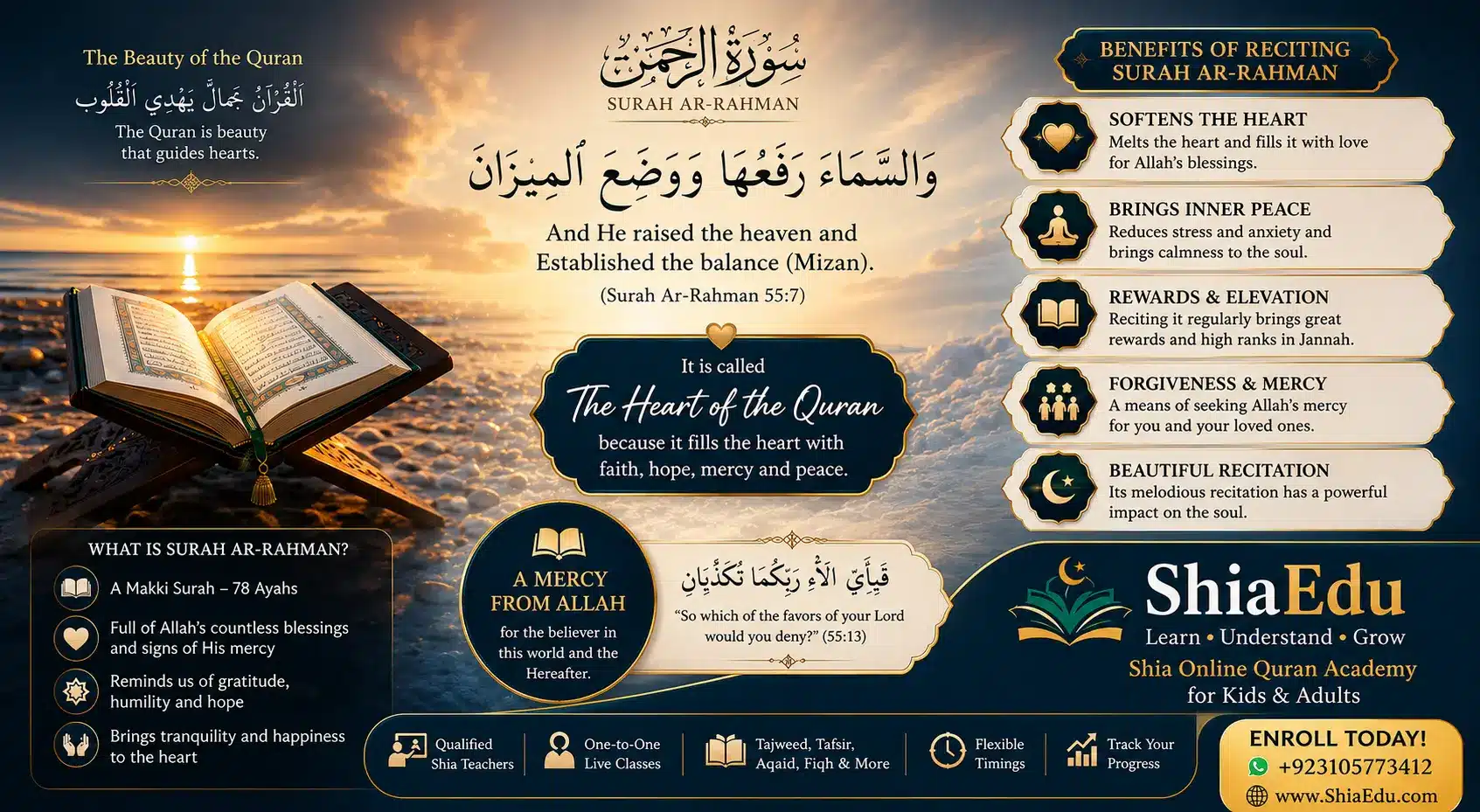
Surah Rahman is the 55th chapter of the Holy Quran, and it holds a rare distinction — it's the only Surah that opens directly with one of Allah's names: Ar-Rahman, "The Most Merciful." Revealed in Makkah, it contains 78 verses and carries one of the most recognizable refrains in the entire Quran: "Fabi ayyi ala'i Rabbikuma tukadhiban" — "Then which of the favors of your Lord will you both deny?" — repeated a striking 31 times throughout the Surah.
That word "both" isn't a coincidence or a translation quirk. Surah Rahman addresses two groups directly throughout: jinn and mankind — the two forms of creation given intellect and free will. It's one of the few places in the Quran where both are spoken to simultaneously, as if Allah is standing before both unseen and seen creation and asking the same question, over and over, until it truly lands. Families who want their children to grasp this depth early often turn to the ShiaEdu Online Quran Center, where recitation is taught alongside meaning rather than in isolation.
The Main Theme: A Direct Confrontation With Ingratitude
If you had to summarize Surah Rahman in a single idea, it would be this: Allah lists, in staggering detail, the blessings He has given — the sun, the moon, the oceans, the fruit, the balance in creation, the gift of speech itself — and after nearly every few verses, He asks the same piercing question: which of these favors will you deny?
It's not a rhetorical flourish. It's a confrontation, gently but firmly delivered, with something every human being is guilty of at some point: taking blessings for granted until they're gone. The Surah moves from the physical world — creation, nature, balance — into the metaphysical, describing the rewards of Paradise for the righteous and the reality of punishment for those who lived in denial, before returning, again and again, to that same unanswerable question.
Two Verses Worth Sitting With
This pairing is easy to skim past, but it's doing something important — placing two entirely different forms of creation side by side, both given free will, both capable of gratitude or denial. It's a quiet reminder that the ability to choose belief over arrogance isn't unique to humans; it's a shared test across creation.
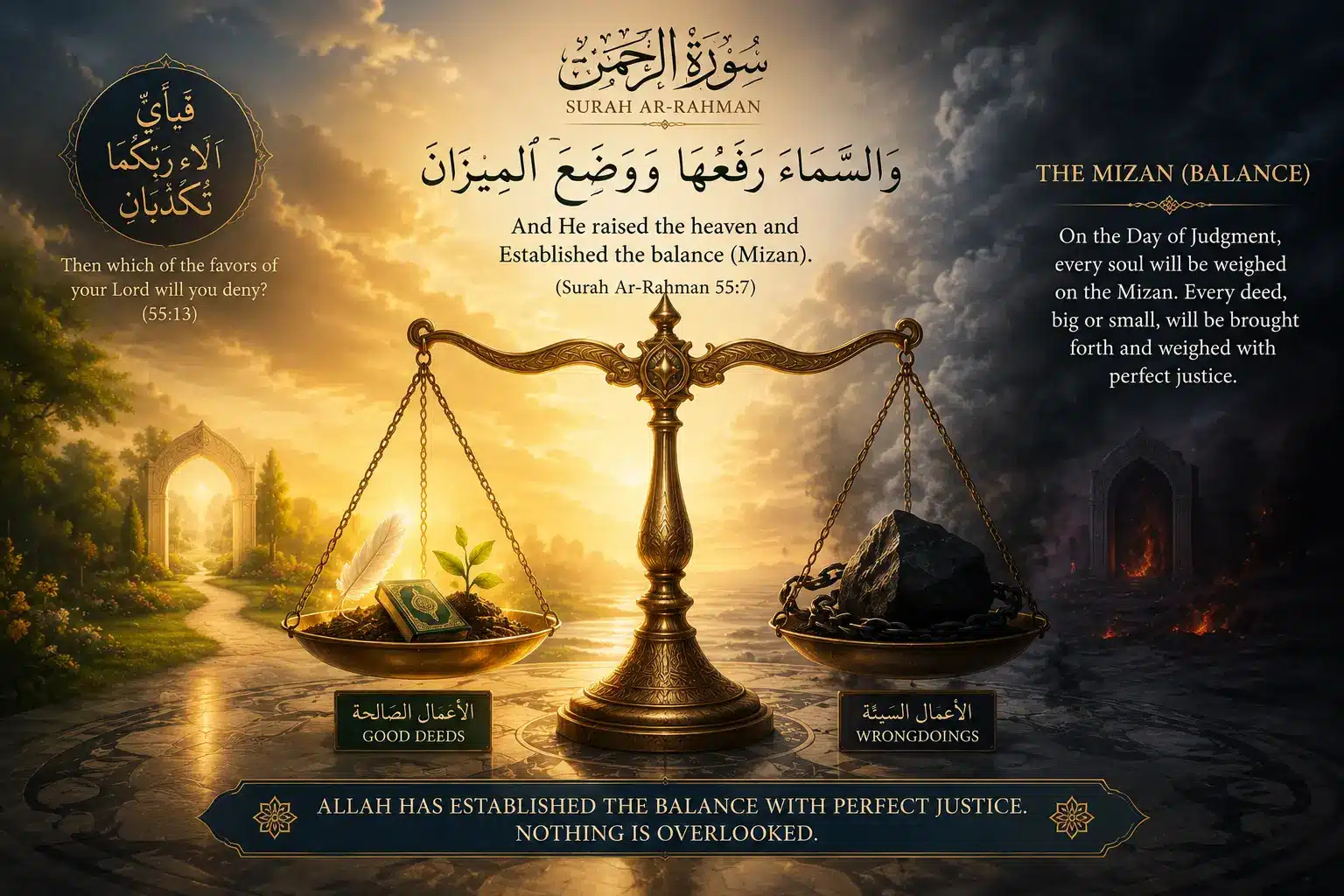
This verse is often read narrowly as being about literal weighing scales, but classical commentators, across Shia and Sunni tafsir alike, read it far more broadly — as a statement about balance in justice, in speech, in relationships, in how a person conducts their entire life. Allah didn't just create the heavens with precision; He built balance into the moral order of existence itself, and violating that balance, in any form, is what the rest of the Surah keeps circling back to warn against.
The Most Opportune Time to Recite Surah Rahman
There's no single verse or authentic narration fixing one exact mandatory time for reciting Surah Rahman, and it's worth being honest about that rather than inventing a rule that isn't there. That said, a few times carry particular weight based on scholarly practice and narrated virtue:
- After Fajr on Fridays — narrated as a time of especially great reward
- On the night of Friday (Thursday evening onward) — a time widely regarded as spiritually elevated for Quran recitation in general
- During times of anxiety, grief, or difficulty — many scholars and spiritual teachers recommend it precisely because its content redirects the heart toward gratitude rather than despair
- As part of a regular weekly recitation habit — even without a fixed occasion, consistency matters more than timing alone
The Reward of Reciting Surah Rahman: Hadith Evidence
From a Shia source: In Fawaid al-Quran (Benefits of the Recitation of the Chapters of the Holy Quran), a narration traced back to Imam Ja'far al-Sadiq (A.S.) states that reciting Surah Rahman on Friday, after the dawn prayer, carries immense reward, and that it removes hypocrisy from the heart of the one who recites it regularly. The same narration adds that a person who passes away shortly after reciting this Surah is regarded as dying in a state akin to martyrdom — a reflection of how deeply this Surah is tied to sincerity and closeness to Allah.
From a Sunni source: A narration recorded in Imam Bayhaqi's Shu'ab al-Iman, attributed to Sayyiduna Ali (R.A.), quotes the Prophet Muhammad (P.B.U.H.) as saying that everything has an adornment, and the adornment of the Quran is Surah Rahman — a description that gave rise to its well-known title, "Arus al-Quran," the Bride of the Quran. It's worth noting, in the interest of honesty rather than glossing over it, that some hadith scholars, including Imam al-Albani, have graded this specific narration as weak in its chain of transmission. Even so, scholars across both traditions generally agree that weaker narrations concerning the virtue of a good deed — as opposed to matters of law — can still be cited to encourage devotion, so long as they don't establish something false about the religion itself. Visit our Google site for more information about Quran learning.
Taken together, both traditions arrive at the same conclusion through different chains: this Surah occupies a genuinely elevated place in the hearts of reciters, regardless of school of thought.
The Etiquettes of Reciting Surah Rahman
Reciting any part of the Quran carries etiquette, but a few points are worth emphasizing specifically for this Surah:
- Recite in a state of wudu, as with any Quran recitation, out of respect for the words being spoken.
- Slow down at the refrain. Rushing past "which of the favors of your Lord will you deny?" defeats the entire purpose of the Surah. Many reciters pause briefly at each repetition to actually reflect rather than recite mechanically.
- Respond to the refrain, as narrated from the Prophet's own companions and continued in practice today — quietly saying something to the effect of "none of Your favors do we deny, our Lord" after the verse, especially when reciting alone.
- Recite with presence, not just speed. This Surah, more than most, rewards a reciter who reflects rather than one who simply completes it quickly.
- Teach its meaning alongside its recitation, especially to children, so the habit of gratitude is being built alongside the habit of correct Tajweed.
How Surah Rahman Brings Healing — Physical and Mental
This is the part that tends to surprise people who've only ever thought of Quran recitation as an act of worship separate from wellbeing. Surah Rahman's entire structure — the steady rhythm, the repeated refrain, the deliberate slowing down it invites — has a genuinely calming effect on the nervous system, and this isn't only a spiritual claim. Several studies on Quran recitation and listening, including research published in psychology and public health journals, have found measurable reductions in markers of stress and anxiety among listeners, with some studies noting effects on heart rate and relaxation comparable to other rhythmic, meditative practices.
For the growing number of young people today dealing with chronic stress, anxiety, and elevated blood pressure — often driven by academic pressure, social media, and a constantly "switched on" lifestyle — building a habit of slow, reflective recitation through structured online Quran classes, with Surah Rahman as a starting point, can genuinely support a calmer nervous system alongside whatever medical care is appropriate. Its repeated focus on gratitude also works against one of the quiet drivers of low mood in young people: the habit of constantly comparing what they don't have to what others seem to. Surah Rahman does the opposite, verse after verse, forcing the mind back toward what has already been given.
To be clear and responsible about this: Surah Rahman is not a substitute for proper medical treatment for depression, hypertension, or any diagnosed condition, and anyone struggling with these should absolutely see a qualified doctor or mental health professional. But as a complementary spiritual practice alongside proper care, its calming, gratitude-centered structure has a real, well-documented place in supporting mental and emotional wellbeing.
Teaching This Surah to the Next Generation: Why the Right Teacher Matters
Understanding Surah Rahman properly — its Tajweed, its meaning, its emotional weight — isn't something most children pick up by simply hearing it recited around them. It takes a teacher who can slow down at the right moments, explain the refrain in language a child actually understands, and model the reflection this Surah is built for, rather than just correct pronunciation and move on. Families based in the UK looking for this kind of guided approach can explore Shia Quran classes UK, taught one-on-one and paced to each child.
Learning Quran Recitation With Expert Shia Quran Teachers
A qualified Shia Quran teacher doesn't just teach correct Makharij and Tajweed rules — they teach a child to recite with presence, the way Surah Rahman demands. Through one-on-one online Quran learning classes, a teacher can pause at the refrain with a young student, ask them what it means to them personally, and build genuine reflection into recitation from an early age, rather than treating fluency as the only goal. ShiaEdu's online Quran teachers are trained specifically to teach this way.
Memorizing Surah Rahman and Beyond: A Structured Hifz Approach
Surah Rahman's repeated refrain actually makes it one of the more approachable Surahs for children beginning memorization, since the recurring pattern reinforces itself naturally. A structured online Hifz program, guided by an experienced Shia tutor, breaks the Surah into manageable sections, using its rhythm to support retention rather than relying on rote repetition alone — building not just a memorized Surah, but a genuine, lasting connection to its meaning, as part of a broader foundation in online Islamic teachings.
Surah Rahman isn't simply a beautiful chapter to recite — it's a mirror held up to how easily gratitude slips away from us, and a gentle, repeated invitation to pick it back up. Whether it's calming an anxious mind, teaching a child their first steps in Hifz, or simply being recited quietly on a Friday morning, this Surah keeps asking the same question century after century, waiting patiently for an honest answer.
Frequently Asked Questions
Why is Surah Rahman called the "Bride of the Quran"?
Based on a narration attributed to the Prophet Muhammad (P.B.U.H.), everything is said to have an adornment, and the adornment of the Quran is Surah Rahman — a title reflecting its beauty and its detailed description of Paradise.
How many times is the refrain repeated in Surah Rahman?
The verse "Then which of the favors of your Lord will you both deny?" is repeated 31 times throughout the Surah's 78 verses.
Is there a specific time it's obligatory to recite Surah Rahman?
No specific time is obligatory, though Friday, particularly after Fajr, is widely regarded as a time of especially great reward for its recitation.
Can Surah Rahman genuinely help with anxiety or stress?
Its slow, rhythmic structure and repeated focus on gratitude have been associated in several studies with reduced stress markers, though it should complement, not replace, proper medical or mental health care when needed.