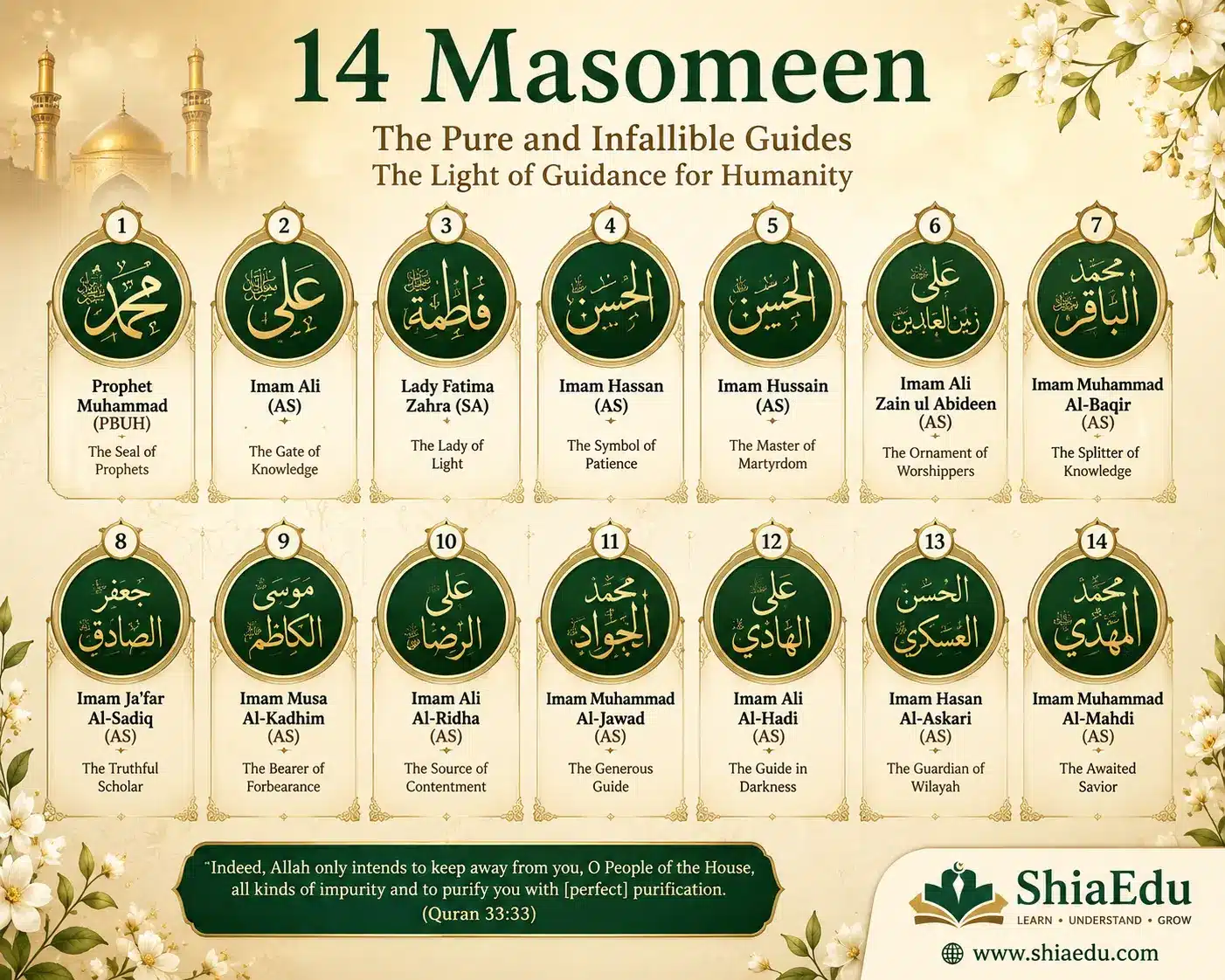
In the name of Allah, the Most Gracious, the Most Merciful. What follows is a complete account of the Fourteen Masomeen — the purified souls through whom Allah chose to perfect His religion, preserve His Book, and guide all of humanity until the Day of Judgement.
Who Are the Masomeen? The Divine Reality of the Fourteen Infallibles
There are names in Islamic history that do not merely occupy a place in the past — they define the very axis around which human existence revolves. These are the names of the Fourteen Masomeen, the Fourteen Infallibles: the Holy Prophet Muhammad ibn Abdullah ☉, his beloved daughter Fatimah al-Zahra (sa), and the Twelve Imams of the Ahlulbayt (as). Together they form a chain of divine light, unbroken across fourteen centuries, illuminating the path for every soul that sincerely seeks Allah.
To understand who the Masomeen are is to understand why Allah created this world. The Prophet ☉ himself narrated: "Had it not been for you, O Muhammad and Ahlulbayt, I would not have created the heavens." They were not simply historical personalities — they were, and remain, the purpose of existence itself.
"Allah only desires to keep away all impurity from you, O People of the Household, and to purify you with a thorough purification."
— Surah Al-Ahzab, 33:33 (Ayah al-Tathir)This verse — Ayah al-Tathir — is the Quranic cornerstone of the doctrine of Ismah (Infallibility). Allah Himself declares the Ahlulbayt to be purified from all sin, error, and impurity. The Prophet ☉ sealed this truth with the famous Hadith al-Thaqalayn:
"I am leaving among you two weighty things: the Book of Allah and my progeny, the People of my Household. They will not separate from one another until they reach me at the Pond of Kawthar."
— Hadith al-Thaqalayn (Sahih Muslim, Tirmidhi, Musnad Ahmad)What Is Ismah — Divine Infallibility?
Ismah in Islamic theology refers to the state of being protected by Allah from all major and minor sins, mistakes in conveying divine guidance, and errors in matters of religion. It is not compulsion — the Masomeen possessed full free will — but their knowledge, piety, and nearness to Allah were of such a degree that sin was, for them, as impossible as darkness in the presence of the sun. Those who wish to ground their children in authentic Shia theology can explore our Shia Aqaid course online, taught by certified scholars in the living tradition of the Fourteen Masomeen.
Divine Attributes Bestowed Upon the Masomeen
Divinely protected from all sin and error, confirmed by Quran 33:33.
Knowledge bestowed directly by Allah, encompassing matters of this world and the unseen.
Their intercession on the Day of Judgement is a mercy Allah has granted them.
Spiritual and temporal guardianship of the Muslim community by divine appointment.
Their every action embodied absolute justice — the living expression of divine law.
Created from a single light before the heavens — the first manifestations of divine splendour.
Prophet Muhammad ibn Abdullah ☉
مُحَمَّدُ بْنُ عَبْدِ اللَّهِ ﷺHis Noble Titles
His Luminous History
Muhammad ☉ was born into the noble Quraysh tribe, to the clan of Banu Hashim — a family honoured in Arabia for generations. Orphaned early, he was raised first by his grandfather Abdul Muttalib and then his uncle Abu Talib. Long before prophethood, the people of Makkah called him Al-Amin — the Trustworthy — a title earned entirely by character.
At forty years of age, in the Cave of Hira, the Angel Jibreel descended with the first revelation: "Read in the name of your Lord Who created." For twenty-three years, he carried the weight of prophethood without faltering — through boycotts, exile, the loss of his beloved Khadijah and his uncle Abu Talib, through the battles of Badr, Uhud, and Khandaq, and ultimately through the triumph of the Conquest of Makkah.
The capstone of his mission came at Ghadir Khumm on 18 Dhul Hijjah, 10 AH, where before over 100,000 companions he raised the hand of Imam Ali (as) and declared: "Of whomsoever I am the Mawla, Ali is his Mawla." Within seventy-seven days, the Prophet ☉ departed this world, leaving behind the Holy Quran and his blessed Ahlulbayt as the two eternal guides for humanity.
His Hadiths That Changed the World
"I am leaving among you two weighty things: the Book of Allah and my Ahlulbayt. If you hold fast to both of them, you will never go astray after me."
— Hadith al-Thaqalayn (Sahih Muslim, Tirmidhi, Musnad Ahmad)"Ali is with the truth, and the truth is with Ali. Wherever the truth turns, Ali turns with it."
— Kanz al-Ummal, Vol. 11; Al-Mustadrak, Hakim al-NishaburiA Moment That Speaks Across All Time
There was an elderly woman in Makkah who made it her daily habit to throw garbage on the Prophet ☉ as he passed. He bore this in silence, day after day. One morning there was no garbage — the woman was ill. The Prophet ☉ stopped, inquired after her, and went to her home to visit her. When she saw him standing at her door with nothing but concern on his face, she wept and embraced Islam — not because of any sermon, but because she had witnessed something she had never seen before: a man who responded to hatred with nothing but mercy. This is why Allah called him Rahmat ul-Lil-Aalameen.
Fatimah al-Zahra bint Muhammad (sa)
فَاطِمَةُ الزَّهْرَاء بِنْتُ مُحَمَّد (س)Her Noble Titles
Her Luminous History
Fatimah (sa) was the only child of the Prophet ☉ and Bibi Khadijah (sa) to survive into adulthood — and in her, the divine lineage of the Prophet continued. She grew up in the house of prophethood, absorbing its light at every breath. The Prophet ☉ would stand when she entered a room and say: "Fatimah is a part of me. Whoever angers her, angers me."
She married Imam Ali (as) in a ceremony of divine simplicity. Together they brought into the world Imam Hasan, Imam Husain, Zaynab, and Umm Kulthum — four souls who would each reshape Islamic history. After the Prophet's ☉ passing, Bibi Fatimah (sa) stood as the sole voice defending the rightful succession of Imam Ali (as). Her famous Khutbah-e-Fadakiyya stands as one of the most powerful speeches in all of Islamic history. She lived only seventy-five to ninety-five days after her father's passing, dying of injuries sustained in the tragic events that followed. She was buried at night, in secret — her grave remains unknown to this day.
Her Words That Echo Through Eternity
"Allah made obedience to us [the Ahlulbayt] the order of the religion, our Imamate a safeguard from division, and our love as the honour of Islam."
— Khutbah-e-Fadakiyya, Bihar al-Anwar Vol. 29"Whoever sends salawat upon Muhammad ☉ and his family, Allah will open for them seventy doors of mercy."
— Mustadrak al-Wasail, narrated through Imam al-Sadiq (as)The Night She Gave Away Her Wedding Gift
On the night of her wedding, Bibi Fatimah (sa) was given a silver necklace — one of the very few possessions she owned. As the guests departed, a beggar knocked at the door. Without hesitation, she removed the necklace from around her neck and placed it in the hands of the stranger. The Prophet ☉, upon learning of this the next morning, wept with pride and said: "My daughter is the light of my eyes and the joy of my heart." A woman who had almost nothing, gave everything — on the very first night of her married life. This is Fatimah al-Zahra (sa).
Imam Ali ibn Abi Talib (as)
الإِمَامُ عَلِيُّ بْنُ أَبِي طَالِب (ع)His Noble Titles
His Luminous History
No one in Islamic history entered the world quite like Imam Ali (as) — born inside the sacred Kaaba itself. He was the first male to accept Islam, and the one who slept in the Prophet's bed on Laylat al-Mabit — offering his life without a moment's hesitation so that the Prophet ☉ could safely escape to Madinah.
A warrior of unparalleled bravery, Imam Ali (as) fought in nearly every major battle of early Islam. At Khaybar, when all others had failed, he uprooted the fortress gate with one hand. Yet the same hands that wielded Dhulfiqar also wrote the Nahj al-Balagha — sermons so profound that scholars have spent centuries in their interpretation — and ground grain through the night to feed the orphans of Madinah. Our Fiqh Jaffari course is rooted entirely in the authentic teachings transmitted through Imam Ali (as) and the Imams who followed him.
On the 19th of Ramadan, 40 AH, while prostrate in the Fajr prayer in Kufa, he was struck by a poisoned sword. He died two days later on the 21st of Ramadan, his last words a reminder of the poor and the orphan.
His Words from Nahj al-Balagha
"Do not feel ashamed to give a little, for deprivation is even less."
— Nahj al-Balagha, Saying 67"The worth of a man is what he does well. Speak less than you know, own less than you can, and do more than you say."
— Ghurar al-Hikam, Saying 4957The Night He Fed His Enemy
During the Battle of Siffin, a prisoner was brought before Imam Ali (as). Instead of sentencing him, the Imam ordered that the man be given the same food he himself was eating, that his wounds be treated, and that he be treated with full respect. When the prisoner asked why, the Imam replied: "Because you are a human being, and the dignity of being human belongs to you regardless of what side you stand on." The man wept and, when released, returned to his own camp never again able to raise his sword against Ali (as).
Imam Hasan ibn Ali al-Mujtaba (as)
الإِمَامُ الحَسَنُ بْنُ عَلِيّ المُجْتَبى (ع)His Noble Titles
His Luminous History
Imam Hasan (as) was the first grandchild of the Holy Prophet ☉ — and the Prophet's love for him was so intense that he would interrupt his own sermon to carry the young Hasan in his arms. "Hasan and Husain are the masters of the youth of paradise," the Prophet ☉ declared.
Following the martyrdom of Imam Ali (as), Imam Hasan (as) faced Muawiyah ibn Abi Sufyan's massive army and betrayal within his own ranks. To protect the lives of the Shia and prevent massacre, he signed a historic peace treaty with Muawiyah — all conditions of which Muawiyah subsequently violated. In 50 AH, his own wife poisoned him on Muawiyah's orders. He was forty-seven years old.
His Words of Eternal Wisdom
"Associate with people in such a manner that if you die, they weep for you, and if you are alive, they long for your company."
— Bihar al-Anwar, Vol. 78"Opportunity passes like a cloud. Seize the good opportunities."
— Tuhaf al-UqulTwenty-Five Pilgrimages on Foot
Imam Hasan (as) performed the Hajj pilgrimage twenty-five times in his life — and on every single occasion, he walked the entire journey on foot from Madinah to Makkah, despite having access to horses and carriages. When asked why, the Imam replied: "I am ashamed to meet my Lord mounted, when I am able to walk to His House with my own feet." His wealth he divided three times in his life — giving half of all he owned in the way of Allah each time — earning him the title Karim Ahlulbayt.
Imam Husain ibn Ali — Sayyid al-Shuhada (as)
الإِمَامُ الحُسَيْنُ بْنُ عَلِيّ سَيِّدُ الشُّهَدَاء (ع)His Noble Titles
His Luminous History
If the life of Imam Husain (as) could be compressed into a single sentence, it would be his own words on the plains of Karbala: "I did not rise to cause corruption or to seek fame. I only rose to seek reform in the nation of my grandfather." Of him the Prophet ☉ said: "Husain is from me, and I am from Husain."
When Yazid demanded the Imam's allegiance — which would have been a stamp of legitimacy on tyranny — Imam Husain (as) refused, saying: "A person like me cannot give allegiance to a person like him." With his family and a small band of companions, he was intercepted at the plains of Karbala by an army of thirty thousand. For ten days the camp was surrounded. On the 7th of Muharram, the water supply was cut off — even from the women, children, and infants.
On the morning of Ashura, after the dawn prayers, the battle began. One by one, his companions, brothers, nephews, and sons fell. The baby Ali Asghar (as), just six months old, was struck in the throat by an arrow while the Imam held him in his arms, asking for water for the child. Finally, Imam Husain (as) stood alone — wounded, thirsty, exhausted — and fought until he could fight no more. He fell on the ground of Karbala, and that night the tents of the women and children were burned. Karbala did not end Islam — it saved it.
His Words That Became the Conscience of Humanity
"Death with dignity is better than a life of humiliation. I do not see death except as happiness, and living with tyrants except as misery."
— Imam Husain (as), morning of Ashura (Bihar al-Anwar, Vol. 44)"If you do not believe in any religion and do not fear the Hereafter, at least be free in this world."
— Imam Husain (as) to Ibn Sa'd's army, morning of AshuraThe Night Before Ashura
On the night of the 9th of Muharram, Imam Husain (as) gathered his companions and family and extinguished the lamps. In the darkness, he released every single one of them from their pledge, saying: "I give you permission to leave. The night has covered you. Take it as your mount and depart. These people want only me." Not a single companion moved. One by one they spoke — Zuhayr, Habib, his brother Abbas (as), his son Ali Akbar — each declaring that life without the Imam held no meaning for them. The Imam wept. That night, they prayed, some sang, some sharpened their swords — and the night was the most beautiful any of them had ever known.
Imam Ali ibn Husain al-Sajjad (as)
الإِمَامُ عَلِيُّ بْنُ الحُسَيْن زَيْنُ العَابِدِين (ع)His Noble Titles
His Luminous History
The sole adult male survivor of Karbala, Imam Zain al-Abidin (as) was gravely ill on the day of Ashura — a sickness that, by divine mercy, prevented him from fighting and thus ensured the continuity of the Imamate. He witnessed the massacre of his father, brothers, uncles, and companions. Taken captive and paraded through Kufa and Damascus, it was he who delivered a speech in the very court of Yazid that shook the palace walls and exposed the regime's crimes.
Returning to Madinah, Imam Sajjad (as) chose the weapon of du'a — supplication — as his mode of revolution. The result was the Sahifah al-Sajjadiyyah — a collection of his prayers so profound in theology and love for Allah that scholars have called it the Psalms of the Prophet's Family, and the third most important text in Shia Islam after the Quran and Nahj al-Balagha.
His Du'as That Healed Hearts
"O Allah, grant me the ability to treat those who wrong me with generosity, to reconnect with those who cut me off, and to give generously to those who deprive me."
— Sahifah al-Sajjadiyyah, Du'a 20 (Makarim al-Akhlaq)"O Lord, if my deeds have brought me low before You, my hope in You has elevated me."
— Sahifah al-Sajjadiyyah, Du'a 15The Secret Charity of Madinah
For years, the poor families of Madinah found sacks of flour and food left at their doors in the darkness of night. After the martyrdom of Imam Zain al-Abidin (as), when they washed his blessed body, they found the marks — dark calluses on his back and shoulders, formed from carrying heavy sacks to the needy every night. One hundred families had been sustained by him without ever knowing who their provider was. When the people of Madinah realised who had been feeding them all those years, they wept and said: "We did not know the value of what we had until we lost it."
Imam Muhammad ibn Ali al-Baqir (as)
الإِمَامُ مُحَمَّدُ بْنُ عَلِيّ البَاقِر (ع)His Noble Titles
His Luminous History
Imam Muhammad al-Baqir (as) was given the title Al-Baqir — the one who splits open knowledge — by the Prophet ☉ himself, decades before his birth, through the companion Jabir ibn Abdullah al-Ansari. He presided over a period of relative political respite and used it to establish the first formal university of Islamic sciences — training scholars in Quranic tafsir, jurisprudence, theology, medicine, and natural philosophy.
He revived and codified the authentic teachings of Islam at a time when Umayyad manipulation had distorted the religion almost beyond recognition. His transmission of hadith filled libraries, and he began the systematic articulation of Fiqh Jaffari — the jurisprudence of the Ahlulbayt — which his son Imam al-Sadiq (as) would bring to full flower.
His Teachings on Knowledge
"A scholar whose knowledge is acted upon is greater than a thousand worshippers."
— Al-Kafi, Vol. 1; Wasa'il al-Shia"Our Shia are those who, when they speak, they speak the truth; when they trust, they are trustworthy; and when they are alone, they remember Allah greatly."
— Bihar al-Anwar, Vol. 68The Christian Monk and the Imam
A learned Christian monk once travelled to Madinah with a list of philosophical questions he believed no Muslim scholar could answer. He sat with Imam Baqir (as) and posed them one by one. The Imam answered each with clarity and depth that left the monk speechless. Finally, the monk asked: "Where did you learn all this?" The Imam replied: "From the knowledge of my grandfather, the Prophet ☉, who learned it from Allah." The monk sat in silence for a long time, then whispered: "I testify that there is no god but Allah, and that Muhammad is His messenger."
Imam Ja'far ibn Muhammad al-Sadiq (as)
الإِمَامُ جَعْفَرُ بْنُ مُحَمَّد الصَّادِق (ع)His Noble Titles
His Luminous History
Imam Ja'far al-Sadiq (as) built upon what his father Imam Baqir (as) had begun and established the most comprehensive school of Islamic learning the world had yet seen. His school in Madinah had over four thousand students, including Malik ibn Anas (of the Maliki madhab) and Abu Hanifa (of the Hanafi madhab). Abu Hanifa famously stated: "Were it not for the two years, Nu'man would have perished" — referring to his time studying under Imam Sadiq (as).
Imam Sadiq (as) codified Fiqh Jaffari in its complete and systematic form, covering every domain of Islamic law with precision and depth. He also defeated atheist and Mu'tazilite thinkers in open debate. Families wishing to raise their children in authentic Fiqh Jaffari can explore our Fiqh Jaffari online classes taught by qualified Shia scholars.
His Teachings on Character
"Be honest in your speech, return the trust to whoever entrusted you — whether they be righteous or sinful — for these are among the attributes of our Shia."
— Al-Kafi, Vol. 2"Do not look at the smallness of a sin, but look at Whom you have sinned against."
— Mishkat al-Anwar; Tuhaf al-UqulThe Lesson of the Fire
A philosopher came to Imam Sadiq (as) and declared that he could not believe in Allah because he could not see Him. The Imam simply picked up a lamp and asked: "Do you believe that fire exists?" The man said yes. The Imam asked: "Can you show me the fire itself?" The man pointed to the flame. "That is light. That is heat. Show me the fire itself." The man fell silent. The Imam said quietly: "You know a thing by its effects. Allah is known by His creation. Can you look at the sun with your naked eye and see it entirely? Yet you do not deny the sun." The philosopher had no response.
Imam Musa ibn Ja'far al-Kadhim (as)
الإِمَامُ مُوسَى بْنُ جَعْفَر الكَاظِم (ع)His Noble Titles
His Luminous History
Imam Musa al-Kadhim (as) lived most of his Imamate under Abbasid surveillance and oppression. Caliph Harun al-Rashid imprisoned him multiple times, the final imprisonment lasting years in the dungeons of Baghdad. Despite these chains, those who guarded him often converted to Shia Islam after witnessing his extraordinary patience, constant worship, and kindness even to his jailers.
He was finally martyred by poison on the orders of Harun al-Rashid, and his body was shamelessly dumped on the Bridge of Baghdad. He is buried in Kadhimiyah, Baghdad — a shrine that to this day draws millions of pilgrims who call out to him as Bab al-Hawa'ij — the Gateway of Needs.
His Teachings on Patience
"Patience toward adversity is one level, and patience in obedience to Allah is another. But the highest of all is patience in refraining from what Allah has forbidden."
— Tuhaf al-Uqul; Bihar al-Anwar Vol. 78"The believer is like the two pans of a scale: the more faith he has, the more tribulation he faces."
— Al-Kafi, Vol. 2The Man Who Hated Him
In Madinah, there was a man who harboured a deep and vocal hatred for Imam Kadhim (as), insulting him in public. The Imam's students begged permission to confront the man. The Imam refused. Instead, he rode out to the man's farm, sat beside him, spoke warmly, asked about his crops, his family, his life, and gifted him with money and kind words. The man came later to the Imam's mosque and declared publicly that he had been wrong, that the Imam was among the best of all men. The Imam smiled and said: "What is better is what removed his enmity from your hearts."
Imam Ali ibn Musa al-Ridha (as)
الإِمَامُ عَلِيُّ بْنُ مُوسَى الرِّضَا (ع)His Noble Titles
His Luminous History
The Abbasid Caliph Mamun al-Rashid summoned Imam Ridha (as) from Madinah to Khorasan and declared him Crown Prince of the Caliphate — a calculated political move to neutralise the Imam's independent religious authority. Imam Ridha (as) accepted only under duress, publicly stating that he would take no role in government appointments or policies. He remained a witness, not a participant.
Despite these constraints, the Imam turned the royal court into a school. His famous theological debates with scholars of every religion — Jews, Christians, Zoroastrians, Mu'tazilites — are preserved in Uyun Akhbar al-Ridha and stand as monuments of Islamic intellectual tradition. He was poisoned by Mamun in 203 AH and is buried in Mashhad, Iran — which grew around his shrine to become one of the holiest cities for Shia Muslims worldwide, drawing tens of millions of pilgrims annually.
His Teachings on Intellect
"The friend of every person is his intellect, and his enemy is his ignorance."
— Uyun Akhbar al-Ridha; Bihar al-Anwar Vol. 78"Whoever does not give thanks to the one who does him a favour among people has not given thanks to Allah."
— Al-Kafi, Vol. 2The Imam Who Sat with the Servants
When Imam Ridha (as) was brought to the royal palace in Khorasan, a visitor found the Imam seated at a table — eating his meal alongside the servants, the kitchen workers, and the stable hands, everyone together. Startled, the visitor asked why. The Imam replied: "They are made of flesh and blood, just as I am. Our Lord is the same. Our father is the same — Adam. And whoever is better among us is only so by virtue of greater piety. I will not make myself a barrier between me and my brothers."
Imam Muhammad ibn Ali al-Taqi al-Jawad (as)
الإِمَامُ مُحَمَّدُ بْنُ عَلِيّ الجَوَاد (ع)His Noble Titles
His Luminous History
Imam al-Jawad (as) assumed the Imamate at approximately eight or nine years of age — making him the youngest Imam in the history of the Twelver Shia. His young age was seized upon by opponents as proof that Imamate could not rest in a child. The Imam silenced all doubts in the famous scholarly debate convened by Mamun, where before the assembled theologians of Baghdad, he answered every question with a mastery that left scholars speechless. He was martyred at just twenty-five years of age — the youngest of all the Masomeen to be martyred.
His Teachings on Honour
"Whoever relies upon his own good opinion of his deeds has perished. And the most ignorant of all people is the one who abandons the certainty of what he knows for the conjecture of what he does not know."
— Bihar al-Anwar, Vol. 78"Three things elevate a person's rank with his Lord: much forgiveness, gentleness of speech, and frequent charity."
— Tuhaf al-UqulThe Nine-Year-Old Who Answered the Scholars
Yahya ibn Aktham, the greatest jurist of his age, posed what he believed was an unanswerable question to the young Imam at Mamun's court: "A man in the state of ihram killed a deer. What is the ruling?" He expected confusion. Instead, Imam Jawad (as) replied: "Was the man inside the sanctuary or outside it? Was the deer inside or outside? Was the man aware or ignorant? Was it deliberate or accidental? Was he free or a slave? Had he performed Hajj before?" — continuing to multiply the possible rulings with each scenario. Yahya stared, then bowed his head and said: "I confess my incapacity."
Imam Ali ibn Muhammad al-Hadi (as)
الإِمَامُ عَلِيُّ بْنُ مُحَمَّد الهَادِي (ع)His Noble Titles
His Luminous History
Imam Ali al-Hadi (as) spent over twenty years under forced house arrest in Samarra, Iraq, relocated there on the orders of the Abbasid Caliph Mutawakkil who wanted him under direct military surveillance. Despite this, he managed his community through a sophisticated network of agents and representatives, and his letters of guidance directed the Shia of every province. He is buried alongside his son Imam Hasan al-Askari (as) in the shrine complex known as Al-Askariyain — the Two Askaris — in Samarra.
His Teachings on the Self
"Whoever humbles himself for Allah, Allah will raise him. And whoever is arrogant against Allah, Allah will humiliate him."
— Bihar al-Anwar, Vol. 78"The world is a marketplace in which some profit and others lose."
— Tuhaf al-UqulThe Imam and the Caliph's Banquet
Mutawakkil once summoned Imam Hadi (as) to a banquet hall where wine was flowing, expecting to humiliate him. He handed the Imam a cup of wine. The Imam declined quietly: "My blood has never been mixed with such a thing since the days of my ancestor. Excuse me." Mutawakkil then asked the Imam to recite something. Imam Hadi (as) recited Quranic verses about the fate of those who live in luxury and arrogance — with such power that Mutawakkil and his courtiers wept openly, some dropping their cups. The hall fell silent, and the Caliph dismissed everyone and sat alone.
Imam Hasan ibn Ali al-Askari (as)
الإِمَامُ الحَسَنُ بْنُ عَلِيّ العَسْكَرِي (ع)His Noble Titles
His Luminous History
Imam Hasan al-Askari (as) lived the entirety of his Imamate — just six years — under the most intense surveillance of any Imam before him. The Abbasid regime knew that the twelfth Imam — the promised Mahdi — would be born from this generation of the Ahlulbayt, and they watched his household constantly. Despite this, Imam al-Askari (as) secretly raised and protected his son Muhammad al-Mahdi (as), concealing the child's existence until the moment of his own martyrdom. He was poisoned at the age of twenty-eight — among the youngest of the Masomeen to be martyred.
His Teachings on the Community
"Among the signs of the believer are five: the fifty-one rak'at prayer, the Ziyarah of Arba'een, the ring on the right hand, the forehead prostration on soil, and reciting Bismillah aloud."
— Wasa'il al-Shia; Mafatih al-Jinan"No person's good manners were ever perfected without his desire being curbed. And no person's desire was ever curbed except through the sword of endurance."
— Tuhaf al-UqulThe Letter to Ahmad ibn Ishaq
Ahmad ibn Ishaq, a trusted companion of Imam al-Askari (as), came to the Imam in distress — he had heard conflicting reports that the Imam had no son. The Imam brought out a young boy of radiant face, placed the child before Ahmad and said quietly: "After me, this is your Imam and my successor. His name is that of the Prophet ☉. Preserve this knowledge among the trustworthy and conceal it from those who are not. The tyrants will search for him to kill him." Ahmad wept with gratitude and never spoke of what he had seen except to those the Imam had deemed trustworthy.
Imam Muhammad ibn Hasan al-Mahdi (atfs) — The Awaited One
الإِمَامُ مُحَمَّدُ بْنُ الحَسَن المَهْدِيّ (عج)His Noble Titles
His Luminous History
He is the son of Imam Hasan al-Askari (as), born on the blessed night of 15 Sha'ban, 255 AH in Samarra. His birth was kept secret from the Abbasid regime. He first appeared to the Shia community at the funeral of his father, leading the prayers — a moment witnessed by dozens of companions who immediately recognised him as the promised Imam.
He entered the Minor Occultation immediately after, communicating with the Shia community through four successive deputies. With the death of the fourth deputy in 329 AH, the Major Occultation began and continues to this day. The Prophet Muhammad ☉ prophesied his coming in over two hundred narrations found in both Shia and Sunni collections — a descendant of Fatimah (sa), who will emerge at the end of times to fill the earth with justice and equity after it has been filled with injustice and tyranny.
He is alive. He is present among us — though hidden. The scholars of Shia Islam teach that he sees us, knows our needs, and that his prayers are a continuous mercy upon the community. Every Friday prayer, Shia Muslims around the world pray for the hastening of his reappearance. Those who wish to raise their children with a deep and living connection to the Imam of our time can begin today with our Shia online Quran academy, where every lesson carries the light of authentic Wilayah.
His Letter to the Shia in the Major Occultation
"As for the benefit of me during my Occultation, it is like the benefit of the sun when the clouds conceal it from view. Indeed I am the security for the people of the earth, just as the stars are the security for the inhabitants of the heavens."
— Tawqi' of Imam Mahdi (atfs), Bihar al-Anwar, Vol. 53"Recite much salawat, for it removes hypocrisy. Whoever wishes for us to pray for him, let him be God-fearing and righteous — and we will intercede for him."
— Tawqi' of Imam Mahdi (atfs), Ihtijaaj, TabarsiThe Letter That Brought a Mother's Child Back
A woman in the era of the Minor Occultation came in desperate grief, her son taken by the authorities. A response came back from the Imam's blessed pen: "Your son is safe. He will return to you within three days. When he comes, ask him what he saw." On the third day, her son knocked at the door — unharmed and shaken. When she asked what had happened, he said: "I was in the prison, and I had given up hope. Then one night, a young man of radiant face and immense dignity came and sat beside me. He spoke to me with such gentleness that I forgot my fear. In the morning, the prison doors were opened and I was released."