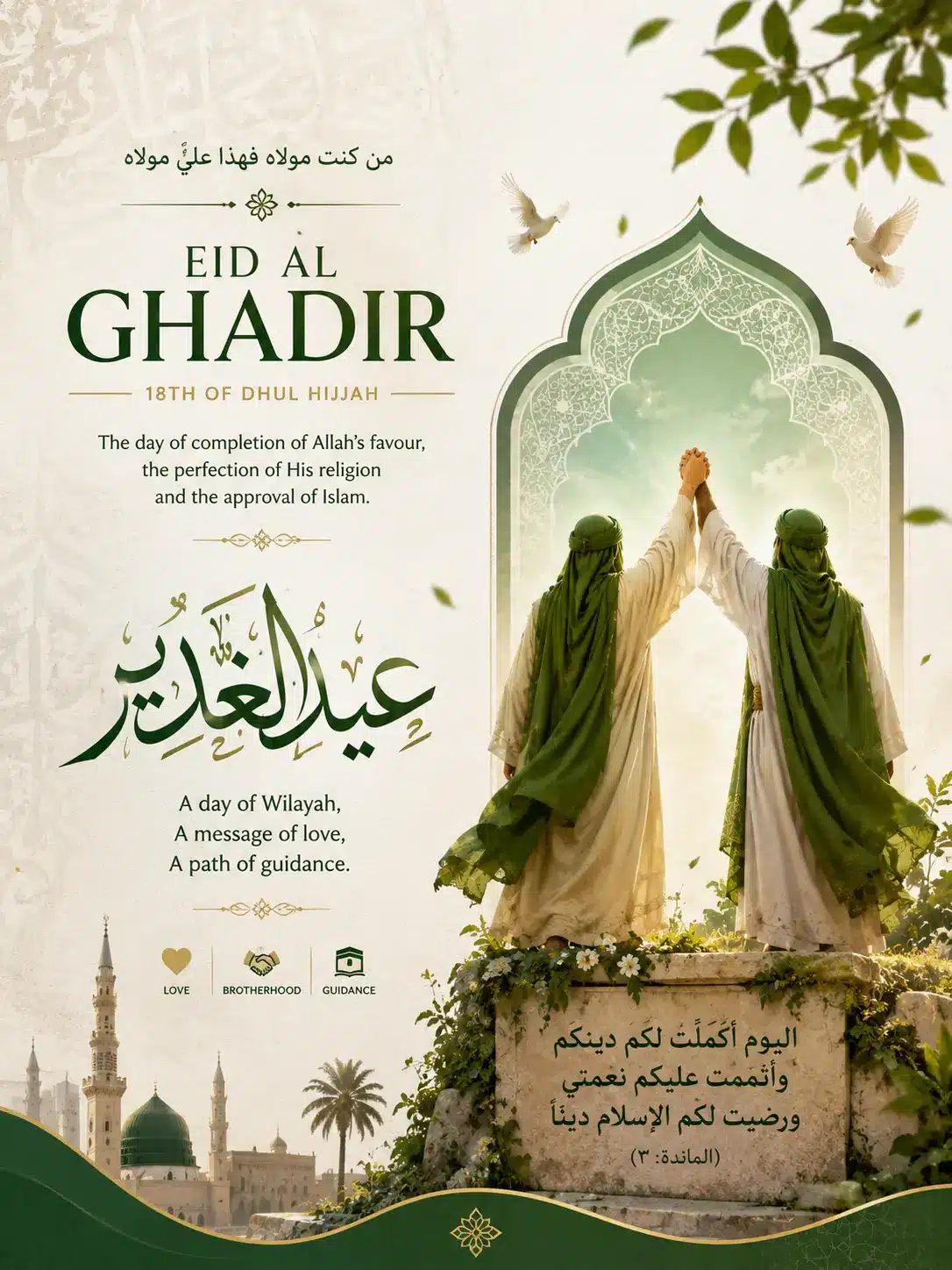
What Is Eid al-Ghadir?
On the 18th of Dhul Hijja, 10 AH — approximately March 632 CE — the Prophet Muhammad ﷺ made the most consequential public announcement of his entire prophethood. At a place called Ghadir Khumm, a crossroads on the caravan route between Mecca and Medina, he halted an army of returning pilgrims estimated between 70,000 and 120,000 people, stood on a pulpit built from camel saddles, and delivered a declaration that would define the course of Islamic history forever.
Eid al-Ghadir — celebrated every year on 18 Dhul Hijja — commemorates this event. Shia Muslims regard it as the greatest Eid of the Islamic calendar: greater than Eid al-Fitr and Eid al-Adha, because it marks the day the Prophet ﷺ completed his mission by divine command. Understanding what happened at Ghadir, and what the Quran says about it, is essential for any Muslim who wishes to know their religion in full.
Historical EventWhat Happened at Ghadir Khumm?
The Prophet ﷺ had just completed the Hajjat al-Wada' — his one and only Hajj — when the Angel Jibreel descended with a divine command that could not be delayed. The entire caravan was brought to a halt in the valley of Ghadir Khumm, in what is now the Hijaz region of Saudi Arabia.
-
1
The Divine Order to Stop
Allah commanded the Prophet ﷺ to halt the entire caravan — those who had walked ahead were called back, those behind were waited upon. No one was to proceed until all 70,000–120,000 pilgrims had gathered and heard what was to be said.
-
2
The Pulpit of Camel Saddles
A makeshift pulpit was erected from stacked camel saddles and luggage. The Prophet ﷺ ascended it so his voice could carry across the vast crowd in the midday heat. He led a congregational prayer, then delivered a lengthy sermon reminding the people of his imminent departure from this world.
-
3
The Declaration of Mawla-ship
The Prophet ﷺ took the hand of Imam Ali ibn Abi Talib (عليه السلام) and raised it in the air. He asked the crowd three times: "Am I not your Mawla — more worthy of authority over you than your own selves?" All affirmed. He then declared: "Whoever's Mawla I am, Ali is his Mawla."
-
4
Revelation of the Completion Verse
Following this proclamation, the verse of Surah al-Ma'idah 5:3 — "This day I have perfected your religion for you" — descended as divine confirmation that the mission of prophethood had now been fully fulfilled.
-
5
Three Days of Congratulations
The Companions offered formal tahni'ah (congratulations) to Imam Ali for three days. Among the very first to congratulate him were Abu Bakr and Umar ibn al-Khattab, who said: "Congratulations, O son of Abu Talib — you have become the Mawla of every believing man and woman."
"O People! Am I not more worthy of authority over you than you have over yourselves?" They said: "Yes, O Messenger of Allah." He said: "Whoever's Mawla I am — Ali is his Mawla. O Allah! Be a friend to whoever befriends him, and an enemy to whoever opposes him. Help whoever helps him, forsake whoever forsakes him."
— Hadith al-Ghadir | Musnad Ahmad, al-Tirmidhi, al-Nasa'i, Ibn Majah, al-Hakim al-Naysaburi (Mustadrak — declared Sahih on the criteria of al-Bukhari and Muslim). Narrated by over 110 Companions.
The Hadith of Ghadir is among the most mass-transmitted (mutawatir) narrations in Islamic history. Al-Hakim al-Naysaburi declared it sahih on the criteria of both al-Bukhari and Muslim; Imam al-Dhahabi confirmed this. Its narration from over 110 Companions in the first generation makes any denial of the event itself historically untenable.
Quranic Ayat I — Surah al-Ma'idah 5:67The Command to Convey — Or Risk All Being Lost
Before the Prophet ﷺ made his announcement at Ghadir, this verse descended — commanding him in the most urgent possible terms to deliver a specific message, with a stark and unprecedented warning attached:
"O Messenger! Convey what has been revealed to you from your Lord. And if you do not, then you have not conveyed His message at all. And Allah will protect you from the people."
اے رسول! جو کچھ آپ کے رب کی طرف سے آپ پر نازل کیا گیا ہے اسے پہنچا دیجئے، اور اگر آپ نے یہ نہ کیا تو آپ نے اللہ کا پیغام ادا نہیں کیا۔ اور اللہ آپ کو لوگوں (کے شر) سے بچائے گا۔
Surah al-Ma'idah • 5:67The structure of this verse is extraordinary. The Prophet ﷺ had spent 23 years conveying revelation — every command, prohibition, and ruling. Yet Allah says this single undelivered message is so weighty that its absence would render the entire prophetic mission as if it had never happened. The phrase "Allah will protect you from the people" implies the Prophet ﷺ anticipated a reaction — that this message would provoke controversy. No routine legal ruling requires a divine bodyguard assurance.
Exegesis of Surah al-Ma'idah 5:67
☺ Shia Interpretation
The Wilayah of Imam Ali — Allama Tabatabai & Sheikh al-Tusi
Shia commentators — led by Allama Tabatabai in al-Mizan fi Tafsir al-Quran and Sheikh al-Tusi in al-Tibyan — are unequivocal: this verse was revealed specifically at Ghadir Khumm to command the proclamation of Imam Ali's wilayah (divinely-appointed leadership). The verse's framing — that all of prophethood would be negated without this one act — proves that wilayah is the crown and seal of the prophetic mission. The assurance "Allah will protect you from the people" refers directly to anticipated opposition from certain Companions. Even classical Sunni scholars al-Wahidi and al-Suyuti recorded the Ghadir occasion as the cause of this verse's revelation.
☺ Sunni Interpretation
A Reinforcement of Prophetic Mission — Ibn Kathir & al-Qurtubi
Many Sunni commentators, including Ibn Kathir in Tafsir al-Quran al-Azim and al-Qurtubi in al-Jami' li Ahkam al-Quran, read this verse more broadly — as a divine reaffirmation of the Prophet's duty to convey revelation without fear. Ibn Kathir acknowledges a narration connecting it to the declaration of Ali's virtue at Ghadir, though he prefers the general reading. Crucially, al-Wahidi and al-Suyuti — both major Sunni authorities — explicitly recorded in their asbab al-nuzul works that this verse was revealed on the Day of Ghadir, on the authority of the Companion Abu Sa'id al-Khudri. Both traditions agree on the Ghadir context; the disagreement is in the scope of "what was conveyed."
Scholarly Note: Al-Suyuti (d. 911 AH), one of the most prolific and respected Sunni scholars of hadith and tafsir, records in al-Durr al-Manthur: this verse was revealed on the Day of Ghadir when the Prophet ﷺ took Ali's hand and declared: "Whoever I am his Mawla, Ali is his Mawla" — on the authority of Abu Sa'id al-Khudri (ra).
What Was Conveyed After This Verse?
After verse 5:67 commanded the Prophet ﷺ to make the announcement without delay, he raised the hand of Imam Ali and delivered the declaration recorded in Hadith al-Ghadir. He then made the following supplication — completing the covenant:
"O Allah, be the friend of whoever befriends him, and the enemy of whoever is his enemy. Love whoever loves him, and hate whoever hates him. Help whoever helps him, and abandon whoever abandons him. And make the Truth revolve around him wherever he turns."
— Du'a al-Ghadir | Musnad Ahmad ibn Hanbal, al-Tirmidhi, Ibn Majah, al-Hakim al-Naysaburi (Mustadrak). Narrated by over 30 Companions.
Following this declaration and supplication, the verse of completion (5:3) descended — Allah's own confirmation that the announcement had been made and the mission was now fulfilled. For Muslim families who want their children to understand events like these in depth, the Shia Online Quran Classes UK program at ShiaEdu covers Islamic history, Aqeedah, and Quranic context through live one-to-one sessions.
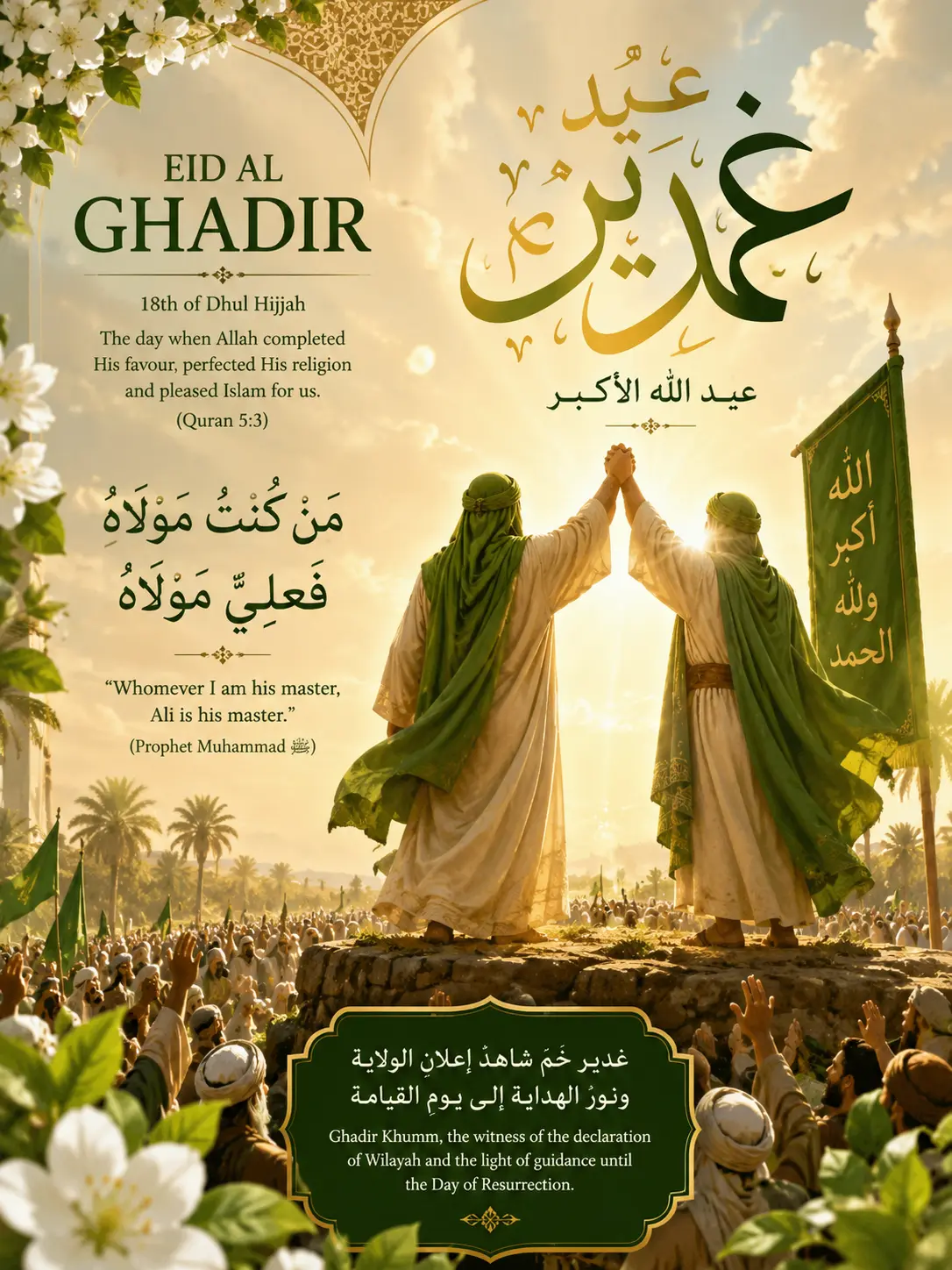 Quranic Ayat II — Surah al-Ma'idah 5:3
"This Day I Have Perfected Your Religion" — The Completion Verse
After the proclamation at Ghadir, this portion of verse 5:3 was revealed — and it is among the most celebrated and debated revelations in the entire Quran:
"This day I have perfected for you your religion, completed My favour upon you, and have approved for you Islam as your religion."
آج میں نے تمہارے لیے تمہارا دین مکمل کر دیا، اور تم پر اپنی نعمت پوری کر دی، اور تمہارے لیے اسلام کو بطور دین پسند کر لیا۔
Surah al-Ma'idah • 5:3 (excerpt)The word al-Yawm (الْيَوْمَ) — "This Day" — is the interpretive key. It does not refer to a day long in the past; it points to the specific day of the verse's revelation. The central question for all scholars is: what event on which day made the religion complete? Everything before this day was apparently incomplete — what was the final, missing element?
Exegesis of Surah al-Ma'idah 5:3
☺ Shia Interpretation
Completion Through Wilayah — Allama Tabatabai & Allama Majlisi
Allama Tabatabai in al-Mizan presents the most rigorous argument: every shariah ruling — halal, haram, prayer, fasting, Hajj, jihad — had already been revealed before this day. So what was incomplete? The question of leadership (imamah) after the Prophet ﷺ. Without a declared, divinely-appointed successor, the ummah would be rudderless and the religion could not function as a complete guided system after his death. The "favour" (ni'ma) completed is wilayah itself. Until the successor was named by Allah's command, the circle of prophethood was open; at Ghadir, it was closed. Sheikh Mufid, Allama Hilli, and nearly all major Shia scholars affirm this reading.
☺ Sunni Interpretation
Completion Through Islam's Dominance — Ibn Kathir & al-Hakim
The mainstream Sunni position, expressed by Ibn Kathir and al-Qurtubi, holds that "completion" refers to the day of Arafah during the Farewell Hajj — polytheists had been excluded from Hajj, Islam was politically dominant, and no major rulings remained. However, al-Hakim al-Naysaburi in al-Mustadrak — whose authentication al-Dhahabi confirmed — records a narration stating this verse was revealed specifically on the Day of Ghadir after the declaration of Ali as Mawla, and that Umar ibn al-Khattab himself congratulated Imam Ali, saying it was a "great day" for him. Ibn Kathir acknowledges this narration while preferring the Arafah context.
A common objection: The verse appears within a passage about dietary laws in Surah al-Ma'idah — suggesting it refers to the completion of halal/haram rulings. Shia scholars respond: the Quran was compiled thematically, not chronologically. The occasion of revelation (asbab al-nuzul) is independent of surah placement. The word "al-Yawm" demands a specific, identifiable event. No dietary ruling was legislated on the day of Arafah or Ghadir that would explain such a sweeping declaration of "completion."
Three Days of Congratulations — How the Sahaba Responded
One of the most historically documented aspects of the Ghadir event is the three-day formal gathering of Companions to offer their tahni'ah (congratulations) to Imam Ali. This detail is found in Sunni hadith collections, not only Shia sources.
Abu Bakr and Umar ibn al-Khattab were among the first to approach Imam Ali and said: "Congratulations, O son of Abu Talib (هنيئاً يا ابن أبي طالب) — you have become, this morning, the Mawla of every believing man and believing woman."
— Recorded by Ahmad ibn Hanbal (Musnad, Vol. 4, p.281), al-Tabari in Kitab al-Wilayah, Ibn Abi Shaybah, and al-Khatib al-Baghdadi in Tarikh Baghdad
The significance of the word tahni'ah cannot be overstated. In Arabic, you congratulate someone upon receiving a rank, honour, or position — not upon being mentioned in a general speech. The use of this term by the Companions — including the two men who would later become the first and second caliphs — confirms that they understood the Prophet's ﷺ declaration to be an appointment to a position of authority, not merely a statement of personal affection.
Hassan ibn Thabit, the official poet of the Prophet ﷺ, composed verses on that very day with the Prophet's ﷺ permission, immortalising the event. His poem declared that the Prophet ﷺ called on them on the Day of Ghadir to acknowledge Ali as their Imam and leader after him. For families raising Shia children in Western countries, understanding these foundations is addressed in detail in this insightful article on raising Shia children in the West.
SignificanceThe Importance of Eid al-Ghadir
The Religion Was Completed by Allah Himself
No event of greater religious magnitude than the completion of Islam can be imagined. Allah's own declaration in 5:3 marks this as the culmination of the entire prophetic era.
A Divine Command — Not a Political Choice
Verse 5:67 makes clear that failure to convey this message would have nullified 23 years of prophethood. This is not the Prophet's personal initiative; it is a divine institution.
The Most Mass-Transmitted Event of the Farewell Pilgrimage
Over 110 Companions narrated the Ghadir hadith, making it among the most mutawatir — mass-transmitted — narrations in all of Islamic literature.
Called a Day of Celebration by the Prophet ﷺ Himself
Classical sources record the Prophet ﷺ referring to this day as a day of festivity for the Muslims, comparable to the two Eids.
Establishes the Principle of Divine Appointment (Nass)
The Shia theological position that succession after the Prophet ﷺ is a matter of divine designation — not popular consensus — is grounded entirely and inseparably in the event of Ghadir.
Authenticated by Major Sunni Scholarship
Scholars including Ahmad ibn Hanbal, al-Tirmidhi, al-Nasa'i, al-Hakim, Ibn Kathir, al-Dhahabi, and al-Suyuti all authenticated the core event and hadith of Ghadir.
What Eid al-Ghadir Means for Every Believer
- Love of Ahl al-Bayt — the Prophet ﷺ explicitly bound wala' (allegiance) to Imam Ali with allegiance to himself
- Completion of Islam — the religion was not complete until the question of leadership was divinely resolved
- Divine authority of the Imams — leadership is by Allah's appointment, established at Ghadir for all generations
- A living covenant — celebrated annually as a reaffirmation of the oath taken by 120,000 pilgrims
- Inseparability of Prophet & Imam — to follow the Prophet ﷺ is, by this hadith, inseparable from the recognition of Imam Ali
After Ghadir — A Turning Point in Islamic History
The Prophet ﷺ lived for approximately 70 days after Ghadir before passing away in Safar of 11 AH. In those remaining weeks, he repeatedly reinforced the theme of Ghadir — most notably through the declaration of the Hadith al-Thaqalayn:
"I am leaving among you two weighty things (thaqalayn): the Book of Allah and my Ahl al-Bayt. If you hold fast to them both, you will never go astray after me. They will not separate from one another until they meet me at the Hawd."
— Hadith al-Thaqalayn | Sahih Muslim (Hadith 2408), Musnad Ahmad, Sunan al-Tirmidhi, and over 30 other collections. Agreed upon as authentic across Shia and Sunni scholarship.
Despite the unambiguous events of Ghadir, the succession following the Prophet's ﷺ death went to Abu Bakr, then Umar, then Uthman — before Imam Ali finally assumed the Caliphate in 35 AH, over two decades after Ghadir. For Shia Muslims, this interval is not a minor political disagreement — it is a theological rupture whose consequences echo through all of Islamic history, culminating most tragically in the martyrdom of Imam Husayn (grandson of the Prophet ﷺ and son of Imam Ali) at Karbala in 61 AH.
Understanding Fiqh Jaffari — the jurisprudence of the School of the Ahlulbayt, which flows directly from the authority established at Ghadir — is one of the most important pillars of Shia Islamic education. At ShiaEdu, this is taught through live one-to-one classes for all ages.
The Living Covenant of Ghadir
Eid al-Ghadir is celebrated not merely as commemoration, but as a living annual covenant — a reaffirmation by every believer that they hold fast to the rope that the Prophet ﷺ himself tied on that scorching afternoon in the valley of Ghadir Khumm. It is the day the mission of prophethood was sealed, the religion was completed, and the divine institution of leadership was made public before 120,000 witnesses.
To understand Ghadir fully — with its Quranic context, its hadith evidence across both schools, and its theological implications — is to understand the very foundation of what it means to follow the Prophet Muhammad ﷺ and hold fast to the Ahlulbayt (عليهم السلام).
Learn Islam from Expert Shia Scholars
Understanding events like Ghadir — with authentic Quranic context, hadith verification, and proper scholarly exegesis — requires qualified teachers rooted in the Ahlulbayt tradition. At ShiaEdu, our certified instructors bring this knowledge to you and your children through live one-to-one classes.
🎓 Explore Our Courses →Quran • Fiqh Jafari • Islamic History • Aqeedah • Namaz & Duas • For All Ages • Free Trial Available