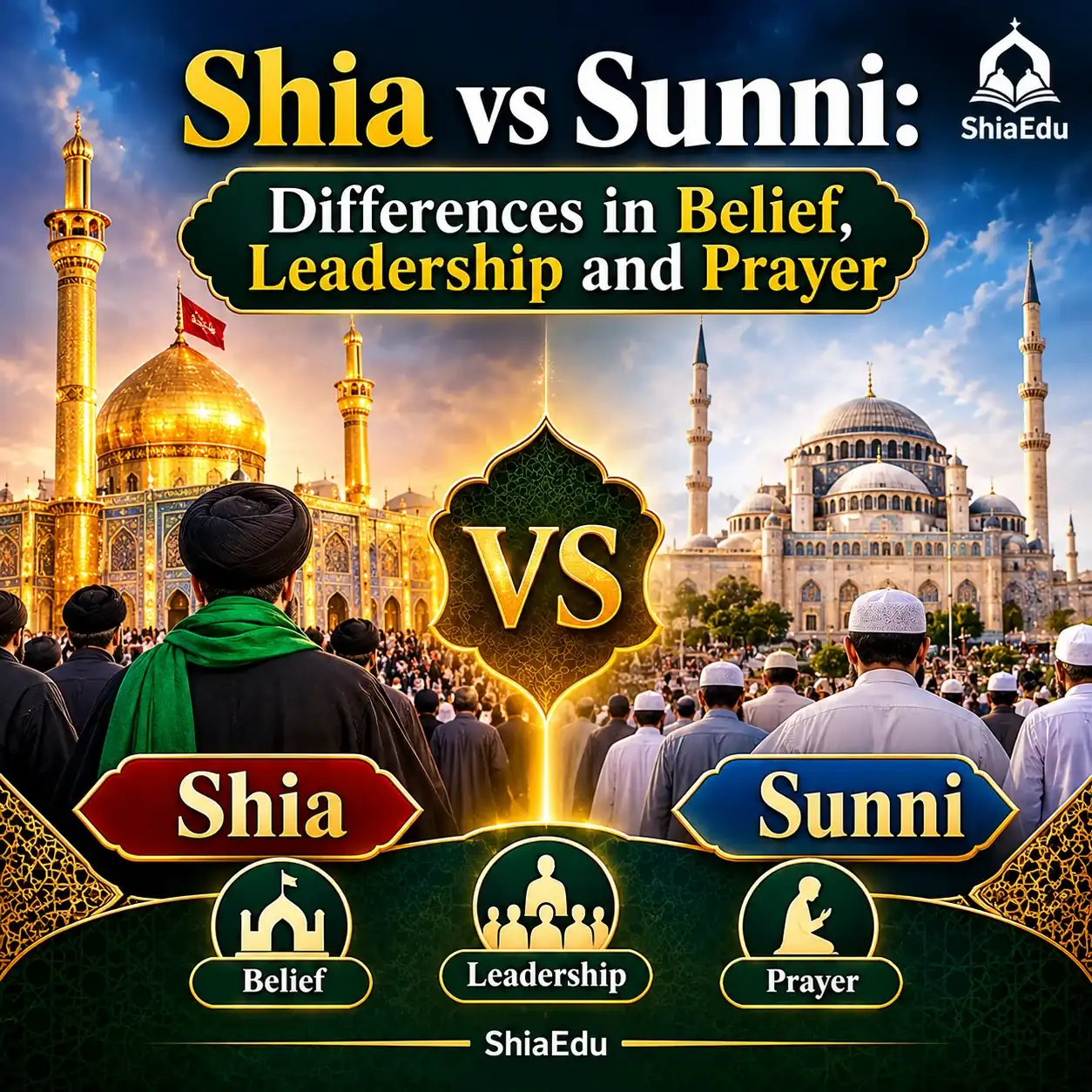
Shia and Sunni Muslims pray to the same God, recite the same Quran, love the same Prophet Muhammad (S.A.W.W.), face the same Kaaba and fast in the same month of Ramadan. So why are they two schools at all? The short answer is that the main difference between Shia and Sunni Islam is the question of who should lead the Muslim community after the Prophet, and on what basis. Almost every other difference, in belief and in practice, grows out of that one question.
This guide explains the differences between Shia and Sunni Muslims from the sources themselves. Wherever we describe a Sunni position, we cite Sunni books; wherever we give the Shia answer, we show the verse of the Quran or the narration it rests on, and many of these narrations come from Sahih al-Bukhari, Sahih Muslim and other Sunni collections. Our aim is to explain, not to insult. A Muslim who disagrees with us should still find his own view described fairly here.
- How the Shia–Sunni Split Began
- The Sunni View of Leadership
- The Shia Criterion: Virtue Proven from the Quran
- Imamat: Appointed by Allah, Not Elected
- Obey Ulil Amr (4:59): Why the Leader Must Be Infallible
- The Verse of Purification and Who the Ahlulbayt Are
- The Verse of Love for the Prophet's Relatives (42:23)
- Fadak, the Inheritance Hadith and the Burial Question
- The House of Lady Fatima (S.A.)
- Why Shia Do Not Follow the First Three Caliphs
- Abu Sufyan, Mu'awiya and the Treaty with Imam Hasan (A.S.)
- Differences in Practice: Wudu, Prayer and More
- What Shia and Sunni Muslims Share
- Where Shia and Sunni Muslims Live
- Shia vs Sunni: Who Is Right?
- Frequently Asked Questions
How the Shia–Sunni Split Began
The word Shia means "followers" or "party". In the early sources it is used for the Shi'at Ali, the followers of Imam Ali ibn Abi Talib (A.S.), the Prophet's cousin and son-in-law. The word Sunni comes from Ahl al-Sunna wa al-Jama'a, "the people of the Sunna and the community". Both groups claim to follow the Sunna of the Prophet; they differ over who carried it after him.
In the tenth year after the Hijra, on the way back from his Farewell Pilgrimage, the Prophet stopped the caravan of pilgrims at a place called Ghadir Khumm. Shia scholars, and a number of Sunni commentators, connect the following verse with that day:
يَٰٓأَيُّهَا ٱلرَّسُولُ بَلِّغْ مَآ أُنزِلَ إِلَيْكَ مِن رَّبِّكَ ۖ وَإِن لَّمْ تَفْعَلْ فَمَا بَلَّغْتَ رِسَالَتَهُۥ ۚ وَٱللَّهُ يَعْصِمُكَ مِنَ ٱلنَّاسِ
"O Apostle! Communicate that which has been sent down to you from your Lord, and if you do not, you will not have communicated His message, and Allah shall protect you from the people."
The Holy Quran 5:67, translation by Ali Quli Qara'i.There, holding up the hand of Imam Ali, the Prophet made a declaration that is recorded in Sunni collections as well as Shia ones:
مَنْ كُنْتُ مَوْلاَهُ فَعَلِيٌّ مَوْلاَهُ
"Whoever I am his mawla, Ali is his mawla."
Sunan al-Tirmidhi, Book of Virtues, chapter on the virtues of Ali ibn Abi Talib, hadith 3713. Al-Tirmidhi called it hasan gharib; Zubair Ali Za'i graded it sahih. Also in Sunan Ibn Majah 121.Sunni scholars generally read mawla here as "friend" or "one to be loved". Shia scholars read it as "master" and "guardian", the same authority the Prophet had over the believers, and point out that nobody would stop a hundred-thousand-strong caravan in the midday heat to announce a friendship. You can read more on this in our guide to Eid al-Ghadir and the declaration at Ghadir Khumm.
About seventy days later the Prophet passed away. While Imam Ali and the Banu Hashim were washing and preparing his blessed body, a group of the Ansar and some of the Muhajirun met at the Saqifa (meeting hall) of Banu Sa'ida, and Abu Bakr was given allegiance as caliph. Imam Ali, Lady Fatima (S.A.), the Banu Hashim and a number of companions did not give allegiance in those first months. From that day the community carried two answers to one question: the Sunni answer that the community chooses its leader, and the Shia answer that Allah, through His Prophet, had already chosen him.
The Sunni View of Leadership
It is only fair to state the Sunni position in the words of its own sources before we answer it. In Sunni belief, the Prophet did not name a successor. The caliph is chosen by consultation (shura), by the allegiance (bay'a) of the leading companions, or by nomination from the previous caliph. The first four caliphs, Abu Bakr, Umar, Uthman and Ali, are called the Rightly Guided Caliphs, and most Sunni scholars hold that their rank in virtue follows the order in which they ruled.
Two reports in Sahih al-Bukhari are usually given for this order of virtue. In the first, Abdullah ibn Umar says that in the Prophet's lifetime the companions used to compare people and would rank Abu Bakr first, then Umar, then Uthman (Sahih al-Bukhari 3655). In the second, Muhammad ibn al-Hanafiyya says he asked his father, Imam Ali, who was the best of people after the Prophet; Imam Ali named Abu Bakr and then Umar, and when his son asked "then you?", he replied that he was only a man among the Muslims (Sahih al-Bukhari 3671).
So, in the Sunni view, the caliphate went to the best of people, and the order of the caliphate is itself the order of their merit. This is exactly the point at which Shia scholarship asks its first question.
The Shia Criterion: Virtue Proven from the Quran
Shia scholars agree with one thing in the Sunni position: the leader of the Ummah must be the most virtuous of its people, the afdal. Where they differ is on how that virtue is known. Holding an office does not make a man the best of people; virtue must come first, and the office should follow it. And the measure of virtue cannot be the opinion of a group of men, however respected. It must be what Allah Himself has shown in His Book.
The Quran gives this rule plainly. It asks who has the greater right to be followed:
أَفَمَن يَهْدِىٓ إِلَى ٱلْحَقِّ أَحَقُّ أَن يُتَّبَعَ أَمَّن لَّا يَهِدِّىٓ إِلَّآ أَن يُهْدَىٰ ۖ فَمَا لَكُمْ كَيْفَ تَحْكُمُونَ
"Is He who guides to the truth worthier to be followed, or he who is not guided unless shown the way? What is the matter with you? How do you judge?"
The Holy Quran 10:35, translation by Ali Quli Qara'i.In another verse it asks, "Are those who know equal to those who do not know?" (39:9). And when the Children of Israel objected to the king Allah had appointed for them, saying they had more right to rule because Talut had little wealth, the Quran answered with the true measure of fitness:
إِنَّ ٱللَّهَ ٱصْطَفَىٰهُ عَلَيْكُمْ وَزَادَهُۥ بَسْطَةًۭ فِى ٱلْعِلْمِ وَٱلْجِسْمِ ۖ وَٱللَّهُ يُؤْتِى مُلْكَهُۥ مَن يَشَآءُ
"Indeed Allah has chosen him over you, and enhanced him vastly in knowledge and physique, and Allah gives His kingdom to whomever He wishes."
The Holy Quran 2:247, translation by Ali Quli Qara'i.Three lessons come from this verse. The choice belonged to Allah, not to the people. The people's own measure, wealth and status, was rejected. And the measure Allah used was knowledge and strength. Now apply the same test to the companions. Which of them did the Quran single out in this way?
- Mubahala (3:61)When the Prophet was told to bring "our souls" to the mutual prayer with the Christians of Najran, he brought Imam Ali. Sahih Muslim 2404 records that he took Ali, Fatima, Hasan and Husain and said, "O Allah, these are my family." No other companion was called the Prophet's own self.
- Purification (33:33)The verse of purification, as Sahih Muslim 2424 shows, was applied by the Prophet to the five People of the Cloak, Imam Ali among them.
- Wilayah (5:55)"Your guardian is only Allah, His Apostle, and the faithful who maintain the prayer and give the zakat while bowing down." Shia commentators, and Sunni commentators such as al-Wahidi and al-Zamakhshari, connect it with Imam Ali giving his ring to a beggar while bowing in prayer.
- Manzila"Will you not be pleased to be to me as Harun was to Musa, except that there is no prophet after me?" (Sahih al-Bukhari 4416; Sahih Muslim 2404). In the Quran, Harun was Musa's brother, minister and deputy (20:29–32, 7:142).
Shia Muslims honour the companions who served Islam sincerely, and we do not deny that the first caliphs were early converts who spent their wealth and lives in the early years. But early conversion and service are not the same as the virtues the Quran itself names. When the measure is the Book of Allah, Shia scholars argue, Imam Ali stands alone.
What about the two reports from Sahih al-Bukhari? The report of Ibn Umar records the opinion of a group of companions about one another; it is not a verse, and it is not a saying of the Prophet ranking them. The report from Muhammad ibn al-Hanafiyya conflicts with what Imam Ali said of the caliphate in his own sermons, such as the famous Shiqshiqiyya sermon in Nahj al-Balagha (sermon 3), where he describes the caliphate as his right, taken from him. For Shia scholars, a report about opinions cannot outweigh verses of the Quran and the agreed hadiths of Manzila, Thaqalayn and Ghadir.
Imamat: Appointed by Allah, Not Elected
For Shia Muslims, the Imam is not simply a ruler. He is the guardian of the religion after the Prophet, the one who explains the Quran and the Sunna without error. That is why Shia Muslims count Imamat among the roots of the faith (Usool-e-Deen). The Quran describes Imamat as a covenant that Allah gives, and it sets one condition on it:
قَالَ إِنِّى جَاعِلُكَ لِلنَّاسِ إِمَامًۭا ۖ قَالَ وَمِن ذُرِّيَّتِى ۖ قَالَ لَا يَنَالُ عَهْدِى ٱلظَّٰلِمِينَ
"He said, 'I am making you the Imam of mankind.' Said he, 'And from among my descendants?' He said, 'My pledge does not extend to the unjust.'"
The Holy Quran 2:124, translation by Ali Quli Qara'i.Notice three things. Ibrahim (A.S.) was already a prophet when he was made Imam, and only after being tested, so Imamat is a rank given by Allah ("I am making you"), not by the votes of people. Ibrahim asked for it for his descendants, and Allah answered that it does not reach the zalimin, the wrongdoers. In the Quran, worshipping idols is called the greatest zulm (31:13). Shia scholars therefore argue that anyone who ever committed injustice, including the worship of idols before Islam, cannot hold this covenant. Only one whose life was free of such wrongdoing can.
The Prophet then pointed to his successors in clear words, recorded in the most trusted Sunni books. At Ghadir Khumm, Sahih Muslim records, he said:
وَأَنَا تَارِكٌ فِيكُمْ ثَقَلَيْنِ أَوَّلُهُمَا كِتَابُ اللَّهِ فِيهِ الْهُدَى وَالنُّورُ ... وَأَهْلُ بَيْتِي أُذَكِّرُكُمُ اللَّهَ فِي أَهْلِ بَيْتِي
"I am leaving among you two weighty things: the first is the Book of Allah, in which there is guidance and light... and my Ahlulbayt. I remind you of Allah regarding my Ahlulbayt."
Sahih Muslim, Book of the Virtues of the Companions, chapter on the virtues of Ali, hadith 2408, narrated by Zayd ibn Arqam.Sunan al-Tirmidhi (3788) records the same hadith with the words "that which, if you hold fast to it, you will never go astray after me", adding that the two "will not separate until they come to me at the Pond". Al-Tirmidhi's narration is graded sahih by Zubair Ali Za'i. If the Book of Allah and the Ahlulbayt will never separate, and holding to both is the protection from going astray, then the Ahlulbayt must be as free from error as the Book is. That is the idea of Imamat in a single sentence of the Prophet.
Obey Ulil Amr (4:59): Why the Leader Must Be Infallible
One verse of the Quran, known as the verse of obedience, sits at the centre of the Shia argument for the infallibility of the Imams:
يَٰٓأَيُّهَا ٱلَّذِينَ ءَامَنُوٓا۟ أَطِيعُوا۟ ٱللَّهَ وَأَطِيعُوا۟ ٱلرَّسُولَ وَأُو۟لِى ٱلْأَمْرِ مِنكُمْ
"O you who have faith! Obey Allah and obey the Apostle and those vested with authority among you."
The Holy Quran 4:59, translation by Ali Quli Qara'i.Look carefully at how this command is built. Allah joins obedience to Ulil Amr, "those vested with authority", to obedience to Himself and His Messenger, under a single verb, "obey". He gives no condition and no exception. He does not say "obey them in what is right" or "obey them unless they command a sin", as He does elsewhere when speaking about parents: "If they urge you to ascribe to Me as partner that of which you have no knowledge, then do not obey them" (29:8).
Now think it through. If the person to be obeyed could make a mistake or order a sin, then a believer would face two commands from Allah at once: "obey him" and "do not commit this sin". Allah does not contradict Himself. So the only way an unconditional command to obey can stand is if the one obeyed never commands what Allah forbids, in other words, if he is protected from sin and error, just as the Prophet is. The same unconditional obedience that proves the Prophet's infallibility, Shia scholars say, proves the infallibility of the Ulil Amr.
This is not only a Shia reading. Fakhr al-Din al-Razi (d. 606 AH), one of the greatest Sunni commentators, reached the same conclusion in his al-Tafsir al-Kabir: Allah commanded obedience to Ulil Amr absolutely, so whoever Allah commands us to obey absolutely must be infallible. Al-Razi then said that since we cannot identify an infallible individual, the Ulil Amr must be the consensus of the scholars of the community taken together. Shia scholars accept his first step and question the second. A consensus is made of fallible individuals, and the verse speaks of people "among you" whom believers can actually obey. And the Prophet had already named the ones who would never separate from the Quran: his Ahlulbayt.
Some Sunni scholars answer that the next part of the verse, "if you dispute concerning anything, refer it to Allah and the Apostle", shows that rulers can be wrong. The Shia reply is that the dispute in that sentence is between the believers themselves; the verse does not say "refer it to Allah, the Apostle and Ulil Amr", because the Ulil Amr are the ones who carry the Apostle's authority. For Shia Muslims, the Ulil Amr are the twelve Imams, beginning with Imam Ali (A.S.) and ending with Imam al-Mahdi (A.T.F.S.). You can read the life of each of them in our guide to the 14 Masomeen and the 12 Imams.
The Verse of Purification and Who the Ahlulbayt Are
The verse of purification is the other pillar of the belief in the infallibility of the Ahlulbayt (A.S.):
إِنَّمَا يُرِيدُ ٱللَّهُ لِيُذْهِبَ عَنكُمُ ٱلرِّجْسَ أَهْلَ ٱلْبَيْتِ وَيُطَهِّرَكُمْ تَطْهِيرًۭا
"Indeed Allah desires to repel all impurity from you, O People of the Household, and purify you with a thorough purification."
The Holy Quran 33:33, translation by Ali Quli Qara'i.The word innama ("indeed only") limits the statement to these people alone, and the will of Allah here is a creative will: He purifies them. That is why Shia scholars understand the verse as a declaration of their purity from all sin, not a general wish that every Muslim should be clean.
The wives or the People of the Cloak?
This sentence sits inside a passage addressed to the wives of the Prophet, which is why many Sunni scholars hold that the wives are included among the Ahlulbayt, together with Ali, Fatima, Hasan and Husain. A report attributed to Ibn Abbas through his student 'Ikrima, recorded by al-Tabari and Ibn Kathir, goes further and says the verse was about the wives only; Ibn Kathir himself did not limit it to them.
The Arabic text gives the first answer. Every command to the wives in these verses uses the feminine plural: "you are not like other women" (lastunna), "stay in your houses" (buyutikunna), "maintain the prayer" (aqimna), "obey Allah" (ati'na), and again in the next verse, "remember what is recited in your houses" (buyutikunna). But the sentence of purification suddenly changes to the masculine plural: "from you" ('ankum) and "purify you" (yutahhirakum). In Arabic, a group that includes men is addressed in the masculine. The change of pronoun signals a change of the people addressed, and then the passage returns to the wives in the feminine in verse 34.
The Prophet himself gave the second answer, and he gave it so clearly that it was preserved in the Sunni Sahihs. Lady 'A'isha narrates in Sahih Muslim that the Prophet came out wearing a cloak of black wool, brought Hasan, Husain, Fatima and Ali under it, and then recited this verse (Sahih Muslim 2424). In the house of Umm Salama, the event was even clearer:
اللَّهُمَّ هَؤُلاَءِ أَهْلُ بَيْتِي فَأَذْهِبْ عَنْهُمُ الرِّجْسَ وَطَهِّرْهُمْ تَطْهِيرًا. قَالَتْ أُمُّ سَلَمَةَ: وَأَنَا مَعَهُمْ يَا نَبِيَّ اللَّهِ؟ قَالَ: أَنْتِ عَلَى مَكَانِكِ وَأَنْتِ عَلَى خَيْرٍ
"O Allah, these are the people of my house, so remove impurity from them and purify them thoroughly." Umm Salama said, "And am I with them, O Prophet of Allah?" He said, "You are in your place, and you are upon goodness."
Sunan al-Tirmidhi, Book of Tafsir, Surat al-Ahzab, hadith 3205, and Book of Virtues, hadith 3787, narrated by 'Umar ibn Abi Salama, the Prophet's stepson. Graded sahih by Zubair Ali Za'i.Umm Salama was a noble and righteous wife of the Prophet, and Shia Muslims respect her deeply. Yet when she asked to be included, the Prophet did not bring her under the cloak. He praised her, "you are upon goodness", and kept her in her place. Some Sunni scholars read "you are in your place" as meaning "you are already one of my family". But if that were so, there was nothing to stop the Prophet from simply letting her in, as he did with the others. The cloak drew a line, and the Prophet himself drew it.
The companion Zayd ibn Arqam, who narrated the hadith of the two weighty things, was asked directly whether the wives were the Ahlulbayt. In one narration in Sahih Muslim he answered:
"No, by Allah. A woman is with a man for a period of time, then he divorces her and she returns to her father and her people. His Ahlulbayt are his own stock and his relatives by blood, for whom charity (sadaqa) is forbidden after him."
Sahih Muslim, Book of the Virtues of the Companions, hadith 2408 (the narration of Hassan ibn Ibrahim from Sa'id ibn Masruq). In another narration of the same hadith Zayd says the wives are of his household in a general sense, but that the Ahlulbayt meant here are those for whom charity is forbidden.So the Shia position rests on the Quran's grammar, on the Prophet's own action in two Sunni books, and on the answer of a senior companion in Sahih Muslim. For a fuller account of the Event of the Cloak and its place in the life of Lady Fatima, see our article on the life of Lady Fatima Zahra (S.A.).
The Verse of Love for the Prophet's Relatives (42:23)
Every prophet in the Quran tells his people, "I do not ask you for any reward." The Prophet Muhammad (S.A.W.W.) is told to say the same, with one exception:
قُل لَّآ أَسْـَٔلُكُمْ عَلَيْهِ أَجْرًا إِلَّا ٱلْمَوَدَّةَ فِى ٱلْقُرْبَىٰ
"Say, 'I do not ask you any reward for it except the love of [my] relatives.'"
The Holy Quran 42:23, translation by Ali Quli Qara'i.How Sunni commentators explain it
Sunni books record more than one explanation. Sahih al-Bukhari (4818) reports that Ibn Abbas was asked about the verse. His student Sa'id ibn Jubayr, who was present, answered that it means the relatives of the family of Muhammad. Ibn Abbas said he had answered too quickly: there was no clan of Quraysh to which the Prophet was not related, so the meaning was, "unless you keep the ties of kinship between me and you". Ibn Kathir prefers this explanation in his tafsir.
But Sunni books also record the other meaning. A narration attributed to Ibn Abbas says that when this verse was revealed, the companions asked who these relatives were whose love had become obligatory, and the Prophet answered, "Ali, Fatima and their two sons." Ahmad ibn Hanbal recorded it in Fada'il al-Sahaba and al-Tabarani in al-Mu'jam al-Kabir; Ibn Kathir considered its chain weak, while al-Zamakhshari in al-Kashshaf and al-Razi in his tafsir cite it. Al-Hakim al-Haskani, a Sunni scholar, gathered more than twenty narrations on the verse in Shawahid al-Tanzil, most of which apply it to the Ahlulbayt.
Ibn Kathir also records a striking scene, through al-Tabari. After Karbala, when Imam Ali ibn al-Husain (A.S.) was brought to Damascus as a captive, a Syrian man praised Allah for killing his family. The Imam asked him whether he had read the Quran, and recited this verse. The man asked, "Are you those relatives?" The Imam replied, "Yes."
The Shia understanding
Shia commentators, following narrations from the Imams of the Ahlulbayt, understand al-qurba as the Prophet's closest family: Imam Ali, Lady Fatima, Imam Hasan, Imam Husain and the Imams from their descendants. They give four reasons. First, the verse speaks of a reward for the whole message of Islam, which only makes sense if the love asked for is something of great religious weight, not ordinary courtesy toward a tribe. Second, the Quran says elsewhere that this "reward" is in fact for the believers' own benefit: "Whatever reward I may have asked you is for your own good" (34:47), and "except that anyone who wishes should take the way to his Lord" (25:57). Love for the Prophet's family is a way to Allah because it leads to following them. Third, the reading that limits it to "keep our tribal ties" would be addressed to the Quraysh unbelievers, yet the verse is spoken to the believers in the context of their reward. Fourth, the Sunni sources themselves preserve the narrations above.
Some Sunni scholars object that Surat al-Shura was revealed in Makkah, before Imam Hasan and Imam Husain were born. Shia scholars answer that a number of early commentators counted this verse and the few after it among the verses revealed in Madinah, and that the duty of love for the Prophet's family is not limited to those who were alive on the day of revelation. However the timing is settled, Muslims of every school agree that loving the Ahlulbayt is part of loving the Prophet. The Shia simply hold that love is shown by following them.
Fadak, the Inheritance Hadith and the Burial Question
Fadak was a village of palm groves near Khaybar that came to the Prophet without any battle. Under the Quran (59:6), such land belonged to the Prophet himself. Shia narrations, and some Sunni reports cited by al-Suyuti under verse 17:26, say the Prophet gave it to Lady Fatima during his lifetime.
After the Prophet's passing, Fadak was taken over by the new government. Sahih al-Bukhari (4240–4241) records that Lady Fatima sent to Abu Bakr asking for her inheritance, and that Abu Bakr answered with a hadith he said he had heard from the Prophet:
لاَ نُورَثُ، مَا تَرَكْنَا صَدَقَةٌ
"We [prophets] are not inherited from; whatever we leave is charity."
Sahih al-Bukhari, Book of the Campaigns, hadith 4240–4241; also Sahih Muslim 1759.Shia scholars reject this report as a ground for denying the Prophet's daughter her right, and they give reasons from the Quran, not from feeling. The Quran tells us that prophets do leave inheritance. It says plainly, "Solomon inherited from David" (27:16). And it records the prayer of Prophet Zakariyya (A.S.), who asked Allah for a son for exactly this reason:
وَإِنِّى خِفْتُ ٱلْمَوَٰلِىَ مِن وَرَآءِى وَكَانَتِ ٱمْرَأَتِى عَاقِرًۭا فَهَبْ لِى مِن لَّدُنكَ وَلِيًّۭا يَرِثُنِى وَيَرِثُ مِنْ ءَالِ يَعْقُوبَ
"Indeed I fear my kinsmen, after me, and my wife is barren. So grant me from Yourself an heir who may inherit from me and inherit from the House of Jacob."
The Holy Quran 19:5–6, translation by Ali Quli Qara'i.Those who defend the hadith say these verses mean the inheritance of knowledge and prophethood. But prophethood is given by Allah, not passed on by blood, and a prophet does not need to "fear his kinsmen" taking it. Lady Fatima made exactly this argument in her famous sermon in the Prophet's mosque, and she asked: "Is it in the Book of Allah that you inherit from your father and I do not inherit from mine?" Sahih al-Bukhari records the outcome: she became angry with Abu Bakr, kept away from him and did not speak to him until she died (4240–4241). We have told the full story in our article on Lady Fatima Zahra (S.A.), Fadak and her final days.
The hadith also surprised the Prophet's own household. Sahih al-Bukhari (6730) records that when the Prophet died, his wives wanted to send Uthman to Abu Bakr to ask for their share of the inheritance, until Lady 'A'isha reminded them of this saying. The Prophet's daughter, his son-in-law Imam Ali, his uncle al-Abbas and his wives had not heard a ruling that concerned them more than anyone else.
The burial question
Shia scholars point to another consequence of the hadith that is rarely discussed. The Prophet was buried in his own room, the hujra of Lady 'A'isha. Abu Bakr and later Umar were buried beside him. Sahih al-Bukhari (1392) records that when Umar was dying he sent his son to 'A'isha to ask her permission to be buried there, and told his family: if she permits, bury me there; if not, take me to the graveyard of the Muslims.
In Islamic law, a person may not be buried in land that belongs to someone else without the owner's permission. So the question is simple: whose land was it? If the Prophet left no inheritance and everything he owned became charity for the Muslims, then the room was public property, and no single person could give permission to be buried in it. If, on the other hand, the room passed to 'A'isha as her share of the Prophet's estate, then the Prophet did leave inheritance, and his daughter Fatima had a far greater share than a wife. In Islamic inheritance a wife with children receives one-eighth of the estate, shared between all nine wives, while a daughter's share is much larger. Either way, the hadith that was used to deny Lady Fatima cannot sit comfortably with the burial of the two caliphs in the Prophet's room.
Sunni scholars answer that the rooms belonged to the wives during the Prophet's lifetime, and point to the Quran calling them "your houses" when addressing the wives (33:33). Shia scholars reply that the same Quran calls them "the houses of the Prophet" (33:53), and that a gift needs proof just as much as inheritance does. When Lady Fatima said Fadak had been a gift to her, her claim was not accepted, yet no witnesses were asked for the rooms.
The question becomes sharper with the burial of Imam Hasan (A.S.), the Prophet's grandson and his blood, in 50 AH. According to historians including al-Baladhuri in Ansab al-Ashraf and al-Dinawari in al-Akhbar al-Tiwal, Imam Hasan had asked to be buried beside his grandfather. When the Banu Hashim carried his body toward the Prophet's grave, Marwan ibn al-Hakam and a group of the Umayyads came out armed and blocked the way. Abu al-Faraj al-Isfahani records in Maqatil al-Talibiyyin that Lady 'A'isha also arrived and objected. To avoid bloodshed, as his brother had asked of him, Imam Husain (A.S.) took the body to Jannat al-Baqi.
Shia Muslims ask a question that every reader can weigh for himself: by what right was the Prophet's own grandson refused a grave beside him, in a room where two men who were not his blood had been buried with permission? To refuse is to claim ownership. If the room belonged to no one, no one could refuse. If it belonged to the Prophet's heirs, his grandson had the first right to it.
The House of Lady Fatima (S.A.)
After the Saqifa, Imam Ali, al-Zubayr and others who had not given allegiance met in the house of Lady Fatima. Abu Bakr ibn Abi Shayba, a teacher of al-Bukhari, records with a chain of trusted narrators that Umar ibn al-Khattab came to her and said:
"By Allah, that [love for you] will not stop me, if these people gather at your house, from ordering that the house be burned upon them."
Ibn Abi Shayba, al-Musannaf, Book of the Campaigns, chapter on the caliphate of Abu Bakr, narrated by Zayd ibn Aslam from his father Aslam (no. 38201 in the 'Awwama edition; 37045 in older printings).Al-Tabari records in his Tarikh that Umar came to the house of Ali, where Talha, al-Zubayr and some of the Muhajirun were gathered, and said he would burn it upon them unless they came out to give allegiance. Al-Baladhuri records a similar account in Ansab al-Ashraf. And al-Tabari and Ibn 'Abd Rabbih record that Abu Bakr, on his deathbed, said he wished he had never "exposed the house of Fatima", even if it had been shut against him for war.
Now set this beside what the Prophet said about his daughter, again in the Sunni books. "Fatima is a part of me; whoever angers her has angered me" (Sahih al-Bukhari 3714). And to Fatima herself: "Allah is angered by your anger and pleased by your pleasure" (al-Mustadrak of al-Hakim, 4730, graded sahih by al-Hakim). Shia Muslims ask how a companion of the Prophet could threaten to burn the house of the one whose anger angers Allah, only months after the Prophet's death, and how anyone could approve of it.
Shia sources go further. Kitab Sulaym ibn Qays, Dala'il al-Imama and other early Shia works record that the house was attacked, that Lady Fatima was injured behind the door and lost the child she was carrying, Muhsin, and that this led to her death. The sahih narration in al-Kafi from Imam Musa al-Kazim (A.S.) calls her "truthful and a martyr" (siddiqa shahida). Most Sunni scholars reject these details, and we have set out both views, with their sources, in our article on her life and martyrdom. But even the reports that Sunni books themselves accept are enough to explain why Shia Muslims cannot regard Umar's conduct toward the Prophet's daughter as the conduct of a rightful successor.
Why Shia Do Not Follow the First Three Caliphs
Shia Muslims are often asked why they do not accept Abu Bakr, Umar and Uthman as rightful caliphs. The first answer is the one already given: Shia Muslims believe the Prophet appointed Imam Ali, so the position belonged to him by Allah's choice. But there are also reasons connected with what each of them did, and Shia scholars draw these reasons from Sunni books, so that the argument does not rest on Shia sources alone.
Abu Bakr
Abu Bakr took the caliphate at the Saqifa while the Prophet's family were burying him, without Imam Ali, the Banu Hashim or many of the companions. He then took Fadak from Lady Fatima, set aside her claim that it was a gift, and denied her inheritance on the basis of a report that, as we saw, conflicts with the Quran and that the Prophet's own family had not heard. Sahih al-Bukhari records that she died angry with him and that Imam Ali buried her at night without informing him. For Shia Muslims, a leader with whom the Prophet's daughter died angry, after the Prophet said her anger is his anger, cannot be his rightful successor.
Umar ibn al-Khattab
Umar was the driving force behind the Saqifa and led the pressure on the house of Lady Fatima, including the threat to burn it recorded in the Musannaf of Ibn Abi Shayba and the Tarikh of al-Tabari. Shia sources also hold him responsible for the attack on the door and its consequences. Shia scholars further point to changes he made in religious practice by his own judgement, which Sunni books also record, as signs that he did not see himself as bound by the Prophet's Sunna in the way an Imam must be.
Uthman ibn Affan
The Prophet had expelled al-Hakam ibn Abi al-'As, Uthman's uncle, from Madinah to Ta'if, and he remained in exile throughout the rule of Abu Bakr and Umar. Ibn 'Abd al-Barr, a Sunni scholar, records the expulsion in his biography of al-Hakam in al-Isti'ab. When Uthman became caliph, he brought al-Hakam back to Madinah, and he gave high office and wealth to al-Hakam's son Marwan, who married Uthman's daughter Umm Aban. Uthman's defenders say he had the Prophet's permission to bring his uncle back; Shia scholars answer that if such permission existed, the two caliphs before him would have honoured it.
The fate of Fadak tells the same story. Abu Bakr had refused it to Lady Fatima on the grounds that it was charity for the poor and could not belong to any one person. Yet Sunan Abi Dawud (2972) records that it was later "given to Marwan as a fief", and Sunni historians such as Ibn Qutayba in al-Ma'arif state that it was Uthman who gave Fadak to Marwan. It stayed with Marwan's family until 'Umar ibn 'Abd al-'Aziz returned it. Shia Muslims ask how land that was too sacred to be given to the Prophet's daughter could be given to the son of the man the Prophet had expelled.
Uthman also appointed relatives such as al-Walid ibn 'Uqba, Abdullah ibn Sa'd ibn Abi Sarh and Marwan to the most powerful posts, and gave large sums from the treasury to members of his family. Sunni historians including al-Baladhuri and al-Tabari record the complaints this caused among the companions, which grew into the revolt in which he was killed in 35 AH. It is worth noting that Imam Ali sent his sons Hasan and Husain to guard Uthman's house during the siege; the Shia view of his rule has never been a call to violence.
Shia Muslims are taught to state these reasons with evidence and good manners. Senior Shia jurists have ruled that insulting the figures Sunni Muslims hold sacred is forbidden. Disagreement about who was right is a matter of history and belief; it is never a licence to curse or abuse.
Abu Sufyan, Mu'awiya and the Treaty with Imam Hasan (A.S.)
Abu Sufyan led the armies of Quraysh against the Prophet at Uhud and at the Battle of the Trench, and accepted Islam only when Makkah was conquered in 8 AH; his son Mu'awiya accepted Islam around the same time. Sunni Muslims count both among the companions, and many Sunnis say "may Allah be pleased with him" after Mu'awiya's name and remember him as a scribe of the Prophet. Shia Muslims do not share this view of Mu'awiya, and the reasons are again found in Sunni books.
He fought the rightful caliph
Mu'awiya refused allegiance to Imam Ali, whom even Sunni Muslims count as the fourth rightful caliph, and fought him at Siffin. In that battle the elderly companion 'Ammar ibn Yasir was killed fighting on Imam Ali's side. Sahih al-Bukhari records what the Prophet had said about 'Ammar while the mosque of Madinah was being built:
وَيْحَ عَمَّارٍ تَقْتُلُهُ الْفِئَةُ الْبَاغِيَةُ، يَدْعُوهُمْ إِلَى الْجَنَّةِ وَيَدْعُونَهُ إِلَى النَّارِ
"Alas for 'Ammar! The rebellious group will kill him. He will be inviting them to Paradise, and they will be inviting him to the Fire."
Sahih al-Bukhari, Book of Prayer, hadith 447, and Book of Jihad, hadith 2812, narrated by Abu Sa'id al-Khudri.He ordered the cursing of Imam Ali
Sahih Muslim (2404) records that Mu'awiya ibn Abi Sufyan instructed Sa'd ibn Abi Waqqas and asked him, "What prevents you from reviling Abu Turab?" (Abu Turab was a name of Imam Ali.) Sa'd replied that he would never do so because of three things he had heard the Prophet say about Ali: the hadith of Manzila, the banner at Khaybar given to "a man who loves Allah and His Messenger, and whom Allah and His Messenger love", and the day of Mubahala. Sunan Ibn Majah (121) records a similar scene in which Mu'awiya spoke against Ali and Sa'd grew angry. The public cursing of Imam Ali from the pulpits continued under the Umayyads until 'Umar ibn 'Abd al-'Aziz stopped it.
He broke the treaty with Imam Hasan
After Imam Ali's martyrdom in 40 AH, the people of Kufa gave allegiance to Imam Hasan (A.S.). Facing betrayal within his own army and seeking to spare Muslim blood, Imam Hasan agreed to a peace treaty with Mu'awiya in 41 AH. The early sources record its conditions in different wordings: al-Baladhuri, al-Dinawari, Ibn A'tham al-Kufi, Ibn 'Abd al-Barr and Ibn al-Athir among the Sunni historians. Taken together, the main conditions were:
- Rule by the Book and the SunnaMu'awiya would govern according to the Quran and the Sunna of the Prophet.
- No successorHe would not appoint anyone to succeed him. After him the matter would be left to the consultation (shura) of the Muslims; some reports say it would return to Imam Hasan.
- Safety for allThe people, and especially the followers of Imam Ali, would be safe in their lives, property and families.
- No plottingMu'awiya would not plot against Imam Hasan, openly or secretly.
Mu'awiya kept none of these conditions. The companions of Imam Ali were hunted down; Hujr ibn 'Adi and his companions were executed in 51 AH. Imam Hasan died of poison in 50 AH, and Shia sources, with some Sunni ones, hold that his wife Ja'da was induced to poison him. And in 56 AH Mu'awiya demanded allegiance for his son Yazid as his successor, breaking the most important condition of all. That decision led directly to Karbala, where Yazid's army killed Imam Husain (A.S.) and his family in 61 AH. This is why Shia Muslims cannot honour Mu'awiya: the Prophet called the side that killed 'Ammar "the rebellious group", Mu'awiya ordered the cursing of the Prophet's brother, and he broke his word to the Prophet's grandson.
Differences in Practice: Wudu, Prayer and More
Most practical differences between Shia and Sunni Muslims follow from the difference over leadership. Sunni Muslims take their law from the four schools (Hanafi, Maliki, Shafi'i and Hanbali), built on hadiths transmitted through the companions. Shia Muslims follow Fiqh Jaffari, built on the Quran and the Sunna as transmitted by the Imams of the Ahlulbayt, who learned it from the Prophet through their fathers. Here are the main differences side by side.
| Topic | Shia (Fiqh Jaffari) | Sunni (four schools) |
|---|---|---|
| Leadership | Twelve Imams appointed by Allah through the Prophet | Caliph chosen by consultation or allegiance |
| Main hadith books | The Four Books: al-Kafi, Man La Yahduruh al-Faqih, al-Tahdhib, al-Istibsar | The Six Books: Sahih al-Bukhari, Sahih Muslim and four Sunan |
| Religious guidance today | Follow a living, qualified jurist (Marja') | Follow one of the four schools |
| Wudu: feet | Wiped with the wetness left on the hands | Washed up to the ankles |
| Hands while standing in prayer | Hanging at the sides | Folded (Hanafi, Shafi'i, Hanbali); the Maliki school prefers the sides |
| Prostration (sajdah) | Forehead on earth or what grows from it, often a clay tablet (turbah) | On any clean surface, including carpet |
| Prayer times | Zuhr with Asr and Maghrib with Isha may be combined at any time | Combining mainly while travelling; the Hanafi school only at Arafa and Muzdalifa |
| Adhan | Includes "Hayya 'ala khayr al-'amal"; the witness to Imam Ali's wilayah is recommended, not part of the Adhan | Adds "al-salatu khayrun min al-nawm" in the Fajr Adhan |
| Saying "Amin" after al-Fatiha | Not said | Said |
| Khums (one-fifth) | Paid on yearly surplus income (8:41) | Mainly on war booty and buried treasure |
Wudu: what the Quran says about the head and the feet
The Quran describes wudu in one verse, and it uses two different verbs: wash (ighsilu) for the face and the arms, and wipe (imsahu) for the head and the feet:
يَٰٓأَيُّهَا ٱلَّذِينَ ءَامَنُوٓا۟ إِذَا قُمْتُمْ إِلَى ٱلصَّلَوٰةِ فَٱغْسِلُوا۟ وُجُوهَكُمْ وَأَيْدِيَكُمْ إِلَى ٱلْمَرَافِقِ وَٱمْسَحُوا۟ بِرُءُوسِكُمْ وَأَرْجُلَكُمْ إِلَى ٱلْكَعْبَيْنِ
"O you who have faith! When you stand up for prayer, wash your faces and your hands up to the elbows, and wipe a part of your heads and your feet, up to the ankles."
The Holy Quran 5:6, translation by Ali Quli Qara'i.The word "feet" (arjul) comes straight after "your heads", under the verb "wipe". The word "wash" is never used for the feet. Among the canonical readers of the Quran, Ibn Kathir, Abu 'Amr, Hamza and Shu'ba from 'Asim read wa-arjulikum, which joins the feet grammatically to "your heads", so the feet are wiped. Others read wa-arjulakum; Shia scholars explain that this reading also joins the feet to the position of "your heads" (which is the object of "wipe"), while Sunni scholars join it to "your faces" and so read it as washing.
Sunni scholars hold that washing the feet is established by the Prophet's practice as reported by many companions. But two of the most learned companions are reported, in Sunni books, to have seen the Quran's wording as wiping. Al-Tabari records in his tafsir that Anas ibn Malik said: "The Quran came down with wiping, and the Sunna is washing." And Ibn Majah (458) records that Ibn Abbas said: "The people insist on nothing but washing, yet I find nothing in the Book of Allah but wiping." (Zubair Ali Za'i graded this chain weak.) Shia Muslims follow the wording of the Quran, as the Imams of the Ahlulbayt taught it.
Washing each part once is obligatory and a second washing is allowed; the head and feet are wiped once. Follow the rulings of your Marja' for details.
Prayer: hands at the sides, and prostration on earth
Shia Muslims pray with their hands at their sides, as the Imams of the Ahlulbayt taught. In a well-known narration, Imam Ja'far al-Sadiq (A.S.) told his student Hammad ibn 'Isa that he did not know how to pray properly, then stood facing the Qibla and showed him the whole prayer, with his hands hanging at his sides and his fingers together (Man La Yahduruh al-Faqih, chapter on the description of the prayer). Another narration from Zurara in al-Kafi says the hands should rest on the front of the thighs.
This is not a practice of the Shia alone. Imam Malik, founder of one of the four Sunni schools, is reported in al-Mudawwana, the main reference of his school, as saying he did not know folding the hands in the obligatory prayers, and most Maliki scholars after him prefer praying with the hands at the sides. The Musannaf of Ibn Abi Shayba also records early Muslims who prayed with their hands down. Sunni scholars of the other schools rely on reports such as Sahih al-Bukhari 740, in which Sahl ibn Sa'd says that people "were commanded" to place the right hand on the left forearm. Shia scholars note that this report does not name who gave the command, and that the companions who described the Prophet's prayer in detail did not all mention folding.
Shia Muslims prostrate on earth, or on what grows from the earth and is not eaten or worn, which is why many carry a small clay tablet called a turbah. This follows the hadith in Sahih al-Bukhari: "The earth has been made for me a place of prostration and a means of purification" (Sahih al-Bukhari 335, 438). The turbah is not worshipped and is not an idol; it is simply a clean piece of earth to place the forehead on, and many Shia prefer one made from the soil of Karbala out of love for Imam Husain (A.S.).
In the prayers of Sunni Muslims of the Hanafi, Shafi'i and Hanbali schools, the hands are folded while standing, and "Amin" is said after al-Fatiha. The rest of the positions are shared by all Muslims.
Combining the prayers
Shia Muslims often pray Zuhr and Asr together, and Maghrib and Isha together, so they pray at three times of the day. Sahih Muslim (705) records from Ibn Abbas that the Messenger of Allah prayed Zuhr and Asr together, and Maghrib and Isha together, "without fear and without travel". Praying each prayer at its own time is still recommended; combining is a mercy, not an obligation.
If you would like to learn the Shia prayer step by step, our interactive Shia Namaz and Roza guide walks through every position and recitation, and our step-by-step article on Shia namaz covers the same for quick reference.
What Shia and Sunni Muslims Share
For all the differences above, the common ground is far larger. Shia and Sunni Muslims both believe in one God, in all His prophets, in Muhammad (S.A.W.W.) as the final Prophet, in the Quran as the word of Allah that has never been changed, and in the Day of Judgement. Both pray five daily prayers facing the Kaaba, fast in Ramadan, pay zakat, and perform the same Hajj around the same House. Both love the Ahlulbayt; Sunni Muslims send blessings on the family of Muhammad in every prayer, and Imam Shafi'i wrote famous verses of poetry in their praise.
Shia and Sunni Muslims pray together in Makkah and Madinah, marry one another and live as neighbours in every country where Muslims live. The differences are real and worth understanding, but they are differences within Islam.
Where Shia and Sunni Muslims Live
According to the Pew Research Center's 2009 study Mapping the Global Muslim Population, Shia Muslims make up about 10–13% of the world's Muslims and Sunni Muslims about 87–90%. Most Shia Muslims, between 68% and 80%, live in four countries: Iran, Pakistan, India and Iraq. Shia Muslims are a majority of the Muslim population in Iran, Azerbaijan, Bahrain and Iraq. These are estimates, and current figures may differ.
| Country | Share of Muslims who are Shia (approx.) |
|---|---|
| Iran | 90–95% |
| Azerbaijan | 65–75% |
| Bahrain | 65–75% |
| Iraq | 65–70% |
| Lebanon | 45–55% |
| Yemen | 35–40% |
| Kuwait | 20–25% |
| Syria | 15–20% |
| Pakistan, India, Afghanistan, Saudi Arabia, Turkey | 10–15% |
| United Kingdom, United States | 10–15% |
| Canada, Qatar, United Arab Emirates | about 10% |
| Oman | 5–10% |
Source: Pew Research Center, Mapping the Global Muslim Population (October 2009), estimated percentage range of Shia by country. For Shia families living in the UK, the USA, Canada and the Gulf, that means children often grow up as a minority within a minority, and need teachers who can explain their faith with confidence and respect.
Shia vs Sunni: Who Is Right?
Every Muslim must answer this question for himself, before Allah, with evidence. The Shia answer is simple and comes from the Prophet's own words in the Sunni Sahihs: he left two weighty things, the Book of Allah and his Ahlulbayt, and said that whoever holds to both will never go astray. The Shia path is to hold to both. The Quran shows who the Ahlulbayt are in the verse of purification; the Prophet showed it under the cloak, and drew the line even for his own wife. The verse of obedience shows that those whose obedience is joined to the Prophet's must be free from error, and the Quran's own measure of leadership, knowledge, purity and Allah's choice, points to Imam Ali (A.S.) and the Imams from his descendants.
We do not ask anyone to accept this because we say so. We ask only that the sources be read, including the Sunni sources quoted in this article, and that the question be judged by the Quran, as Lady Fatima (S.A.) asked her listeners to judge it in the mosque of her father. And we ask Shia readers to carry their belief with the manners of the Imams: firm in the truth, gentle with people, and never insulting.
If you would like your children, or yourself, to study the beliefs of the Ahlulbayt properly, our Shia Aqaid course online covers Tawheed, Adl, Nubuwwat, Imamat and Qiyamat with a qualified Shia tutor, and our guide to Shia Aqaid for families is a good place to begin at home.
ShiaEdu is an online Quran academy for Shia families around the world, and your first trial class is free.
- The Holy Quran: 2:124; 2:247; 3:61; 4:59; 5:6; 5:55; 5:67; 8:41; 10:35; 19:5–6; 25:57; 27:16; 29:8; 31:13; 33:32–34; 33:53; 34:47; 39:9; 42:23; 59:6. English translation by Ali Quli Qara'i.
- Sahih al-Bukhari, hadith 335, 438, 447, 740, 1392, 2812, 3655, 3671, 3714, 4240–4241, 4416, 4818, 6730.
- Sahih Muslim, hadith 705, 1759, 2404, 2408, 2424.
- Sunan al-Tirmidhi, hadith 3205, 3713, 3787, 3788; Sunan Ibn Majah, hadith 121, 458; Sunan Abi Dawud, hadith 2972. Gradings of Zubair Ali Za'i where stated.
- Al-Hakim al-Naysaburi, al-Mustadrak 'ala al-Sahihayn, hadith 4730.
- Ibn Abi Shayba, al-Musannaf, Book of the Campaigns, chapter on the caliphate of Abu Bakr (no. 38201, 'Awwama edition).
- Al-Tabari, Tarikh al-Rusul wa al-Muluk and Jami' al-Bayan (under 5:6, 33:33 and 42:23); Ibn Kathir, Tafsir al-Quran al-'Azim (under 33:33 and 42:23); Fakhr al-Din al-Razi, al-Tafsir al-Kabir (under 4:59 and 42:23); al-Zamakhshari, al-Kashshaf; al-Wahidi, Asbab al-Nuzul; al-Hakim al-Haskani, Shawahid al-Tanzil; Ahmad ibn Hanbal, Fada'il al-Sahaba; al-Tabarani, al-Mu'jam al-Kabir; al-Suyuti, al-Durr al-Manthur (under 17:26).
- Al-Baladhuri, Ansab al-Ashraf; al-Dinawari, al-Akhbar al-Tiwal; Ibn A'tham al-Kufi, al-Futuh; Ibn 'Abd al-Barr, al-Isti'ab; Ibn al-Athir, al-Kamil fi al-Tarikh; Ibn Qutayba, al-Ma'arif; Ibn 'Abd Rabbih, al-'Iqd al-Farid; Abu al-Faraj al-Isfahani, Maqatil al-Talibiyyin.
- Sahnun, al-Mudawwana al-Kubra (Malik on the hands in prayer).
- Al-Kulayni, al-Kafi (book of the Divine Proof; book of prayer); Shaykh al-Saduq, Man La Yahduruh al-Faqih (description of the prayer); al-Sharif al-Radi, Nahj al-Balagha, sermon 3; Kitab Sulaym ibn Qays; al-Tabari al-Imami, Dala'il al-Imama; al-Tabrisi, al-Ihtijaj.
- Pew Research Center, Mapping the Global Muslim Population (October 2009).
Hadith gradings are given as the scholars named above stated them. Translations of hadith are by ShiaEdu. This article has been prepared for review by Maulana Muntaziri.
Frequently Asked Questions
What is the main difference between Shia and Sunni Muslims?
The main difference is leadership after the Prophet Muhammad (S.A.W.W.). Shia Muslims believe Allah appointed Imam Ali (A.S.) and eleven Imams from his descendants, announced by the Prophet at Ghadir Khumm. Sunni Muslims believe the community chose its caliphs, beginning with Abu Bakr.
Do Shia and Sunni Muslims read the same Quran?
Yes. Shia and Sunni Muslims read exactly the same Quran, with the same 114 surahs. Both believe it has never been changed.
Who are the Ahlulbayt?
In Shia belief, the Ahlulbayt of the verse of purification (33:33) are the Prophet, Imam Ali, Lady Fatima, Imam Hasan and Imam Husain, whom the Prophet gathered under his cloak, and the nine Imams from Imam Husain's descendants. Sunan al-Tirmidhi records that the Prophet did not bring his wife Umm Salama under the cloak.
What does Ulil Amr mean in the Quran?
Ulil Amr means those vested with authority. In verse 4:59 Allah joins obedience to them with obedience to Himself and His Messenger without any condition. Shia scholars, and the Sunni commentator Fakhr al-Din al-Razi, conclude that they must be infallible. Shia Muslims believe they are the twelve Imams.
Why do Shia Muslims pray with their hands at their sides?
Because the Imams of the Ahlulbayt prayed and taught the prayer this way, as in the narration of Imam Ja'far al-Sadiq (A.S.) teaching Hammad ibn Isa. The Maliki school of Sunni Islam also prefers praying with the hands at the sides.
Which countries are mostly Shia?
According to the Pew Research Center, Shia Muslims are a majority of the Muslim population in Iran, Azerbaijan, Bahrain and Iraq, and close to half in Lebanon. Large Shia communities also live in Pakistan, India, Yemen, Saudi Arabia, Kuwait and Western countries.
Related reading