
Ask ten Muslims what happened right after the Holy Prophet (peace be upon him and his family) passed away, and you'll likely get ten different stories woven around the same handful of facts. But strip away the centuries of politics, and one question remains at the heart of it all: did Allah appoint a successor to the Prophet, or was that decision left to the people?
This is not a small, academic argument buried in old books. It is the question that split the Muslim Ummah into two broad paths — Sunni and Shia — and it still shapes how millions of Muslims understand leadership, spirituality, and the very nature of guidance after Prophethood.
Two words sit at the center of this debate: Imamat and Khilafat. They sound similar. Both are usually translated as "leadership" or "succession." But they come from two completely different sources of authority, and understanding the difference is the key to understanding why Shia Muslims believe Imam Ali (peace be upon him) was the divinely appointed successor to the Prophet — not a man chosen by a show of hands in a tent. This is one of the foundational beliefs ShiaEdu covers as part of the Five Pillars of Shia Islam in its Islamic Studies curriculum.
Let's walk through this carefully, with the Qur'an, hadith from both Shia and Sunni sources, and the actual historical events that unfolded in the days after the Prophet's death.
What Is Khilafat?
Khilafat (Caliphate) comes from the Arabic root khalafa, meaning "to succeed" or "to come after." In the political sense that developed after the Prophet's death, Khilafat refers to a leadership chosen through consultation, allegiance (bay'ah), or selection by the community or its elders.
This is precisely how the first Caliphate came into being. It wasn't announced by the Prophet. It wasn't the fulfillment of a divine appointment. It was decided by a group of men who gathered at a place called Saqifah Bani Sa'idah — while the Prophet's body had not yet been buried, and while his household, including Imam Ali, was preparing him for burial.
What Is Imamat?
Imamat, on the other hand, is not a political office decided by popular vote. It is a divine institution, the same way Prophethood is divine. An Imam, in the Shia understanding, is appointed directly by Allah, through the Prophet, to preserve and interpret the din (religion) without error — spiritually and politically.
The Qur'an itself draws this distinction. When Allah tested Ibrahim (peace be upon him) and made him an Imam, Ibrahim asked whether this rank would extend to his descendants. Allah's answer is striking:
"And [mention] when Ibrahim was tried by his Lord with commands and he fulfilled them. [Allah] said, 'Indeed, I will make you a leader (Imam) for the people.' [Ibrahim] said, 'And of my descendants?' [Allah] said, 'My covenant does not include the wrongdoers.'" (Surah Al-Baqarah 2:124)
This verse tells us something crucial: Imamat is a covenant from Allah, not a title earned through popularity or seniority, and it can never rest upon someone who has committed injustice — even for a moment of their life. That is a very high bar. It rules out any process where imperfect people simply select one of their own.
The Event of Ghadir Khum: A Public, Divine Announcement
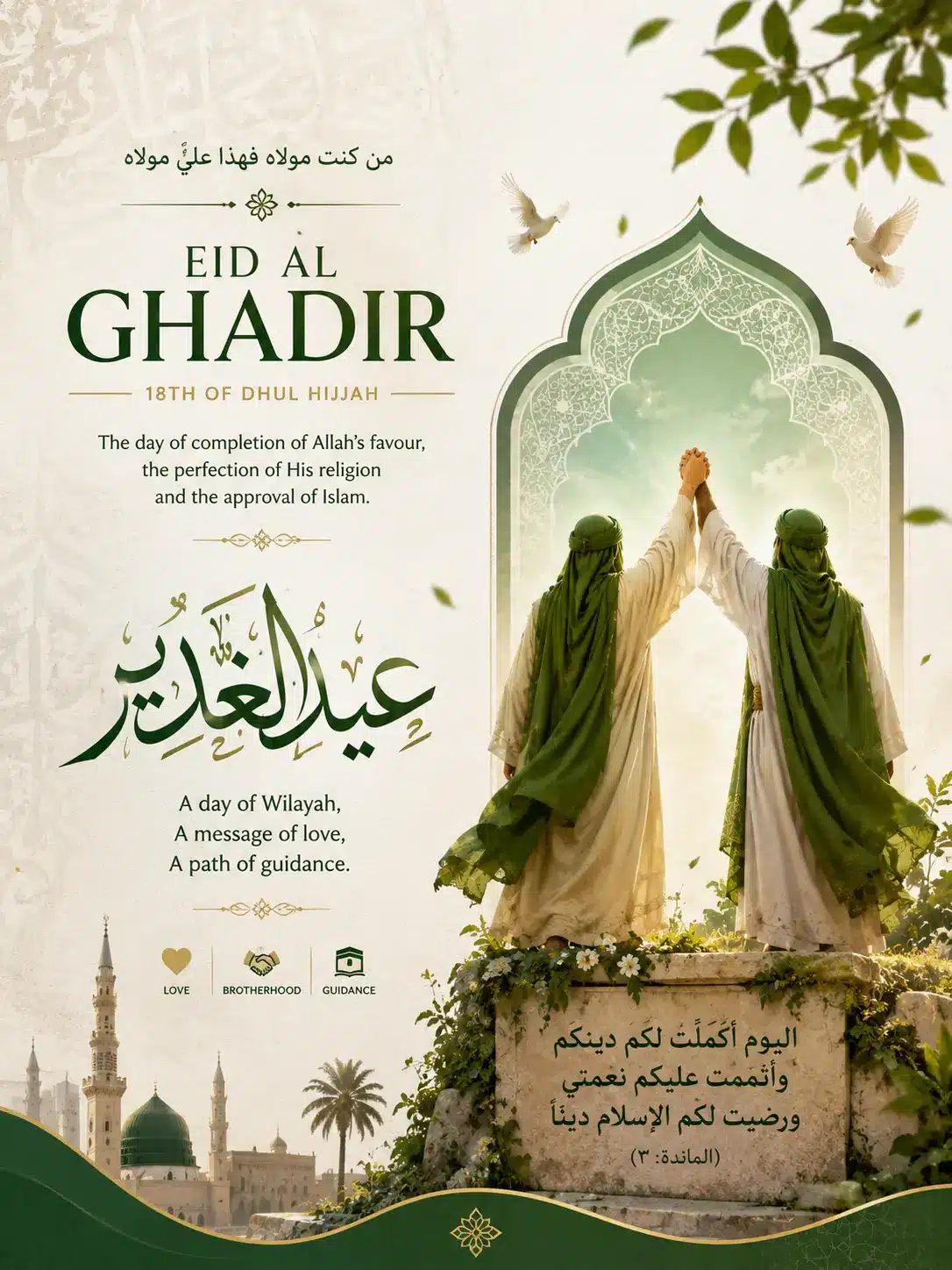
In the year 10 AH, on the Prophet's final pilgrimage (Hajj al-Wida), on his way back from Mecca to Medina, the Prophet stopped a massive caravan of over 100,000 pilgrims at a place called Ghadir Khum — the very event Shia Muslims commemorate annually as Eid al-Ghadir. This was not a casual stop. Allah had just sent down a verse of unusual urgency:
"O Messenger, announce that which has been revealed to you from your Lord, and if you do not, then you have not conveyed His message. And Allah will protect you from the people." (Surah Al-Ma'idah 5:67)
The wording is intense, and in the extreme heat of that day the Prophet gathered the people, took Imam Ali by the hand, raised it, and declared:
"Man kuntu mawlahu fa hadha Aliyyun mawlahu" — "Whoever I am the master (mawla) of, this Ali is his master."
This event is not a Shia-only claim. It is recorded in major Sunni collections as well, including Musnad Ahmad ibn Hanbal, Sunan Ibn Majah, and Sunan al-Tirmidhi, which grades the narration as hasan. Sunni scholars may debate the meaning of the word "mawla," but they do not deny that the event happened, nor that the Prophet publicly elevated Ali's status in front of the entire Ummah on that day.
Ghadir Khum — At a Glance
- When: 10 AH, during the Prophet's final pilgrimage (Hajj al-Wida)
- Where: Ghadir Khum, on the road between Mecca and Medina
- Witnesses: A caravan of over 100,000 pilgrims
- The declaration: "Whoever I am the master (mawla) of, this Ali is his master"
- Recorded in: Musnad Ahmad ibn Hanbal, Sunan Ibn Majah, and Sunan al-Tirmidhi (graded hasan)
Shia scholars point to what happened immediately afterward as the clincher. According to numerous narrations preserved in Shia hadith literature — traced back to Imam Muhammad al-Baqir and recorded by scholars such as al-Kulayni and al-Tabarsi — the following verse was revealed right after this declaration:
"This day I have perfected for you your religion and completed My favor upon you and have approved for you Islam as religion." (Surah Al-Ma'idah 5:3)
It's worth being upfront here: connecting verse 5:67 and 5:3 specifically to the events at Ghadir Khum is the Shia reading of these verses, held as near-unanimous across Shia exegesis. Mainstream Sunni tafsir, including scholars like al-Tabari and al-Baydawi, generally connects the "perfection of religion" in 5:3 to the completion of the Hajj rites or the final removal of idolatry from the pilgrimage — not to Ghadir. Shia scholars find that explanation unconvincing given the timing and the intensity of 5:67's language, and argue the Ghadir connection fits the historical sequence far more naturally. But readers should know this is a point of real scholarly disagreement, not something both sides read the same way.
Why, Shia scholars ask, would the "completion of religion" be tied to this specific moment — mere days after Ghadir — unless the appointment of Ali as the spiritual and political heir was the final piece needed to complete the message of Islam?
The Story of Surah Bara'at: A Message Only "One Like the Prophet" Could Deliver
There is another episode that Shia scholars consider powerful evidence, and remarkably, it is preserved in Sunni hadith literature too — including Musnad Ahmad and Sunan al-Tirmidhi.
When the opening verses of Surah At-Tawbah (also called Surah Bara'at) were revealed, declaring a formal break of treaty with the pagans of Mecca, the Prophet initially sent Abu Bakr to deliver this proclamation to the pilgrims. Shortly after Abu Bakr set out, the Prophet received instruction — through the Angel Jibra'il — that this particular announcement could not be conveyed by just anyone. The instruction, preserved in these hadith collections, was essentially:
"No one should deliver this on my behalf except myself, or a man who is of me (minni)."
The Prophet then sent Ali to overtake Abu Bakr on the road, retrieve the verses, and personally deliver the proclamation to the people at Mina himself.
Think about what this tells us. This wasn't a matter of seniority, age, or who arrived first. Allah specifically intervened to say that certain divine messages carry a weight that only someone of the same spiritual rank and closeness as the Prophet himself could carry. And the man chosen for that task, by direct instruction relayed through revelation, was Ali ibn Abi Talib — not Abu Bakr, not Umar, not any of the senior companions who had already been dispatched.
If this standard applied to delivering a message, how much more would it apply to leading the Ummah after the Prophet was gone?
What Actually Happened at Saqifah
Now here is where the two systems diverge in real, documented history — not interpretation, but actual events recorded even in Sunni sources.
While the Prophet's body lay in his home, awaiting burial, and while Imam Ali and the Prophet's close family were occupied with the burial preparations, a group gathered at Saqifah Bani Sa'idah, a tribal meeting hall, to decide who would lead the Muslims. Discussions grew heated between the Ansar (the Medinan helpers) and the Muhajireen (the Meccan emigrants), each side arguing they had more right to leadership. Eventually, Abu Bakr was put forward, and Umar ibn al-Khattab gave him the pledge of allegiance, with others following.
What is remarkable is that Umar himself, years later, openly admitted the nature of this decision. In Sahih al-Bukhari (Hadith 6830), delivering a khutbah (sermon) near the end of his life, Umar says plainly that the pledge of allegiance to Abu Bakr was a falta — a sudden, unplanned affair — though he adds that Allah spared the Muslims from any harm that could have come of it. In that same sermon, Umar goes further and lays down a warning for the future: that whoever gives, or receives, a pledge of allegiance without first consulting the wider body of Muslims — exactly the pattern of what happened at Saqifah — puts both parties at risk of being killed, precisely because a leadership decision made in secret, without consultation, is too dangerous to allow again.
Read that again. The second Caliph himself, describing the very event that established the Caliphate, called it a rushed, unplanned affair, and used it as the example of the kind of unconsulted decision-making he was now warning the Ummah never to repeat. This is not a Shia narration twisted for polemics. It is preserved in the most trusted Sunni hadith collection in existence.
Compare this to Ghadir Khum: a public event, announced through direct revelation, in front of over a hundred thousand witnesses, months before the Prophet's death, with Allah explicitly warning the Prophet that failing to deliver this message would mean failing his entire mission. One process was open, deliberate, and divinely commanded. The other was improvised in a tent, under pressure, in the space of hours.
✖ Khilafat — Human Selection
- Decided through tribal consultation and allegiance (bay'ah)
- Established at Saqifah while the Prophet's body awaited burial
- Later admitted by Caliph Umar himself to be a "falta" — a rushed, unplanned affair (Sahih al-Bukhari)
- No divine announcement or Qur'anic verse tied to its establishment
- Open to error, since no covenant of infallibility applies to it
✔ Imamat — Divine Appointment
- Announced publicly at Ghadir Khum before 100,000+ witnesses, by direct instruction from Allah
- Bound by a Qur'anic covenant that "does not include the wrongdoers" (2:124)
- Confirmed through the unique mission entrusted to Imam Ali during Surah Bara'at
- Follows the same model as Prophethood — appointed by Allah, not elected by the people
- Understood by Shia Muslims as free from error, safeguarding the Qur'an and din without corruption
Why Imamat Makes More Intellectual Sense
Step back and think about this logically, the way the Qur'an itself invites us to reflect (afala ta'qilun — "will you not use reason?").
Prophethood was never left to a vote. No community ever gathered to elect Musa, Isa, or Muhammad (peace be upon them all) as a Prophet. Prophethood was always a direct divine appointment, because only Allah knows who possesses the purity, knowledge, and infallibility required to convey and safeguard His message without corruption.
Now ask: after the Prophet passed away, did the Ummah suddenly stop needing protected, error-free guidance? Did the Qur'an stop needing an authoritative interpreter? Did the risk of political and doctrinal corruption disappear the moment the Prophet closed his eyes?
Shia theology answers: no. The need for a divinely protected guide (Imam) did not end with Prophethood — only the revelation of new scripture ended. Guidance itself had to continue, and reason tells us that guidance of this magnitude cannot be safely entrusted to a system of majority opinion, tribal negotiation, or seniority — the very system that produced the "hasty affair" at Saqifah.
This is precisely why the Qur'an tied Imamat to a covenant that "does not include the wrongdoers." A position of this weight has to be free from even the possibility of error or injustice — something no election, however well-intentioned, can guarantee.
The Qur'anic Covenant
Ibrahim's Imamat in Surah Al-Baqarah 2:124, and Allah's condition that the covenant "does not include the wrongdoers."
Ghadir Khum
A public declaration before 100,000+ pilgrims, recorded even in Sunni hadith collections such as Musnad Ahmad.
Surah Bara'at
Only "a man who is of me" could deliver this proclamation — and that man was Ali, not Abu Bakr.
Saqifah, By Umar's Own Words
Sahih al-Bukhari records Umar's own admission that the pledge to Abu Bakr was a rushed "falta."
In a Nutshell
Khilafat and Imamat may sound like two words for the same thing, but they represent two entirely different philosophies of leadership. One is a human institution, built through consultation and, as history and Sahih al-Bukhari itself record, sometimes through hurried improvisation. The other is a divine institution, announced publicly at Ghadir Khum, reinforced through the unique mission entrusted to Ali during the proclamation of Surah Bara'at, and rooted in the Qur'anic principle that true leadership must be untouched by wrongdoing.
For Shia Muslims, recognizing Imam Ali and the eleven Imams from his progeny — together honored as the Fourteen Masumeen (A.S.) — as the rightful, divinely appointed successors to the Prophet is not a rejection of history — it is the history, read through the lens of the Qur'an and hadith preserved even within Sunni tradition itself.
It's worth noting that Sunni scholarship offers its own detailed responses to these same events — interpreting "mawla" at Ghadir as meaning friend or ally rather than a claim to political succession, and viewing Saqifah as a legitimate, Qur'anically-sanctioned process of shura (consultation). This article presents the Shia position and the evidence its scholars rely upon; readers are encouraged to explore both perspectives and the centuries of scholarly discussion around them.
Understanding the true nature of Imamat is part of the foundation ShiaEdu builds with every student. Families studying with us from the United Kingdom and the United States learn these same foundations of Shia belief from day one.
So do families joining us from Canada and Australia, wherever they call home.
The same is true for students learning with us from Saudi Arabia.
If you're exploring why choosing a reliable Shia Quran academy matters, or simply asking what a Shia Quran academy online actually looks like, ShiaEdu's courses and blog are a good place to start.
Frequently Asked Questions
What is the difference between Imamat and Khilafat?
Khilafat refers to a leadership chosen through human consultation and allegiance (bay'ah), as happened at Saqifah after the Prophet's death. Imamat, in the Shia understanding, is a divine appointment — the same way Prophethood is divine — given directly by Allah to a leader protected from error and injustice, so the Qur'an and the din can be preserved without corruption.
What happened at Ghadir Khum?
In 10 AH, during his final pilgrimage, the Prophet stopped a caravan of over 100,000 pilgrims at Ghadir Khum and declared, "Whoever I am the master (mawla) of, this Ali is his master." The event is recorded in Sunni hadith collections including Musnad Ahmad, Sunan Ibn Majah, and Sunan al-Tirmidhi, though scholars differ on how to interpret the word "mawla."
Do Sunni sources acknowledge the events described in this article?
Yes. The declaration at Ghadir Khum and the sending of Imam Ali to deliver Surah Bara'at are both recorded in major Sunni hadith collections. Caliph Umar's own description of the pledge to Abu Bakr as a falta, or hasty affair, is preserved in Sahih al-Bukhari itself. Sunni scholarship interprets these same events differently — for example, reading "mawla" as friendship rather than political succession.
Why do Shia Muslims believe Imam Ali (A.S.) was the rightful successor to the Prophet?
Shia Muslims point to the Qur'anic covenant of Imamat given to Ibrahim (A.S.) in Surah Al-Baqarah 2:124, the public declaration at Ghadir Khum, and the unique mission entrusted to Ali during the proclamation of Surah Bara'at as evidence that his succession was divinely appointed rather than decided by the community.