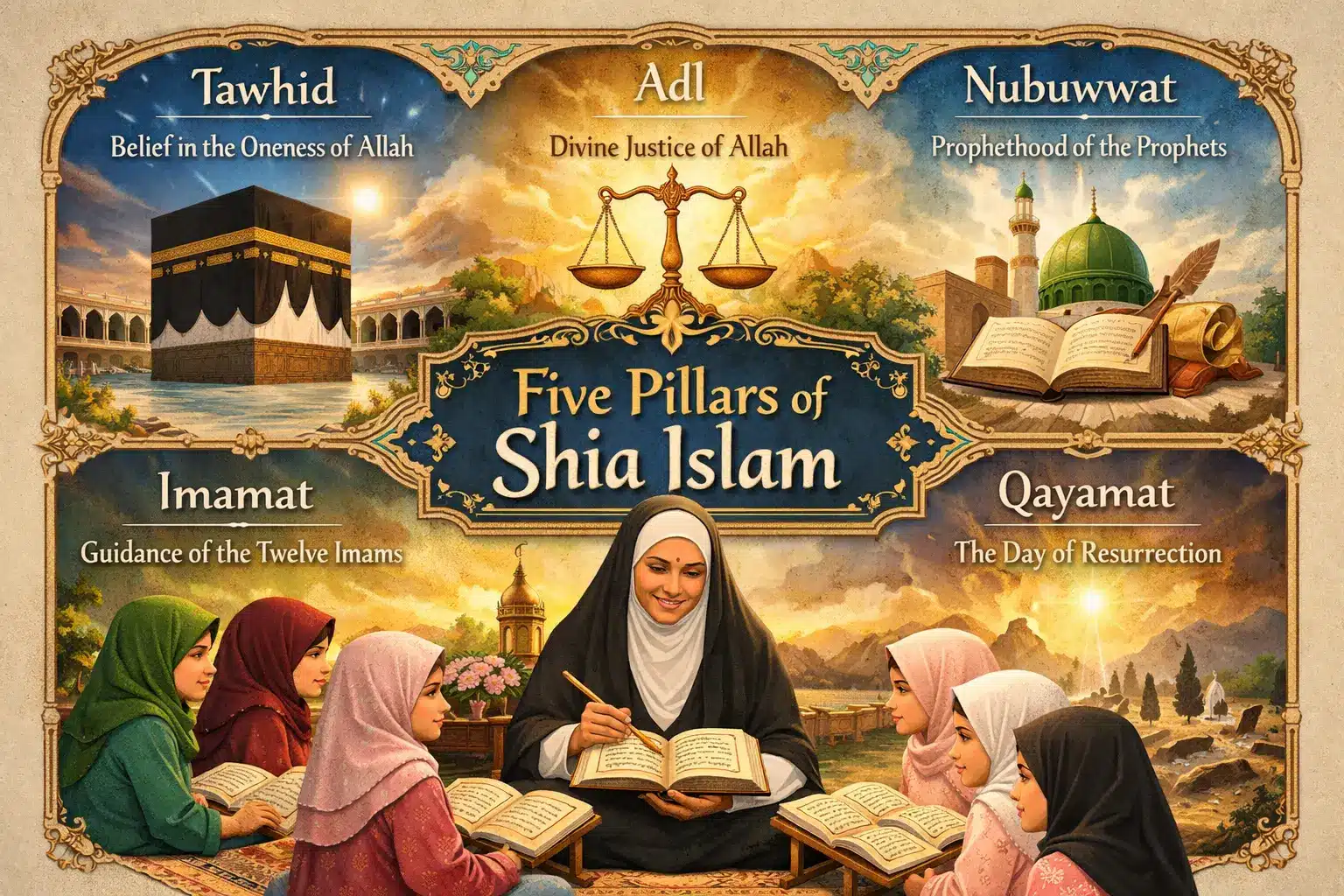
The foundation of Shia Islamic belief rests upon five core principles known as Usul e Deen — the Principles of Religion. These are not merely academic doctrines; they are the living convictions that shape the spiritual identity, worship, and daily conduct of every Shia Muslim.
📋 The Five Pillars at a Glance
Before exploring each principle in detail, here is a clear summary of the five pillars that form the doctrinal foundation of Shia Islam as taught at ShiaEdu:
| # | Pillar | Meaning |
|---|---|---|
| 1 | Tawhid | The absolute Oneness of Allah — the sole Creator and Sustainer of all existence. |
| 2 | Adalat | Divine Justice — Allah is perfectly just and never oppresses any soul. |
| 3 | Nabuwat | Prophethood — Allah sent Prophets to guide mankind, ending with Prophet Muhammad (PBUH). |
| 4 | Imamat | The divinely appointed leadership of Twelve Imams (AS) from the Ahlulbayt after the Prophet. |
| 5 | Qayamat | The Day of Judgment — every soul will be resurrected and held accountable for its deeds. |
— Surah Al-Baqarah 2:177
☝️ 1. Tawhid – The Oneness of Allah
Tawhid is the very heart of Islam — the absolute declaration that Allah alone is God. He is unique, eternal, and incomparable. Nothing in creation resembles Him and worship is due to Him alone. This is not merely the first principle of Shia Islam; it is the foundation upon which all other beliefs are built.
Tawhid means that Allah has no partners, no equals, and no rivals. He is the sole Creator, Sustainer, and Sovereign of all that exists. Every act of worship — prayer, fasting, giving in charity — derives its meaning and validity from this foundational conviction.
The Holy Prophet Muhammad (PBUH) said: "The best statement that I and the prophets before me have said is: There is no god except Allah."
Tawhid is the heart of Islam and the foundation of every act of worship. To deepen your child's understanding of this and other core beliefs, explore our structured Shia Aqaid (Beliefs) course — taught live by qualified Shia scholars.
⚖️ 2. Adalat – Divine Justice
The belief in Adalat — Divine Justice — is one of the defining features that distinguishes Shia Islamic theology. Shia Muslims believe that Allah is perfectly and absolutely just in all His actions and decrees. He does not oppress any soul, does not compel anyone towards sin, and does not punish anyone unjustly.
This principle carries profound implications for how Shia Muslims understand human free will, moral responsibility, and accountability. Because Allah is just, human beings are genuinely free to choose between right and wrong — and will be held accountable accordingly on the Day of Judgment.
"Allah is too Just to oppress His servant and then punish him."
The belief in Divine Justice teaches Muslims responsibility, accountability, and deep trust in Allah's infinite wisdom. It is the basis of ethical living in Islam.
💚 3. Nabuwat – Prophethood
Nabuwat refers to the belief that Allah, in His infinite mercy, did not leave humanity without guidance. From the very beginning of human existence, He sent Prophets — from Prophet Adam (AS) to the final Prophet Muhammad (PBUH) — each carrying the same essential message of Tawhid and righteous living.
Shia Muslims believe firmly that Prophet Muhammad (PBUH) is the last and final Prophet. There is no prophet after him. The chain of prophethood is sealed with him, and his teachings — preserved through the Holy Quran and the authentic traditions of the Ahlulbayt (AS) — remain the definitive guidance for all humanity until the Day of Judgment.
— Surah Al-Ahzab 33:40
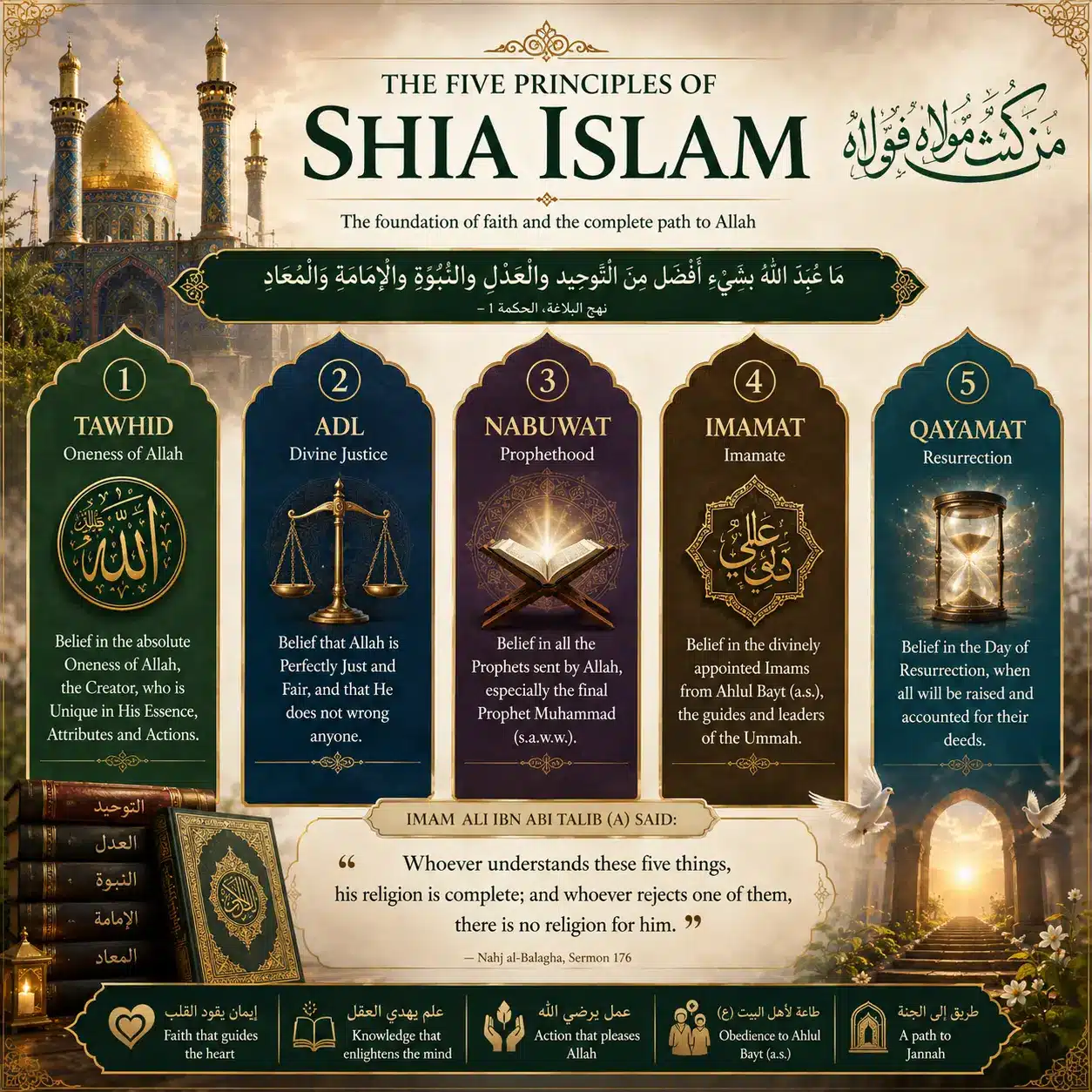
The Five Pillars of Shia Islam (Usul e Deen) — Tawhid, Adalat, Nabuwat, Imamat and Qayamat
🌿 4. Imamat – Leadership After the Prophet
Imamat is perhaps the most distinctive doctrine of Shia Islam and the one that most clearly differentiates it from other schools of Islamic thought. Shia Muslims believe that divine guidance did not end with the passing of Prophet Muhammad (PBUH). Rather, Allah appointed twelve Imams from the Prophet's own blessed lineage — beginning with Imam Ali ibn Abi Talib (AS) — to continue guiding the Muslim community with knowledge, justice, and piety.
These Twelve Imams are not self-appointed leaders; they are divinely designated guides chosen by Allah and announced by the Prophet himself. The most celebrated declaration of this appointment came at Ghadir Khumm, where the Holy Prophet (PBUH) proclaimed before thousands of companions:
"For whatever master I am, Ali is his master."
The Imams preserved the pure teachings of Islam, interpreted the Holy Quran, and guided believers through the challenges of their times with knowledge, justice, and divine wisdom.
💡 Did you know? Our Ziyarat & Ahlulbayt Studies course at ShiaEdu is specifically designed to teach students the history, teachings, and significance of the Twelve Imams (AS) through live one-on-one sessions with qualified Shia scholars.
🌅 5. Qayamat – The Day of Judgment
Qayamat — the Day of Judgment, Resurrection, and final accountability — is the fifth and final pillar of Usul e Deen. Shia Muslims believe that this earthly life is not the end. Every human soul will be resurrected, and every deed — however small — will be weighed and presented before Allah Almighty.
This belief is not one of fear alone. It is a belief that gives life profound meaning. Every act of kindness, every prayer offered in sincerity, every moment of patience in difficulty — all of it matters. Nothing is lost before Allah.
— Surah Al-Zalzalah 99:7–8
The belief in Qayamat encourages Muslims to live with intention, integrity, and compassion — knowing that every action leaves a trace that will one day be witnessed in full clarity.
🎓 Learn Shia Islamic Beliefs with ShiaEdu
Understanding Usul e Deen is not merely an intellectual exercise — it is the beginning of a lifelong journey of faith. At ShiaEdu – Shia Online Quran Academy, we offer structured, authentic Shia Islamic education for children and adults across the UK, USA, Canada, Australia, and worldwide.
What you can start today at ShiaEdu:
Learn Shia beliefs and Islamic principles in live one-on-one sessions with qualified Shia scholars. Whether you are a complete beginner or looking to deepen existing knowledge, our tutors tailor every lesson to your level and pace.
🤰 Conclusion
The five principles of Usul e Deen — Tawhid, Adalat, Nabuwat, Imamat, and Qayamat — are the spiritual and intellectual backbone of Shia Islam. They are not separate beliefs but a deeply connected framework: a belief in the One God who is Just, who sent Prophets and Imams to guide humanity, and who will bring every soul to account on the Day of Judgment.
These principles lead Muslims towards sincere worship of Allah, devoted adherence to the Holy Prophet Muhammad (PBUH), and a living connection with the teachings of the Ahlulbayt (AS) — a connection that ShiaEdu strives to nurture in every student through authentic, expert-led education.
For further authentic reading on these principles, the resources at Al-Islam.org and IMAM-US.org are highly recommended.
❓ Frequently Asked Questions
The five pillars of Shia Islam, known as Usul e Deen (Principles of Religion), are: Tawhid (Oneness of Allah), Adalat (Divine Justice), Nabuwat (Prophethood), Imamat (Leadership of the Twelve Imams), and Qayamat (Day of Judgment). These are the core doctrinal beliefs every Shia Muslim holds.
Usul e Deen means the Principles of Religion. These are the five foundational beliefs that form the intellectual and spiritual basis of Shia Islamic faith, grounded in the Holy Quran and the authentic teachings of Prophet Muhammad (PBUH) and Imam Ja'far al-Sadiq (AS).
Imamat is the belief that after the Prophet Muhammad (PBUH), Allah appointed Twelve Imams from his lineage — beginning with Imam Ali (AS) — to lead and guide the Muslim community with divine authority. This is a defining doctrine of Shia Islam and sets it apart from other Islamic schools of thought.
ShiaEdu offers a dedicated Shia Aqaid (Islamic Beliefs) course for children and adults worldwide. All classes are live, one-on-one, taught by qualified Shia scholars, and the first class is completely free. You can apply for admissions here.