
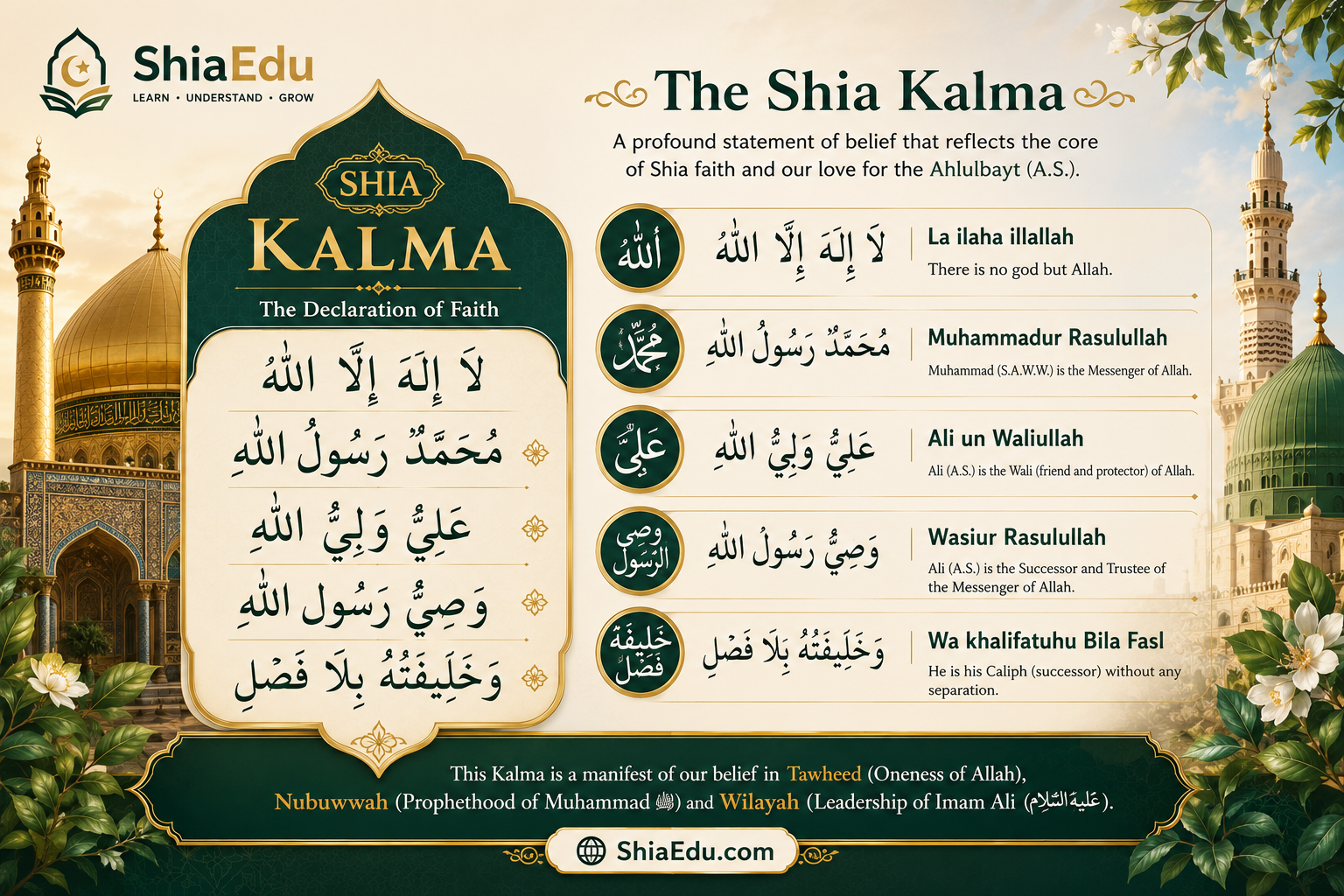
What Is the Shia Kalma?
The Kalma — the declaration of faith — is the foundation upon which a Muslim's entire spiritual identity rests. For Shia Muslims, the Kalma carries a third testimony that is not born of tradition alone, but rooted directly in divine revelation:
"There is no god but Allah. Muhammad is the Messenger of Allah. Ali is the Wali of Allah, the successor of the Messenger of Allah and his Caliph without interruption."
"اللہ کے سوا کوئی معبود نہیں۔ محمد اللہ کے رسول ہیں۔ علی اللہ کے ولی ہیں، رسول اللہ کے وصی اور بلا فاصلہ ان کے خلیفہ ہیں۔"
The first two parts — Tawheed and the Prophethood of Muhammad (S.A.W.) — are shared with all Muslims. The third part, the Wilayah of Imam Ali ibn Abi Talib (A.S.), is what distinguishes the Shia declaration of faith. It is not an addition born of sentiment or innovation. It is a position grounded directly in the Quran.
For those studying Shia Aqaid and Islamic beliefs in depth, understanding the Kalma is the natural starting point — because every pillar of Shia theology, from Usul e Deen to Imamate, flows from this declaration.
Understanding Wilayah: More Than Leadership
The Arabic word Wali is often translated simply as "friend" or "guardian," but its theological weight is far greater. In classical Arabic and Quranic usage, Wilayah denotes divinely sanctioned authority — the right to lead, to guide, and to represent the truth of the deen after the Prophet (S.A.W.).
When Shia Muslims declare Imam Ali (A.S.) as Waliyyullah, they are affirming that his authority was not a matter of political consensus. It was ordained by Allah (S.W.T.) Himself and announced by the Prophet (S.A.W.) on divine command.
The clearest Quranic evidence for this is found in three consecutive verses of Surah Al-Maidah — a chapter revealed in the final stages of the Prophet's mission, when foundational matters of the deen were being sealed.
Surah Al-Maidah, Ayat 55 — The Verse of Wilayah
This ayat is known among Shia scholars and many Sunni commentators alike as the Verse of Wilayah — Ayat al-Wilayah:
"Your Wali is only Allah, His Messenger, and those who believe — those who establish prayer and give Zakat while bowing (in ruku)."
"بے شک تمہارے ولی صرف اللہ ہیں، اس کے رسول ہیں، اور وہ مومنین ہیں جو نماز قائم کرتے ہیں اور حالتِ رکوع میں زکوٰۃ ادا کرتے ہیں۔"
Classical commentators across both Shia and several Sunni traditions — including Zamakhshari in Al-Kashshaf, Ibn Kathir, and Al-Wahidi in Asbab al-Nuzul — record the occasion of revelation (Sha'n al-Nuzul) of this ayat. Imam Ali (A.S.) was in a state of ruku during prayer when a beggar entered the mosque. Without breaking his prayer, he extended his hand and gave his ring in charity. This ayat was revealed in direct response to that singular, luminous act.
The use of the plural alladhina ("those who") in the ayat is a well-established feature of Arabic rhetoric — using plural address to honour a specific individual. The context, the occasion of revelation, and the consensus of early commentators all identify this verse as referring specifically and exclusively to Imam Ali (A.S.).
Surah Al-Maidah, Ayat 67 — The Command to Announce
Before the event of Ghadir Khumm, Allah (S.W.T.) commanded His Prophet directly with a verse of unmistakable urgency:
"O Messenger! Convey what has been revealed to you from your Lord. If you do not, you will have not conveyed His message at all. And Allah will protect you from the people."
"اے رسول! جو کچھ آپ کے رب کی طرف سے آپ پر نازل کیا گیا ہے وہ پہنچا دیجیے۔ اگر آپ نے ایسا نہ کیا تو گویا آپ نے اللہ کا پیغام ہی نہیں پہنچایا۔ اور اللہ آپ کو لوگوں سے محفوظ رکھے گا۔"
This ayat was revealed on the journey back from the Farewell Pilgrimage. The gravity of the divine command is unmistakable — the phrase "wa in lam taf'al" (if you do not) signals that what was to be announced was of such fundamental importance that leaving it unsaid would have rendered the entire mission of prophethood incomplete. Shortly after this revelation, the Prophet (S.A.W.) stopped the entire caravan at Ghadir Khumm and made his historic declaration regarding Imam Ali (A.S.).
Surah Al-Maidah, Ayat 3 — The Completion of Religion
Immediately following the announcement at Ghadir Khumm, this ayat descended — and its timing is among the most theologically significant moments recorded in Islamic history:
"Today I have perfected your religion for you, completed My favour upon you, and have chosen Islam as your religion."
"آج میں نے تمہارے لیے تمہارا دین مکمل کر دیا اور تم پر اپنی نعمت پوری کر دی اور تمہارے لیے اسلام کو بطورِ دین پسند فرمایا۔"
This ayat descended on the 18th of Dhul-Hijjah at Ghadir Khumm, moments after the Prophet (S.A.W.) raised the hand of Imam Ali (A.S.) and declared before over one hundred thousand witnesses:
The sequence is theologically decisive. The religion was declared complete only after the Wilayah of Imam Ali (A.S.) was publicly announced. This is not coincidence. It is confirmation — that the Imamate is not peripheral to Islam. It is the final pillar upon which the structure of the faith was sealed.
This is precisely why our Fiqh Jaffari online course begins with a grounding in Usul e Deen and Imamate — because no practice of the deen stands complete without first understanding its theological foundation.
Why the Shia Kalma Carries This Declaration
Including the Wilayah of Imam Ali (A.S.) in the Kalma is therefore not innovation. It is acknowledgement — of what Allah revealed in Surah Al-Maidah, of what the Prophet (S.A.W.) announced at Ghadir Khumm, and of what was confirmed the moment Allah declared the religion complete.
For Shia Muslims, faith in the Imamate is inseparable from faith in the message itself. The Prophet (S.A.W.) did not leave his Ummah without a divinely appointed guide. He left them Imam Ali (A.S.) — by the command of Allah, declared before the entire Ummah, and preserved forever in the words of the Quran.
The Shia Kalma is, in its deepest essence, a believer saying: I accept what Allah revealed — completely, without exception, and without omission.
If you want your children to grow up with this understanding rooted in their hearts from an early age, explore our dedicated Shia Quran tutors for kids programme, where Quranic learning is paired with Shia Islamic belief from the very first lesson.
Frequently Asked Questions
The Shia Kalma is the Shia Muslim declaration of faith. It states: "There is no god but Allah. Muhammad is the Messenger of Allah. Ali is the Wali of Allah, the successor of the Messenger of Allah and his Caliph without interruption." The third part — the Wilayah of Imam Ali (A.S.) — distinguishes it from the standard declaration and is grounded in Quranic evidence from Surah Al-Maidah.
Imam Ali (A.S.) is included because his Wilayah — divinely sanctioned authority — was established by Allah in Surah Al-Maidah (5:55) and publicly announced by the Prophet (S.A.W.) at Ghadir Khumm on divine command. Including his Wilayah in the Kalma is therefore not innovation but acknowledgement of what Allah revealed.
The primary Quranic proof is Surah Al-Maidah 5:55 — the Verse of Wilayah — revealed when Imam Ali (A.S.) gave his ring in charity during ruku. Supporting verses include Surah Al-Maidah 5:67 (the command to announce) and 5:3 (the completion of religion), both linked to the event of Ghadir Khumm.
At Ghadir Khumm, on the 18th of Dhul-Hijjah during the return from the Farewell Pilgrimage, the Prophet (S.A.W.) stopped a caravan of over one hundred thousand people, raised the hand of Imam Ali (A.S.), and declared: "Whoever I am his master, Ali is his master." Immediately after, Surah Al-Maidah 5:3 descended, declaring the religion complete.
In the Shia Kalma, Wilayah means divinely sanctioned authority — the right to lead, guide, and represent the truth of the deen after the Prophet (S.A.W.). It is not simply friendship or guardianship but a specific theological position ordained by Allah and confirmed through Quranic revelation. Visit our other articles about the holy Quran
Begin Your Shia Quranic Education Today
Enrol with certified Shia Quran teachers and study Aqaid, Tajweed, and Fiqh Jaffari online from the comfort of your home — for yourself or your children.
Apply for Admission Chat on WhatsApp