
For Shia families across the UK, one question keeps coming up when it's time to enroll a child in Quran education: should you go with online vs local Quran classes in the UK, or stick with the traditional route of driving to a nearby madrassa? It's not a trivial decision. The choice affects how consistently your child learns, how much individual attention they get, and ultimately how strong their foundation in tajweed, recitation, and Shia beliefs turns out to be.
There isn't a single "correct" answer for every family, but once you look closely at how each option actually works in practice, one tends to come out ahead for most modern UK households — particularly Shia families who need a Shia Quran academy UK they can trust to teach correctly and consistently, such as Shia teachers across UK cities.
What Local Quran Classes Typically Look Like
Local classes — usually run through a mosque or community madrassa — have been the default option for generations, and for good reason. There's real value in physical community presence, and many families appreciate the social side of children learning alongside peers they know from the mosque.
That said, the traditional model comes with some real limitations in a UK context:
- Limited Shia-specific options — many towns and even some cities have no dedicated Shia madrassa nearby, forcing families into long drives or classes that aren't tailored to Shia beliefs at all
- Large class sizes — one teacher often manages ten, fifteen, or more children at different levels simultaneously, which makes individual correction difficult
- Fixed, rigid schedules — usually one set time slot per week, with little flexibility if a child is sick, has homework, or a family event comes up
- Commute time — for families outside major cities, getting to and from a physical class can eat up an hour or more each week, on top of the lesson itself
- Inconsistent teacher training — many local classes rely on community volunteers rather than teachers formally trained in tajweed or Shia fiqh specifically
What Online Quran Classes Typically Look Like
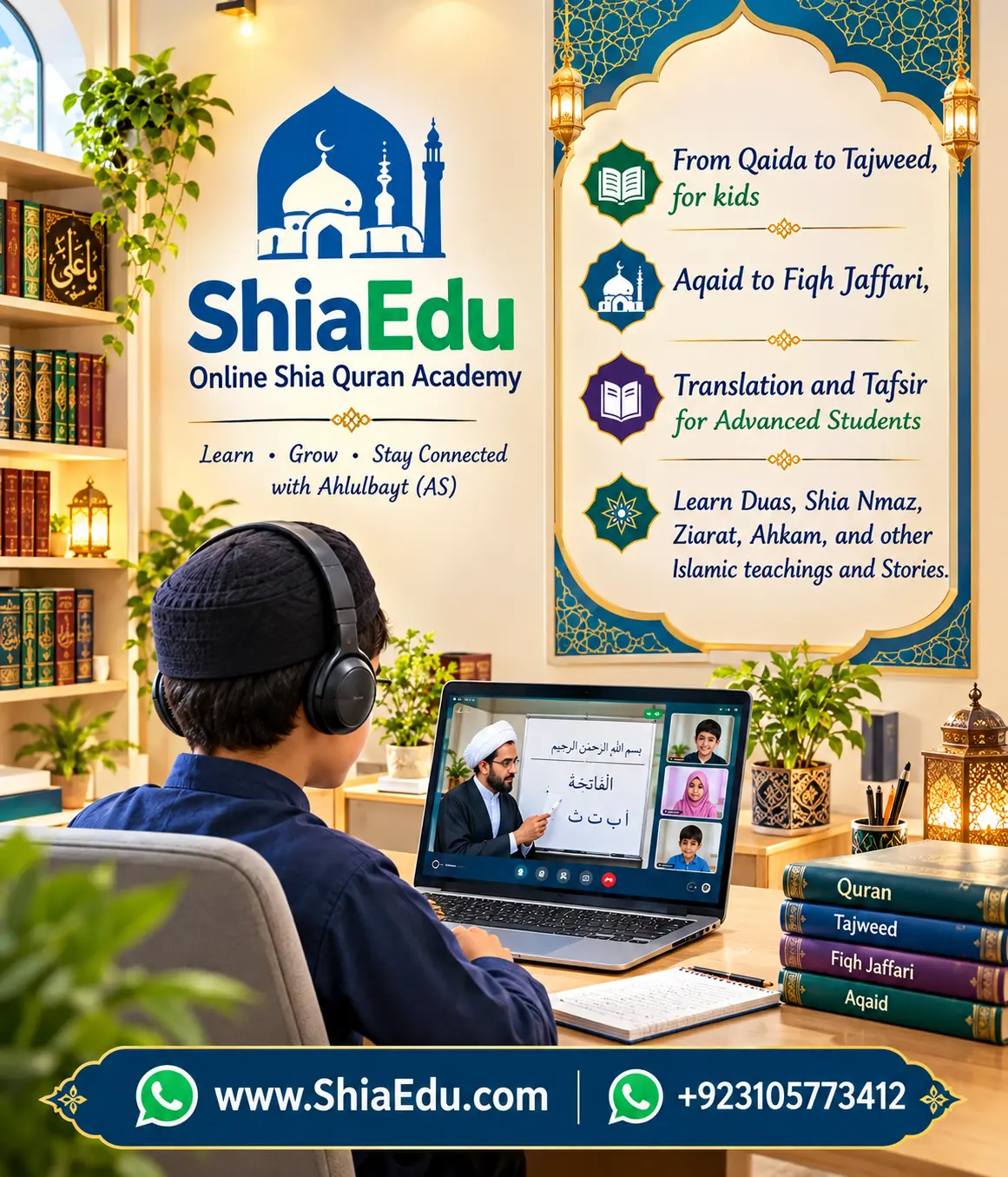
Online classes, delivered through a dedicated Shia Quran academy UK families can access from anywhere in the country, work quite differently — and were largely built to solve the exact problems listed above, often following the same structured path we cover in our Noorani Qaida guide.
- One to one classes — instead of splitting attention across a crowded room, a single teacher focuses entirely on one child's pace, mistakes, and progress
- Flexible scheduling — lessons can typically be booked in the evening, on weekends, or rescheduled when something comes up, rather than being locked into one fixed slot
- No commute — lessons happen from home, saving the time and hassle of driving across town
- Access regardless of location — a family in a small town with no Shia community nearby can still connect with a properly trained teacher
- Structured, trackable curriculum — reputable academies follow a clear progression from Noorani Qaida through tajweed, translation, and Shia studies, with parents able to see what's being covered
Online versus local — the two paths UK Shia families weigh most often.
Comparing the Two on What Actually Matters
Quality of Teaching and Individual Attention
This is where the gap is usually widest. In a local class with a dozen or more children, a teacher simply cannot listen closely to every child's recitation every week. Mistakes in pronunciation or tajweed can go uncorrected for months. With one to one classes online, a teacher hears every word a child recites and can correct errors immediately — which matters enormously in a subject like tajweed, covered in full in our complete Tajweed guide, where small mistakes become deeply ingrained habits if left unaddressed.
Access to Shia-Specific Teachers
For Shia families, this consideration often settles the debate on its own. A general Quran teacher — even a well-meaning one — may not be trained in Shia jurisprudence, Shia aqaid, or the correct approach to teaching Shia namaz and daily duas. An online Shia Quran academy UK families choose specifically for this reason gives access to teachers trained in fiqh Jaffari and Shia beliefs, including Shia teachers in London, regardless of whether a local Shia mosque exists nearby at all.
Flexibility Around Real Family Life
UK school schedules, extracurricular activities, and general weekday exhaustion make rigid class times harder to sustain than they used to be. Online classes tend to survive busy weeks better than local ones, simply because a missed Tuesday evening slot can usually be rescheduled rather than skipped entirely — and consistency, more than any single lesson, is what actually builds strong recitation and understanding over time.
The Value of Physical Community
This is genuinely where local classes still hold an edge. Being physically present at the mosque, socializing with other Shia children, and participating in in-person events like Muharram gatherings offers something online classes can't fully replicate. This is one reason many families don't see this as an either-or decision at all.
Why Many UK Families Choose Both
Rather than treating this as a strict choice, a growing number of Shia families in the UK combine both approaches — using online Quran classes for the core academic learning (tajweed, translation, Quran teachers trained specifically in Shia content) while still attending the local mosque for community events, Muharram programs, and the social side of religious life. This hybrid approach tends to deliver the best of both worlds: strong, individually tailored academic progress alongside genuine community belonging, a pattern seen just as often among Shia Quran teachers in Canada and other parts of the diaspora.
Which Option Is Actually Better for Most UK Shia Families?
For families prioritizing quality of instruction, correct tajweed, and access to teachers genuinely trained in Shia beliefs and Shia namaz, online classes through a dedicated Shia Quran academy UK families can rely on — such as ShiaEdu — tend to outperform the traditional local model, particularly given how spread out the UK's Shia community is outside major cities.
The same gap between local availability and correctly trained instruction shows up well beyond the UK too — from Shia Quran classes in Oman to smaller Shia communities elsewhere, families face the same tradeoffs and reach the same conclusion.
The same pattern holds for Shia Quran classes in the UAE as well. Local classes still hold real value for community connection, but as a primary source of academic Quran education, one to one online classes generally offer more consistency, better individual attention, and far greater flexibility for how modern families actually live.
Frequently Asked Questions
Are online Quran classes as effective as local madrassa classes?
For core skills like tajweed, recitation accuracy, and individual progress, online one to one classes are often more effective than crowded local classes, simply because of the focused attention a single teacher can give.
Can online classes teach Shia namaz properly?
Yes — a qualified Shia Quran academy UK families trust will teach namaz step by step, including correct movements and recitations, the same way it would be taught in person.
Is it better to choose local classes if my child is very young?
Younger children often benefit even more from one to one online attention, since a private teacher can adjust pacing and repetition specifically to a young child's needs, something harder to achieve in a group setting.
Do online Shia Quran teachers in the UK follow a proper curriculum?
Reputable academies follow a structured path from Noorani Qaida through tajweed, translation, and Shia studies, with clear progress tracking parents can see.
Should we drop local mosque classes completely if we switch to online?
Not necessarily — many families keep both, using online classes for academic learning and local mosque involvement for community events and social connection.