
Almost every parent who enrolls their child in Quran classes hears the same two terms early on: Noorani Qaida and tajweed. But few providers actually explain what these stages involve, how long they take, or why the order matters so much. For UK families investing time and effort into their child's Quran education, understanding this learning path properly makes a real difference — both in choosing the right teacher and in knowing what progress should actually look like.
This guide breaks down the full journey from first letter to fluent, correct recitation, and explains why this particular path — Qaida first, tajweed second — has stood the test of time for a reason.
What Noorani Qaida Actually Is
Noorani Qaida is the starting point for almost every child learning to read the Quran. It's a foundational book that teaches the Arabic alphabet, how each letter sounds on its own, how letters change shape depending on their position in a word, and how to combine letters into simple words and short phrases — all before a child ever opens the Quran itself.
Think of it as the equivalent of phonics before reading a full book. Skipping it, or rushing through it, tends to create problems that surface much later, when a child is reciting full verses but mispronouncing sounds they never properly learned in the first place.
A typical Qaida course covers:
- Individual Arabic letters and their correct pronunciation (makharij)
- How letters connect and change form within words
- Short vowel marks (zabar, zair, pesh) and how they alter sound
- Basic joining rules for reading simple word combinations
- An introduction to elongation signs and stopping rules, laying early groundwork for tajweed
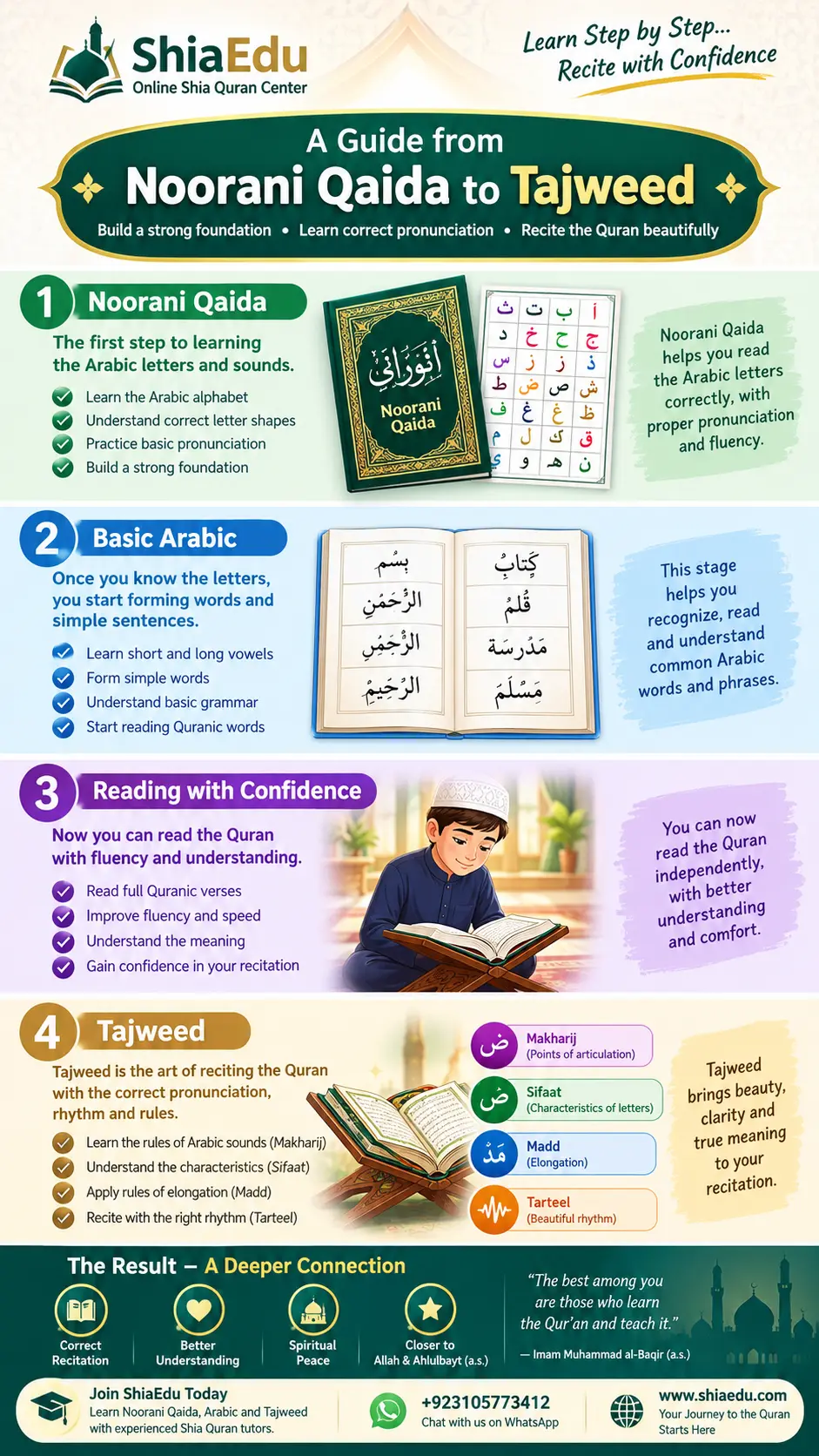
The learning path from first Arabic letter to fluent tajweed recitation.
For most children in the UK, starting Qaida between ages 4 and 6 works well, though older beginners — including adults — go through the exact same process, just often at a faster pace.
Why Rushing This Stage Backfires
It's tempting, especially for eager parents, to want a child moving through Qaida quickly so they can "get to the real Quran." But recitation habits formed here tend to stick. A child who mispronounces a letter consistently during Qaida will likely carry that same mistake into full Quran reading, and unlearning an ingrained habit is far harder than learning it correctly the first time.
This is exactly why one-on-one attention matters so much at this stage. In a group class with a dozen children, a teacher simply can't catch every individual mispronunciation in real time. Experienced Online Quran Teachers UK families rely on allow private lessons where a teacher can listen closely, correct immediately, and make sure the foundation is genuinely solid before moving forward.
The Transition Into Tajweed
Once a child can read Qaida fluently and has started reading directly from the Quran, the focus shifts to tajweed — the detailed set of rules governing how the Quran should be recited correctly. Tajweed isn't a separate subject bolted onto reading; it's really the refinement of everything Qaida introduced, applied now to full verses.
Tajweed covers areas such as:
- Makharij al-huroof — the precise articulation points for each letter in the mouth and throat
- Ghunnah — proper nasal sounds on certain letters
- Madd — rules for elongating vowel sounds, and by how many counts
- Idgham, Ikhfa, and Iqlab — rules governing how certain letters interact with noon sakinah and tanween
- Waqf — where and how to pause correctly within a verse without breaking its meaning
Learning tajweed properly changes not just how the Quran sounds, but how accurately its meaning is preserved. Certain elongations and pauses genuinely affect the sense of a verse, which is part of why tajweed is treated with such seriousness rather than being viewed as optional polish.
Benefits for Kids
For children, this Qaida-to-tajweed path builds far more than recitation skill. It develops disciplined listening, since much of learning tajweed correctly comes from hearing a sound repeated and mimicking it precisely. It strengthens memory and pattern recognition, skills that carry over into general reading and language learning. And for many kids, mastering tajweed builds a genuine sense of pride and confidence — being able to recite beautifully is something children notice and feel good about, often more than parents expect.
There's also an identity benefit that's easy to overlook. Reciting correctly connects a child more deeply to their faith and community, especially during gatherings, Ramadan, or family religious occasions where recitation is heard and valued, and it often lays the groundwork for later, deeper study of Shia Fiqh once a child is a little older.
Benefits for Adults
Adults are sometimes hesitant to start this same path, assuming it's "just for kids." In reality, many adults in the UK — some who grew up without formal Quran education, others who want to correct recitation habits picked up informally — go through the same Qaida-to-tajweed journey with real success. Adults often progress faster through Qaida due to stronger general literacy and pattern recognition, though tajweed still requires the same patient, repetitive practice regardless of age.
For adults, the benefits extend beyond recitation itself. Learning tajweed properly often reawakens a deeper personal connection to the Quran, and many adult students describe the process as unexpectedly calming — a structured, meditative practice fitted into an otherwise busy week.
How Long the Full Path Typically Takes
There's no fixed timeline, since pace depends heavily on age, consistency, and prior exposure to Arabic. As a general guide, young children starting from scratch often complete Qaida within six months to a year of regular lessons, then spend one to two years building solid tajweed fluency. Adults with no prior background follow a similar range, though highly motivated adult learners sometimes move through Qaida noticeably faster.
Consistency matters more than intensity here. Two or three shorter sessions a week, practiced regularly, tend to produce better long-term results than one long weekly class followed by six days of no practice at all — a scheduling rhythm we break down in more detail in our guide to how Kids Quran Classes UK families follow actually run week to week.
Choosing the Right Path for Your Family
For UK families weighing their options, the key is finding a teacher or academy — among the Online Quran Teachers UK families already trust — that treats Qaida and tajweed as a connected, structured progression, not two unrelated boxes to tick. Ask how mistakes are corrected, how progress is tracked, and whether the same teacher stays with the child through both stages, since that continuity often makes a noticeable difference in how quickly a child's recitation genuinely improves.
Frequently Asked Questions
Can a child skip Noorani Qaida and go straight to reading the Quran?
It's not recommended. Qaida builds the pronunciation and letter-recognition foundation that makes accurate Quran reading possible; skipping it usually leads to mistakes that are harder to correct later.
How long does it take to finish Noorani Qaida?
Most children complete it within six months to a year with consistent lessons, though pace varies based on age and how regularly the child practices.
Is tajweed necessary, or is basic reading enough?
Tajweed ensures the Quran is recited the way it was revealed, and certain rules genuinely affect meaning, so it's considered an essential skill rather than an optional extra.
Can adults really start from Noorani Qaida with no prior experience?
Yes, and it's more common than people assume. Adults often move through Qaida faster than children due to stronger literacy skills, while tajweed still takes the same steady, consistent practice.
How many lessons per week are ideal for progressing through this path?
Two to three shorter sessions weekly tend to produce better results than one long weekly class, since consistent, spaced-out practice reinforces correct pronunciation more effectively.