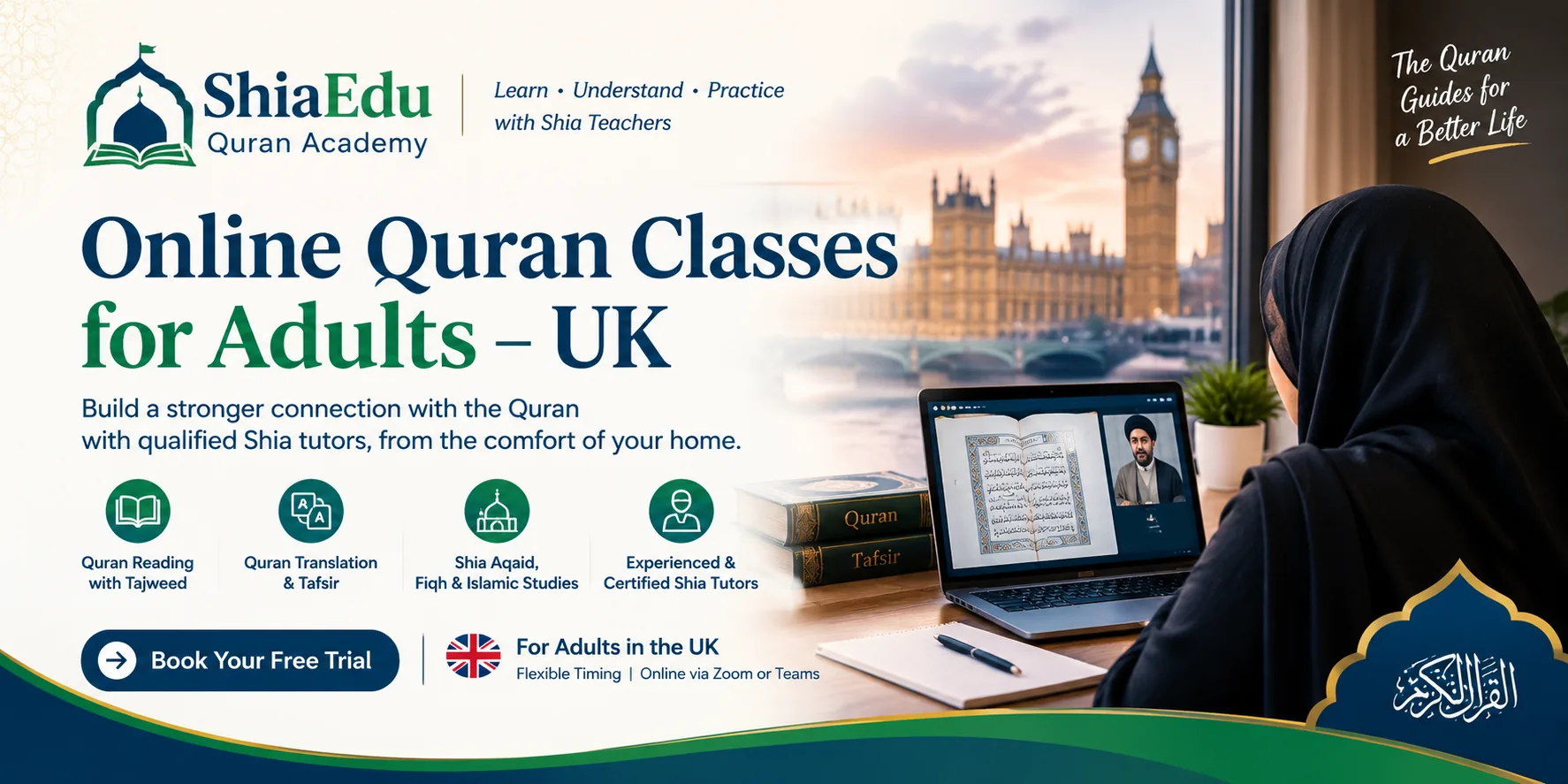
There's a quiet feeling many adult Muslims in the UK carry around without saying it out loud: the sense that they should know the Quran better than they do. Maybe recitation was never properly taught growing up. Maybe English became the dominant language at home and Arabic reading fell by the wayside. Maybe life simply got busy, and religious education stayed something meant for "someday." For a growing number of adults across London, Birmingham, Manchester, Bradford, and Leicester, that someday is finally arriving — and Quran classes for adults in the UK have made starting, or restarting, far more realistic than it used to be.
If you've been putting this off out of embarrassment, lack of time, or simply not knowing where to begin, this is worth reading properly.
- Why So Many UK Adults Never Learned Properly as Children
- Why Adults Often Progress Faster Than They Assume
- What Adult Quran Classes Actually Look Like
- Common Reasons Adults Give for Starting
- Addressing the Embarrassment Factor
- Making It Work Around a Busy UK Life
- Getting Started
- It's Genuinely Never Too Late
- Frequently Asked Questions
Why So Many UK Adults Never Learned Properly as Children
The UK's Muslim population is heavily concentrated in a handful of major cities — London, Birmingham, Manchester, Bradford, Leicester, Luton, and Blackburn among them — each with long-established communities going back generations. Yet even within these communities, plenty of adults grew up without consistent access to proper Quran education.
For some, it was immigrant parents working long hours with little time to arrange formal lessons. For others, it was growing up in a smaller town with no nearby mosque or madrassa at all. And for many British-born Muslims specifically, English simply became the more comfortable language early on, while Arabic reading and recitation quietly slipped to the background.
None of this is unusual, and it's certainly nothing to feel ashamed about. What matters is that the gap is entirely fixable — and often faster than people expect, a point we cover in more depth when comparing online vs local Quran classes in the UK.
Why Adults Often Progress Faster Than They Assume
There's a common misconception that children learn languages and recitation far more easily than adults, which leads many grown adults to assume they'll struggle more than they actually will. In reality, adults bring real advantages to Quran learning:
- Stronger general literacy and pattern recognition, which often speeds up learning Arabic letters and basic reading
- Genuine motivation and intention, since adults are choosing this for themselves rather than being sent by a parent
- Better focus and discipline during lessons, compared to managing a restless child
- Life experience that deepens understanding, especially once lessons move into meaning and tafsir rather than just recitation
Many adults who start Noorani Qaida from scratch are surprised at how quickly basic letter recognition comes together, often completing foundational reading faster than they expected.
What Adult Quran Classes Actually Look Like
Adult learners typically follow a similar overall path to children — starting with Noorani Qaida if needed, moving into tajweed, and eventually into translation and deeper study, covered step by step in our complete Tajweed guide — but the pacing, tone, and content are adjusted considerably.
A well-structured adult program usually includes:
- A judgment-free starting assessment, since many adults feel self-conscious about starting "from the beginning" at their age
- Flexible scheduling around work and family life, with early morning, evening, or weekend slots
- One-on-one sessions, which remove the discomfort some adults feel about reciting alongside strangers or much younger students
- A faster-paced curriculum where appropriate, recognizing that adult learners often move through foundational material more quickly than children
- Optional focus areas, such as tajweed refinement for someone who already reads but wants to recite more accurately, or deeper tafsir study for someone comfortable with recitation already, often alongside the Shia Aqaid course for a fuller grounding in belief
Common Reasons Adults Give for Starting
Talking to adults who've recently started or restarted Quran classes in the UK, a few reasons come up again and again: wanting to lead prayers correctly at home, feeling ready to understand the Quran's meaning rather than only its sound, wanting to set an example for their own children — the same motivation that leads many parents to ShiaEdu's Online Quran Academy for Kids in the first place — or simply reaching a point in life where it feels like unfinished business worth completing.
Whatever the reason, the starting point is almost always the same — a decision to stop waiting for the "right time," because for most adults, that time doesn't arrive on its own.
Addressing the Embarrassment Factor
This deserves to be said directly: it is genuinely common for adults to feel embarrassed about starting Quran lessons later in life, particularly if younger relatives already read fluently. Reputable teachers and academies are well aware of this and structure adult classes specifically to avoid the discomfort of reciting in front of others at an early stage. One-on-one online classes, in particular, remove this concern almost entirely, since there's no audience beyond the teacher — someone whose entire role is to help, not judge, much like the approach taken by Shia Quran teachers in London.
Making It Work Around a Busy UK Life
Between work, family responsibilities, and the general pace of life in cities like London or Manchester, carving out time for anything new can feel unrealistic. This is exactly why flexible, online Quran classes for adults in the UK have become so practical — lessons can happen early morning before work, during a lunch break, or in the evening after the kids are asleep, rather than requiring a fixed commute to a physical class at a set time, an approach shared across our Shia Quran Teachers UK wide.
Getting Started
For adults ready to begin, the process is usually simpler than expected: a short trial lesson to assess current level, followed by a realistic plan built around actual availability, not an idealized schedule. Whether the goal is basic recitation, proper tajweed, or a fuller understanding through translation and Shia studies, a good teacher will meet you exactly where you are rather than assuming a fixed starting point.
It's Genuinely Never Too Late
Across the UK's major Muslim communities — from East London to Birmingham's Alum Rock, from Manchester's Rusholme to Bradford and Leicester — adults are returning to Quran education in growing numbers, often decades after they assumed the opportunity had passed them by. It hasn't. With the right teacher, a judgment-free environment, and a schedule that actually fits real adult life, starting now is entirely realistic — and for most people who finally take that step, the only regret is not starting sooner.
Frequently Asked Questions
Is it too late to start learning Quran as an adult?
No — adults regularly learn Quran recitation and tajweed successfully, often progressing through foundational material faster than they expect due to stronger general literacy skills.
Will I have to recite in front of other students?
Not necessarily. Many adults choose one-on-one online classes specifically to avoid this, allowing them to learn privately with just a teacher present.
How long does it take an adult to learn to read the Quran properly?
This varies, but many adults complete foundational reading (Noorani Qaida) within a few months with consistent practice, followed by ongoing tajweed refinement.
Can online classes fit around a full-time work schedule?
Yes — most academies offering adult classes provide early morning, evening, and weekend slots specifically designed around typical UK working hours.
Do adult classes cover understanding the Quran's meaning, not just recitation?
Many programs include translation and basic tafsir once recitation is solid, allowing adult learners to move beyond sound into genuine understanding.