Whenever someone finds out I run an online Islamic academy, there's a question that comes up almost every single time, usually somewhere around the second or third message: "Is it true Islam is growing faster than every other religion?" I used to answer with a simple yes and move on. But over the past couple of years, as I've actually sat down with the Pew Research numbers instead of repeating what I'd heard secondhand, I realized the honest answer is more interesting than a one-word confirmation — and it says something specific about where the Muslim world, and the Shia community within it, is actually headed. Let's go through it properly.
So, Is It True?
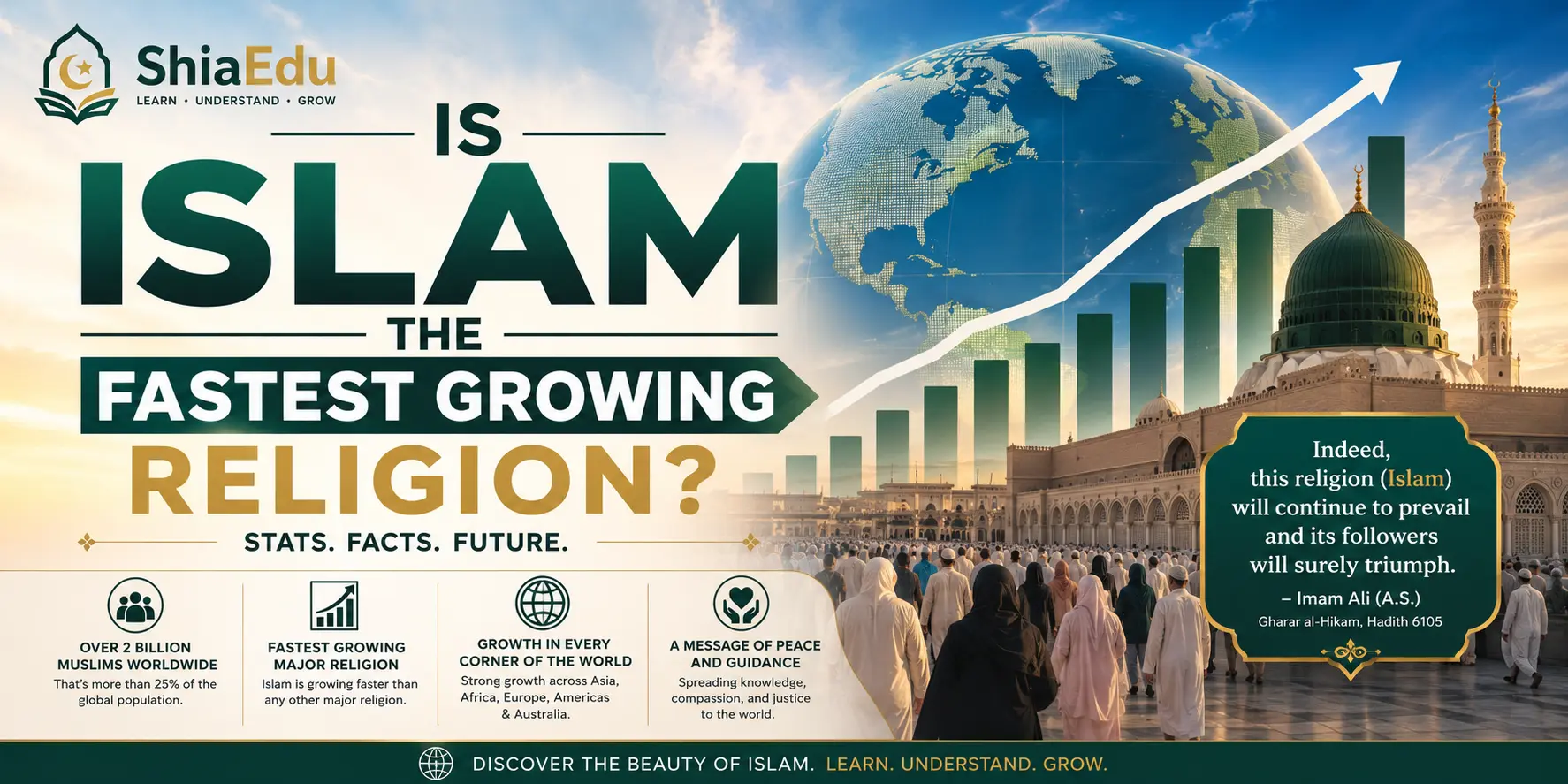
Yes — and this isn't a claim floating around social media without a source. It comes from the Pew Research Center, widely regarded as the most rigorous demographic research body tracking global religion, and their most recent comprehensive report confirms it directly. Between 2010 and 2020, the global Muslim population grew from roughly 1.6 billion to about 1.9–2 billion people — an increase of more than 350 million in a single decade. That's a 21% jump, compared to just 10% growth among everyone who isn't Muslim during the same period. No other major religious group grew anywhere near that fast.
To put that in perspective: Muslims now make up about 25.6% of everyone alive on Earth, up from 23.8% just ten years earlier. Christianity remains the largest religion by raw numbers, at around 28.8% of the world, but its share has actually been slipping, even as the total number of Christians keeps rising. Islam is the only major religion whose global share is climbing at real speed.
Why Is This Happening? The Actual Drivers
It would be easy to assume this growth comes mostly from people converting to Islam, but the data tells a more grounded story. The primary driver is demographics, not conversion.
The Three Real Drivers Behind the Numbers
- Higher birth rates. Muslim women have an average of 2.9 to 3.1 children, noticeably higher than the global non-Muslim average of around 2.2 to 2.3. That gap compounds significantly across a generation.
- A younger population. The median age among Muslims globally is around 24, compared to roughly 32 for non-Muslims. A younger population means more people are entering their childbearing years right now, which accelerates growth further over the coming decades.
- A modest but real conversion effect. Conversion isn't the main engine, but it isn't nothing either — particularly in North America and parts of Europe, where Pew data shows Islam gains more converts than it loses, with an estimated 23% of American Muslim adults being converts to the faith, most citing spiritual conviction, marriage, or a search for meaning as their reasons.
Pew's longer-range projections suggest this trajectory continues well past 2020. Earlier modeling had projected the global Muslim population reaching close to 3 billion by 2060, and multiple reports now suggest Islam could overtake Christianity as the world's largest religion sometime in the second half of this century — not because Christianity is vanishing, but because its growth simply can't keep pace with a demographically younger, faster-growing Muslim world.
Where This Growth Is Happening Fastest
Growth isn't evenly spread. Asia holds more than 60% of the world's Muslim population on its own, with Indonesia, Pakistan, India, and Bangladesh among the largest Muslim populations anywhere, regardless of the fact that three of those four are not Muslim-majority countries in the way people often assume. Sub-Saharan Africa is another major growth region, driven by the same combination of high birth rates and a young population. Meanwhile in Europe, Muslim population share is projected to keep climbing steadily in several countries over the coming years, driven by a mix of migration, birth rates, and — to a smaller but growing extent — conversion.
Shia Growth in the Middle East and South Asia
Now here's the part that doesn't get nearly enough attention in general coverage of this topic: within that larger Muslim growth story, the Shia community has its own distinct pattern worth understanding on its own terms.
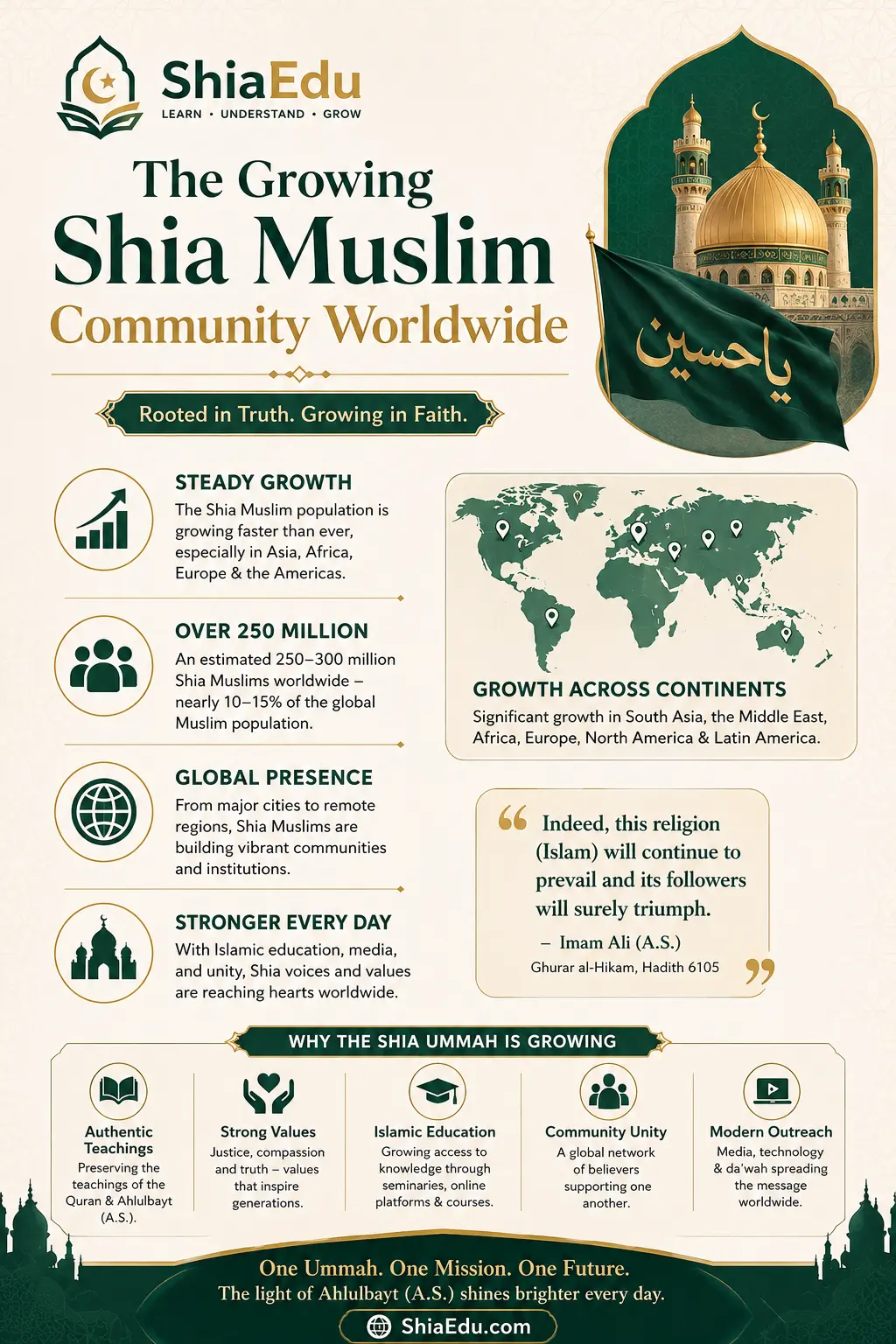
Shia Muslims make up an estimated 10–15% of the global Muslim population, translating to somewhere between 180 and 200 million people as of 2025. That might sound like a minority within a minority, but the concentration matters more than the percentage — roughly 68–80% of all Shia Muslims worldwide live in just four countries: Iran, Pakistan, India, and Iraq. Iran alone is home to the largest single Shia population on Earth, with Shia Muslims making up around 90% of its population, while Iraq's Shia majority has become an increasingly visible and organized religious and political force over the past two decades. Pakistan holds the second-largest Shia population by raw numbers globally, even though Shias remain a minority there (roughly 10–15% of Pakistan's overall Muslim population), and Shia communities across South Asia — including significant populations in India — continue to sustain some of the world's largest annual Muharram and Arbaeen gatherings, a visible marker of a community that is not shrinking into the background but actively organizing, educating, and expanding its religious institutions.
Shia Communities Growing in the West
The second region worth watching closely is the diaspora — Shia communities in Europe, North America, and Australia, which have grown substantially over the past three decades through migration, and increasingly now through the children and grandchildren of those original migrants building permanent religious infrastructure rather than temporary community spaces.
In North America, Shia population estimates have grown well beyond the roughly 300,000 figure Pew recorded back in 2009, with more recent community estimates in the range of several million once broader Shia-adjacent communities are included. Entire networks of Imambargahs, Shia seminaries, and now, notably, online Islamic education platforms have emerged specifically to serve this generation — children who are growing up fluent in English, French, or German first, and need their Quran, duas, and Islamic history taught in a way that actually meets them where they are.
Australia tells a similar story on a smaller scale: Shia migration there began in earnest in the 1970s, largely from Lebanon, and has since expanded through Pakistani, Iranian, Iraqi, and Afghan Hazara communities, with current estimates placing the Shia population at roughly 230,000 across at least 80 active Shia centers, mosques, and community organizations nationwide. That's a striking number of institutions for a relatively small population — a sign of a community investing heavily in its own religious continuity rather than assuming it will simply persist on its own.
What This Growth Actually Means for a Shia Family Today
Numbers on a page are one thing. What they mean for a parent trying to raise a grounded, knowledgeable Shia Muslim child in London, Toronto, Sydney, or anywhere outside a historically Shia-majority region is another thing entirely. A growing global Muslim population, and a Shia community expanding right alongside it, doesn't automatically mean the next generation absorbs correct Fiqh Ja'fari practice, accurate Ahlulbayt history, or proper Quranic tajweed or Quran translation simply by osmosis. If anything, growth without deliberate education tends to produce exactly the opposite — communities that are large in number but increasingly disconnected from the specifics of their own tradition.
This is precisely the gap ShiaEdu was built to close.
What ShiaEdu Was Built For
ShiaEdu – Shia Quran Learning Center Online exists because too many Shia families outside traditional strongholds like Iran, Iraq, or Lebanon found themselves with plenty of general "Islamic" content online, but very little that was actually built around authentic Twelver Shia teaching — correct Fiqh Ja'fari rulings, accurate Ahlulbayt history free of the distortions that show up in generic content, and Quran instruction that treats children as capable of real understanding rather than rote memorization alone.
How ShiaEdu actually teaches. Classes are conducted one-on-one, live, with instructors trained specifically in Shia jurisprudence, tajweed, and akhlaq, rather than repurposed general Islamic studies material. Lessons are built around a structured curriculum — Quran memorization and correct pronunciation, daily Namaz according to Fiqh Ja'fari, the history and character of the fourteen Masumeen, and the manners and etiquette the Ahlulbayt themselves emphasized — delivered at a pace suited to each child rather than a one-size-fits-all class.
Why this matters more as the community grows. As Shia populations expand across Western countries in particular, the risk isn't a lack of mosques or community centers — it's a generation growing up geographically far from Najaf, Qom, or Karbala, without consistent access to a teacher who can answer a child's question about Imam Hussain (a.s.) or the meaning of a specific dua with real depth. ShiaEdu closes that distance with a screen and a genuinely qualified teacher, wherever your family happens to live.
If you'd like your children to be part of this generation of growth in a way that's rooted rather than surface-level, our Quran and Tajweed course and Islamic history and akhlaq course were built exactly for this moment.
Frequently Asked Questions
Is Islam definitely going to become the world's largest religion?
Pew Research projections suggest Islam could surpass Christianity in total numbers sometime in the second half of the 21st century, though this depends on current birth rate and migration trends continuing roughly as they are — not a certainty, but a well-supported projection.
Is most of Islam's growth from people converting?
No — the primary drivers are higher birth rates and a younger population among Muslims globally. Conversion plays a real but secondary role, most visible in North America and parts of Europe.
What percentage of the world's Muslims are Shia?
Roughly 10–15%, translating to an estimated 180–200 million Shia Muslims worldwide as of 2025, concentrated heavily in Iran, Iraq, Pakistan, and India.
Is the Shia population growing faster or slower than the Sunni population?
Some demographic estimates suggest Shia growth rates have recently run slightly ahead of Sunni growth rates globally, though the data here is less comprehensive than Pew's broader Muslim population studies, so this should be read as an informed estimate rather than a settled figure.
Where is the fastest Shia community growth happening outside the Middle East?
North America, parts of Europe, and Australia have all seen substantial growth in Shia communities over the past three decades, driven primarily by migration and, increasingly, by second- and third-generation families establishing permanent institutions.