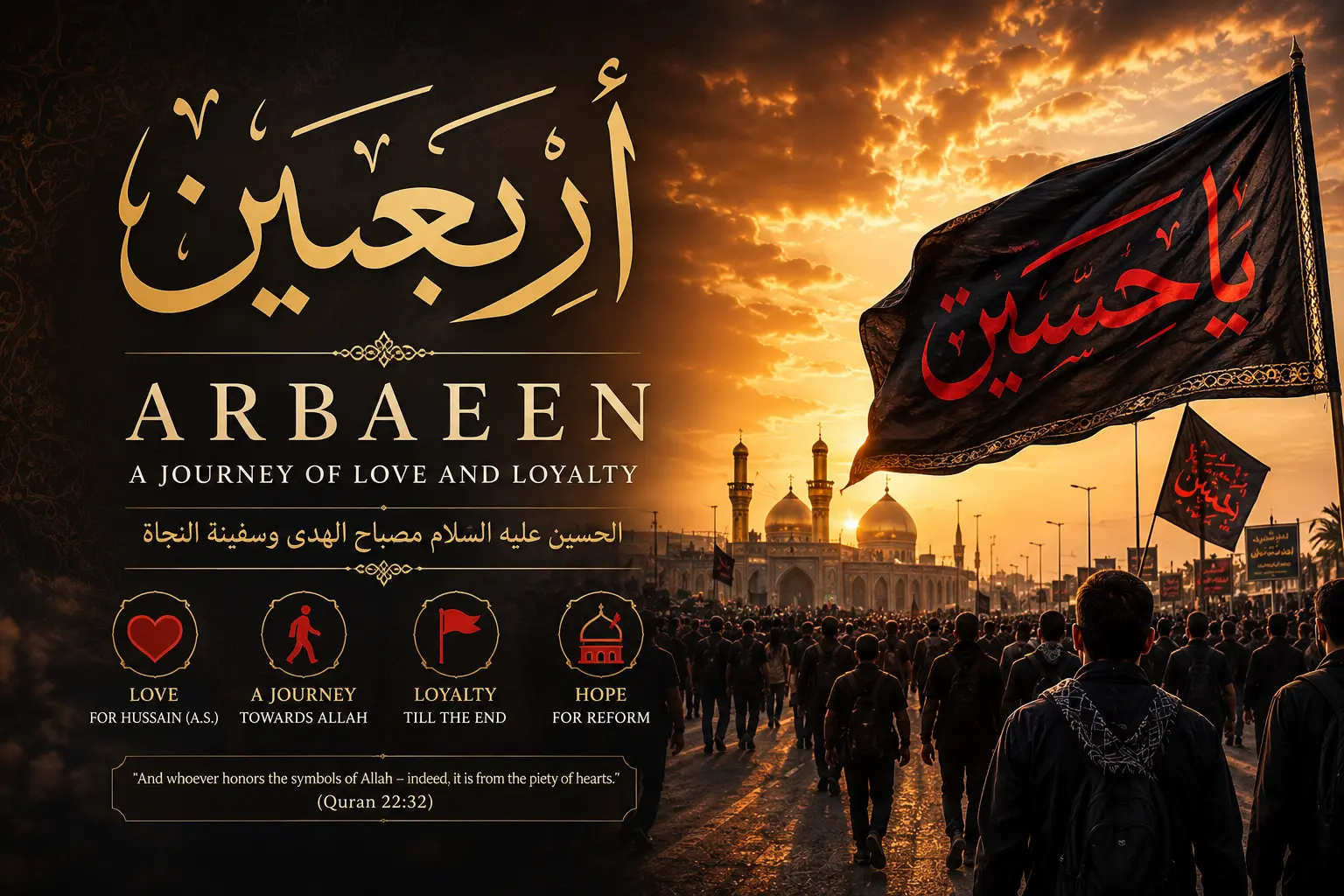
I still remember the first Arbaeen season I followed closely online — not from Karbala itself, but from a small living room, watching clips of an endless river of people walking under the sun, and someone's grandmother handing out dates to strangers on the roadside. Nobody had asked her to. She just stood there for hours, doing it because that's what you do during Arbaeen. That image has stayed with me longer than most things I've actually witnessed in person, and I think that's the real starting point for understanding this event — it isn't a date on a calendar so much as a promise that gets renewed every year.
If you're here because Arbaeen 2026 is approaching and you want the real picture — the date, the meaning, the Ziyarat, and what the walk actually involves — this guide covers all of it in one place, properly and without rushing past the parts that matter.
What Is Arbaeen, Exactly?
"Arbaeen" comes from the Arabic word for "forty." It marks the fortieth day after Ashura — the day Imam Hussain ibn Ali (A.S.), the grandson of the Prophet Muhammad (P.B.U.H.), was martyred at Karbala in 680 CE alongside his family and companions, refusing to pledge allegiance to a ruler whose conduct violated the principles of Islam — a refusal rooted in the same question of rightful succession explored in our piece on Eid al-Ghadir.
In South Asia, the same occasion is often called Chehlum, from the Persian/Urdu word for "fortieth." Same event, different regional name — if you've heard both terms used and wondered whether they're separate occasions, they're not. It's one commemoration.
Arbaeen isn't mourning for the sake of mourning. It's remembrance with a purpose: reaffirming a stand against injustice, renewing loyalty to the Ahlulbayt (A.S.) — including the 14 Masomeen whose example anchors Shia belief and practice — and reflecting on what Imam Hussain's sacrifice asks of every believer, not just historically, but right now, in whatever circumstances we're living in.
Arbaeen 2026 Date: When Does It Fall This Year?
Here's the honest answer, not a rounded-off one: Arbaeen 2026 is expected to fall on either Monday, 3 August, or Tuesday, 4 August 2026, corresponding to 20 Safar 1448 AH.
Why the one-day gap? Because Islamic months begin with the sighting of the new moon, and that sighting isn't identical everywhere. A country that sights the Safar moon a day earlier will observe Arbaeen a day earlier. This is completely normal and isn't a sign of disagreement about the occasion itself — it's simply how the lunar calendar works across different regions and the religious authorities each community follows.
A Few Practical Points Worth Remembering
- Islamic dates begin at sunset, not midnight. So if a community confirms Tuesday, 4 August as 20 Safar, religious programs may already be underway from the evening of Monday, 3 August.
- Communities in Pakistan, India, and much of South Asia are currently expecting Chehlum on 4 August 2026.
- Some international lunar calculations place 20 Safar on 3 August 2026.
- Treat both dates as expected, not confirmed, until your local moon-sighting committee or religious authority makes the final announcement closer to the date.
The Ziyarat of Arbaeen: Arabic Text, Transliteration & Meaning
Reciting Ziyarat Arbaeen on this day is one of the most emphasized practices associated with the occasion. According to a narration from Imam Hasan al-Askari (A.S.), reciting the Ziyarat of Arbaeen is counted among the signs of a true believer — alongside praying fifty-one units of prayer daily, a discipline explained step by step in our guide on how to perform Shia Namaz, and placing the forehead on the earth in prostration.
Here is a portion of the opening of the Ziyarat, presented with its Arabic text, transliteration, and meaning, so you can recite it correctly even if Arabic isn't your first language:
Opening of the Ziyarat:
السَّلامُ عَلَى الْحُسَيْنِ، وَعَلى عَلِيِّ بْنِ الْحُسَيْنِ، وَعَلى أَوْلادِ الْحُسَيْنِ، وَعَلى أَصْحابِ الْحُسَيْنِ
As-salāmu 'alal-Ḥusayn, wa 'alā 'Aliyyi-bnil-Ḥusayn, wa 'alā awlādil-Ḥusayn, wa 'alā aṣḥābil-Ḥusayn — "Peace be upon Hussain, and upon Ali the son of Hussain, and upon the children of Hussain, and upon the companions of Hussain."
A little further into the Ziyarat comes one of its most quoted passages — the testimony:
أَشْهَدُ أَنَّكَ أَقَمْتَ الصَّلاةَ، وَآتَيْتَ الزَّكاةَ، وَأَمَرْتَ بِالْمَعْرُوفِ، وَنَهَيْتَ عَنِ الْمُنْكَرِ
Ash-hadu annaka aqamtaṣ-ṣalāh, wa ātaytaz-zakāh, wa amarta bil-ma'rūf, wa nahayta 'anil-munkar — "I bear witness that you established prayer, gave charity, enjoined what is right, and forbade what is wrong."
Read slowly, that line is really a summary of an entire life — a person who prayed, gave, and stood for what was right even when it cost him everything. That's really what the whole Ziyarat is circling back to again and again: not just grief, but a description of the kind of life that grief is protecting the memory of.
If you can't travel to Karbala this year, this doesn't reduce the value of the Ziyarat. It can be recited at home, in an Imambargah, or at any local Islamic center. Physical presence in Karbala is meaningful, but sincere remembrance was never limited only to those who can make the journey.
The Najaf to Karbala Walk: What Actually Happens
This is the part that leaves most first-time observers speechless, including people who grew up hearing about Arbaeen their whole lives and still weren't prepared for the scale of it.
Every year, in the days leading up to 20 Safar, an estimated 20 million or more pilgrims — some estimates from recent years put the number well above that — walk the roughly 80-kilometer route from Najaf to Karbala in Iraq. Some walk from much farther: Basra, Baghdad, even from neighboring countries, turning the final approach into a route measured in hundreds of kilometers for some pilgrims. By sheer number of participants gathered in one place over a short window, it's frequently described as the largest peaceful annual gathering on Earth — larger, by attendance, than the Hajj.
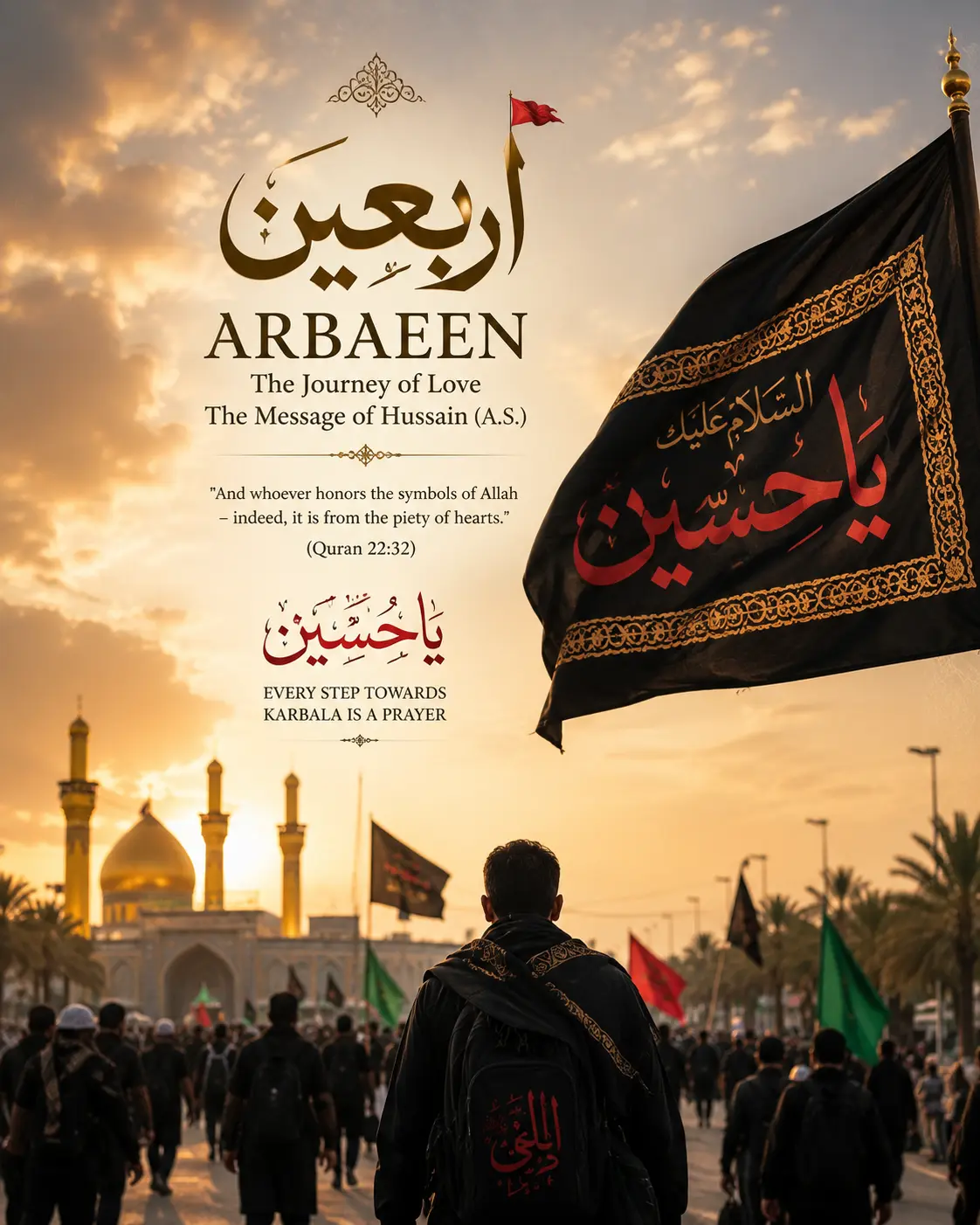
What makes the walk distinct isn't just the distance. It's the mawakib — service stations set up along the entire route by local families, businesses, and volunteers, completely free of charge. Along the road you'll find people offering:
- Food and water, sometimes cooked fresh around the clock
- A place to rest, sleep, or simply sit in the shade
- Free medical care and foot treatment for pilgrims struggling with blisters or heat exhaustion
- Simple acts of hospitality — tea, a fan, a kind word — with no expectation of anything back
This is the detail that tends to move people the most: nobody organizing a mawkib is doing it for recognition. It's an act of service tied directly to the values the walk itself commemorates — sacrifice, generosity, and standing beside people rather than above them.
Preparing for the Walk: What Pilgrims Should Actually Know
If you're planning to join the walk in person, a few realistic points of preparation matter more than most packing lists mention:
- The heat is serious. Early August in Iraq regularly exceeds 40°C (104°F). Hydration, breathable clothing, and pacing yourself matter more than speed.
- Footwear makes or breaks the experience. Broken-in, well-fitted shoes prevent the blisters that stop far more pilgrims than exhaustion does.
- Documentation and visa requirements can shift year to year. Check Iraq's current entry requirements well in advance rather than assuming last year's rules still apply.
- Security has improved significantly in recent years, with a heavy, visible presence of Iraqi authorities and volunteer coordination along the route — but it's still wise to check current travel advisories before finalizing plans.
- Women and children walking the route are generally well accommodated by the mawakib network, with separate rest areas commonly available, but joining as part of an organized group is strongly advisable for anyone walking for the first time.
- Communication can be unreliable in the most crowded stretches near Karbala itself. Agree on a family meeting point in advance in case phones lose signal.
If You Can't Walk to Karbala This Year
Not everyone can make the journey, and Arbaeen was never designed to exclude those who can't. If you're observing from home this year:
- Recite Ziyarat Arbaeen, ideally around midday, individually or with family
- Attend or organize a majlis reflecting on the events of Karbala and their lessons
- Give in charity, even modestly — sadaqah is a consistently emphasized practice tied to this period
- Use the day to teach children in the family about Imam Hussain's stand, in language appropriate to their age
Families across Canada and other diaspora communities often gather at their local Imambargah to recite the Ziyarat together — proof that distance from Karbala never really measures devotion.
The Real Message Behind Arbaeen
It's easy to reduce Arbaeen to a historical anniversary, but that misses what keeps millions of people walking every single year despite the heat, the distance, and the exhaustion. Arbaeen is really a yearly renewal of a single question: are we living in a way that reflects the values we say we admire in Imam Hussain? Justice over convenience. Loyalty over self-interest. Standing for what's right, even when the cost is high.
That's the thread connecting a grandmother handing out dates on a roadside in Iraq to a family reciting Ziyarat Arbaeen quietly at home on the other side of the world. Different distance from Karbala, same commitment.
Closing Thought
Want your children to grow up understanding the full depth of Karbala, Ziyarat, and the Ahlulbayt's teachings — not just the surface story? Learn more about who we are at ShiaEdu, or visit shiaedu.com to book a live one-on-one class built for Shia families, from Ziyarat & Duas through full Islamic History.
Frequently Asked Questions
When is Arbaeen 2026?
Arbaeen 2026 is expected on either 3 or 4 August 2026, corresponding to 20 Safar 1448 AH, pending final moon-sighting confirmation in your region.
Is Arbaeen the same as Chehlum?
Yes. Chehlum is the South Asian name for the same occasion — the fortieth-day commemoration of Imam Hussain's martyrdom.
Can I recite Ziyarat Arbaeen if I'm not in Karbala?
Yes. It can be recited at home, in an Imambargah, or at any Islamic center, individually or with others.
How far is the Najaf to Karbala walk?
Approximately 80 kilometers, though many pilgrims walk considerably farther depending on their starting point.
Is it safe to join the Arbaeen walk?
Security has improved substantially in recent years with strong Iraqi government and volunteer support, though checking current travel advisories before departure is always recommended.