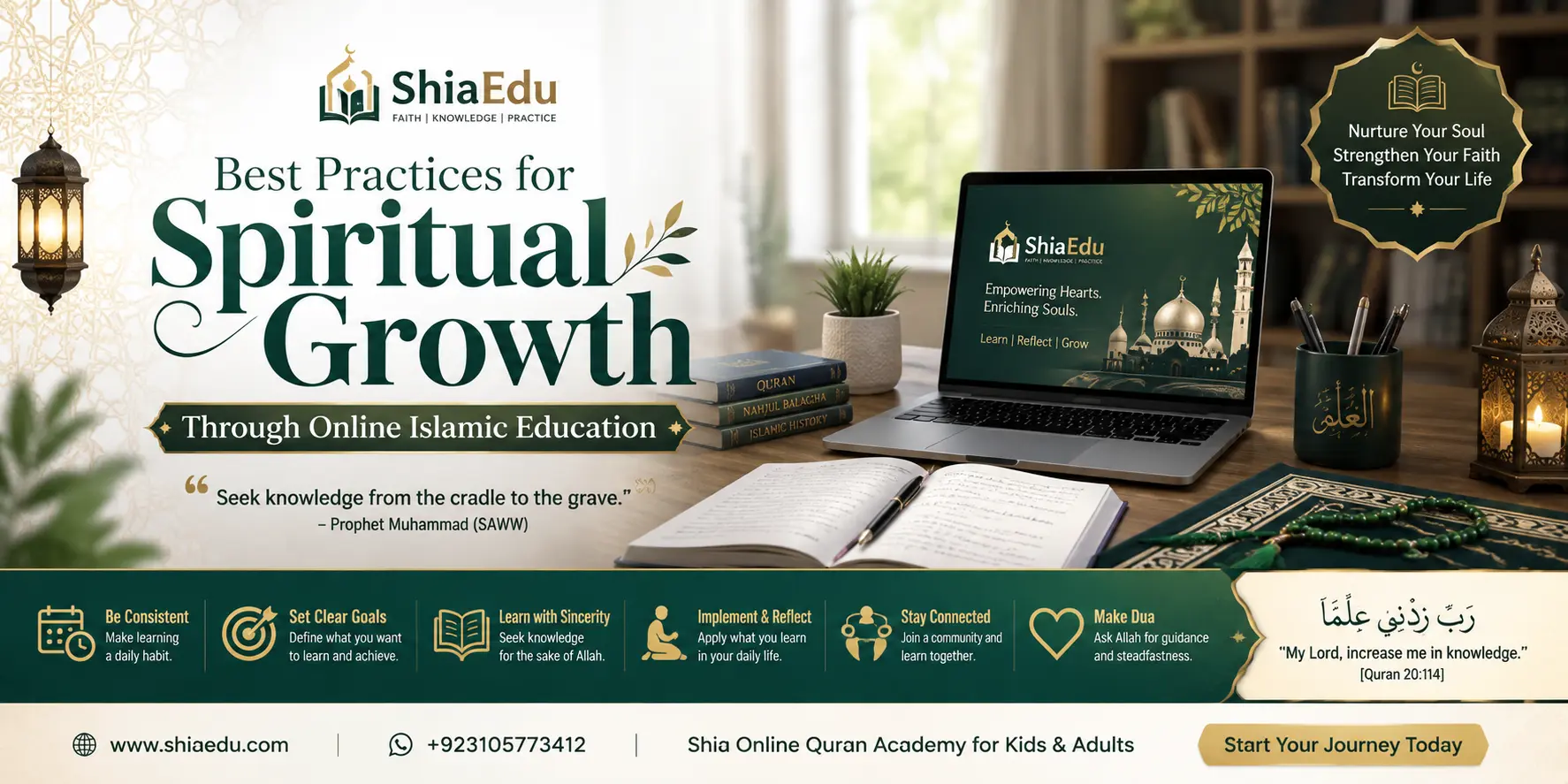
A few years ago, a mother from Toronto messaged me on WhatsApp at almost midnight her time. Her son had just turned seven, and she was worried. Not about his grades or his sports schedule — about something quieter. She wrote, "I don't want him to just memorize Quran. I want him to feel it." That message has stayed with me ever since I started ShiaEdu, our Shia Online Quran Academy, because it captures exactly what so many Shia families are searching for when they look for online Shia Quran classes: not a checkbox, but a real connection to Allah (SWT), to the Ahlul Bayt (AS), and to their own inner life.
Spiritual growth has never really needed a classroom with four walls. What it has always needed is sincerity, consistency, and the right guide. Today, that guide can be sitting in Karachi, Najaf, or Qom, teaching a child in London or a working parent in Sydney through a simple video call. That's the quiet revolution Shia Quran teachers online have brought to the way Islamic teachings are shared — and in this post, I want to walk you through the best practices that actually make that education transformative, not just informative.
Why Spiritual Growth Needs More Than Just Information
There's a difference between knowing about Islam and living it. A student can memorize the rules of Tajweed perfectly and still recite without any khushu (presence of heart). That's why the first best practice I always share with families is this: choose a program that treats the Quran as a relationship, not a subject.
Imam Ali (AS) is reported to have said that the Quran is "the never-ending miracle," a book that speaks differently to a person depending on the sincerity and presence they bring to it. A good Shia Quran institute understands this. It doesn't just drill vocabulary and rules — it teaches the "why" behind every ayah, connects verses to the lives of the Masumeen (AS), and gives students space to ask real questions.
Best Practice #1: Learn From Qualified, Practicing Shia Quran Teachers
This might be the single most important factor in whether online learning actually nurtures the soul. Shia Quran teachers aren't just people who can read Arabic fluently — the best ones combine several things at once, and it's exactly this combination that helps students improve their Quran recitation online:
- Ijazah or formal training in Tajweed and Tafseer from recognized Hawza or Quranic institutions
- A grounding in Shia Fiqh, so rulings and recitation are taught within the correct maktab
- Genuine warmth and patience, especially when teaching children or beginners
- Fluency in explaining Quranic concepts in the student's own language, not just Arabic
When a teacher has all of this, something shifts in the lesson. It stops being a recitation drill and becomes closer to what our scholars call tarbiyah — nurturing the whole person, not just correcting the makharij of letters. If you're evaluating any online Quran classes, ask directly about the teacher's ijazah chain and their approach to character-building alongside recitation.
Best Practice #2: Build Consistency Before You Chase Perfection
Many parents come to us wanting their child reciting flawlessly within weeks. I always gently push back on this. The Prophet Muhammad (PBUH) taught that the deeds most beloved to Allah are those done consistently, even if small. A ten-minute daily class with real presence of heart will do more for a child's spiritual growth than an hour-long weekend cram session done half-heartedly.
Look for a Shia Quran institute that structures its online Shia Quran classes around short, regular sessions rather than long, infrequent ones — the kind of steady, from-home rhythm families describe when they talk about how they learn with expert Shia Quran tutors from home. Spiritual habits, like physical ones, are built through repetition — not intensity.
Best Practice #3: Pair Quran Recitation With Understanding (Tafseer)
Reciting Surah Al-Fatiha correctly is a skill. Understanding that you are personally asking Allah, seven times a day, to guide you on the Sirat al-Mustaqeem — that's spiritual growth. This is why I always encourage families to choose programs that weave in basic Tafseer, even for younger students.
For example, when we teach Surah Ar-Rahman in our own classes, we don't stop at correct pronunciation. We pause on the refrain:
Surah Ar-Rahman, repeated refrain:
فَبِأَيِّ آلاءِ رَبِّكُمَا تُكَذِّبانِ
Fabi-ayyi ala-i Rabbikuma tukazziban — "So which of the favors of your Lord will you both deny?"
We ask students to name one blessing in their own life the ayah reminds them of. That single question turns a recitation exercise into a moment of gratitude — and that is where real spiritual growth quietly happens.
Best Practice #4: Anchor Learning in the Ahlul Bayt (AS)
For Shia families, spiritual education is incomplete without the light of the Ahlul Bayt (AS). A trustworthy Shia Quran institute will naturally connect Quranic lessons to the seerah of the Prophet (PBUH), Imam Ali (AS), Sayyida Fatima Zahra (SA), and the eleven Imams who followed — the same figures at the heart of our guide to the Twelve Imams and the Fourteen Masomeen (AS). When a child learns Surah Al-Kawthar, for instance, understanding its connection to Sayyida Fatima (SA) gives the verse a depth no translation alone can offer.
This is also where hadith becomes a teaching tool rather than a memorization task. Imam Jafar al-Sadiq (AS) is narrated to have encouraged believers to reflect on the Quran as one would reflect on a personal letter from Allah — reading it as though it was revealed specifically for them, today. Teaching children to read the Quran this way, rather than as an ancient text, is one of the deepest gifts an online class can offer.
Best Practice #5: Choose Flexibility Without Sacrificing Structure
One of the real strengths of online Quran classes is flexibility — a working parent in the UK, a student in Bahrain, or a family in Australia can all access the same qualified teacher without relocating or driving across town. This is also why so many American families are able to find qualified, trustworthy instructors online without ever leaving home. But flexibility should never mean a lack of structure.
What to Look for in a Shia Quran Institute
- A clear curriculum with defined milestones (Noorani Qaida, Tajweed rules, Hifz tracks, Tafseer, Islamic studies)
- Regular progress reports so parents can see real growth, not just attendance
- One-on-one or small group classes so every student gets individual correction
- A trial class before committing, so both the student and teacher can find the right fit
Best Practice #6: Make Dua and Reflection Part of Every Session
Spiritual growth isn't only about the Quran itself — it's about the habits that surround it. The best online Shia Quran classes open and close with short duas, encourage reflection questions after each lesson, and remind students of simple daily practices: reciting before sleep, sending salawat, or reflecting on one ayah during the day. These small rituals, repeated over months and years, are often what a student remembers long after they've forgotten the grammar rules.
Best Practice #7: Involve the Whole Family
Children absorb far more from what they see than what they're told. When parents sit nearby during an online class, ask their child what they learned afterward, or even join a parents' Tafseer circle offered by the same Shia Quran institute, the spiritual impact multiplies. Online learning removes the excuse of distance — now the whole family, across generations, can learn from the same qualified teachers together, wherever they call home. If daily prayer is part of that shared routine, our guide on how to perform Shia Namaz is a good place to start as a family.
Closing Thought
None of these seven practices are complicated on their own. What makes them powerful is doing them together, consistently, with a teacher who cares as much about a student's heart as their pronunciation. If you're looking for a place to begin — or to deepen what you've already started — our team at ShiaEdu would be glad to walk you through a free trial class with one of our qualified Shia Quran teachers.
Frequently Asked Questions
How do I know if online Shia Quran classes are authentic to Shia teachings?
Ask about the teacher's background and whether the curriculum follows Jafari Fiqh. A genuine Shia Quran institute will be transparent about its scholars' qualifications and happy to share sample lessons before you enroll.
Is one-on-one or group learning better for spiritual growth?
Both have value, but one-on-one classes generally allow Shia Quran teachers to give more personalized correction and spiritual guidance, which tends to accelerate both recitation accuracy and understanding.
How much daily time should a beginner commit to online Quran classes?
Fifteen to twenty minutes of focused, consistent practice is far more effective for spiritual growth than occasional long sessions. Consistency builds the habit; the habit builds the connection.
Can adults benefit from online Shia Quran classes, or is this mainly for children?
Adults benefit enormously, often more so, since they can engage with Tafseer and reflection on a deeper level. Many students are parents who started learning alongside their children.
What should I look for in a trial class with a Shia Quran teacher?
Notice how the teacher explains mistakes, whether they connect the lesson to meaning and not just pronunciation, and whether your child or you feel comfortable asking questions.